Color Streaks in Molded Plastic Parts: How to Adjust Back Pressure & Screw Speed? How to Measure Color to Know It's Optimized?
In the middle of a night shift, a batch of light-gray fan housings comes off the mold with faint color streaks running along the body. The machine operator takes a quick look and does what feels most natural: cranking up the screw speed and raising the back pressure so the masterbatch pellets thoroughly melt. By morning, the color indeed appears much more uniform. A few weeks later, the customer rejects the entire lot because the products are brittle—cracking easily upon minor impact—and the color of each shipment strays slightly from the master sample.
This scenario repeats itself across countless injection molding plants. Enhancing mixing isn't inherently wrong; the challenge lies in knowing where to stop, yet most facilities still rely on visual inspection. This article explores why plastic degrades when subjected to excessive shear forces, details how to set screw speed and back pressure based on technical metrics, and explains how to utilize colorimeters to ensure process parameters are precisely calibrated.
Why Do High Screw Speeds & Back Pressure Silently Degrade Plastic?
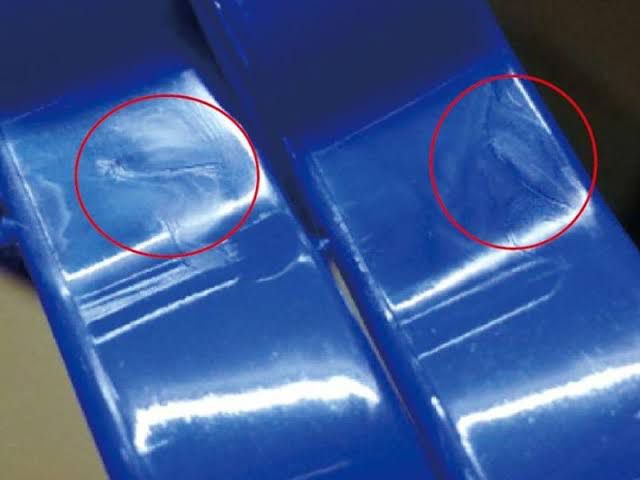
Color streaks and color mottling occur when masterbatch pellets fail to disperse uniformly into the base resin. Increasing shear force helps break down pigment agglomerates, immediately improving visual color uniformity, but this comes at a hidden structural cost. Excessive shear energy snaps polymer molecular chains, degrading the resin and reducing its toughness, making the final part brittle and prone to impact failure.

Shear friction also generates localized heat directly within the melt. Localized melt temperatures can far exceed the set barrel temperature zones, causing pigments or carrier resins to discolor. As a result, color drifts gradually across production batches and Delta E values rise without anyone realizing the machine parameters are to blame. Because parts look visually acceptable at the moment of adjustment, these defects often surface only after reaching the client.
How Do Screw Speed & Back Pressure Actually Affect Plastic Melts?
Rotational Screw Speed determines the shear velocity between the screw flights and the barrel wall. Excessively high RPM causes friction to spike and generates localized hotspots capable of burning pigments or thermally degrading the masterbatch carrier resin.
Back Pressure is the resistance the screw must overcome as it retracts during plasticization. Higher resistance forces resin to remain inside the barrel longer under tighter compaction, venting trapped air and granting pigments additional time to blend fully into the matrix. Because both parameters impart kinetic energy into the melt, adjusting one while ignoring the other can easily push the resin past its thermal shear limit. This limit is lowest in heat-sensitive resins like PVC, while engineering plastics like PC or PA66 also exhibit narrow processing windows.
What Metrics Should Guide Screw Speed Adjustments Instead of Intuition?
The critical metric to monitor is the screw peripheral surface speed (v = π × D × N / 60), where D represents the screw diameter (meters) and N denotes rotational speed (RPM).
For a 40 mm diameter screw rotating at 100 RPM, the resulting surface speed is approximately 0.21 m/s.
Heat-sensitive resins should be kept below 0.2 m/s, whereas commodity plastics like PP and PE can be operated at 0.3 to 0.4 m/s. At the same 100 RPM, a 40 mm screw runs PP comfortably but pushes the upper threshold for PVC. Larger screw diameters yield higher surface speeds at identical RPMs—explaining why copying RPM settings directly from one machine to another frequently causes production defects.
Where Should Back Pressure Start & Where Should It Stop?
Always start low, around 0.5 to 1.0 MPa (5 to 10 bar), and increment gradually by 0.2 MPa steps. Molding a few test samples at each step to inspect surface quality. Stop immediately at the first increment where color streaking disappears entirely; further increases subject the resin to unnecessary shear without providing additional quality gains.
The plasticization time should also be monitored carefully. It should remain within 80% or less of the total cooling time to prevent melt from lingering excessively in the heated barrel and suffering thermal degradation.
Authentic EMIN Colorimeter Solutions for Injection Molding
Compact handheld colorimeter ideal for press-side QA inspection. Rapidly measures Delta E (ΔE) on fresh molded parts using dual Φ8mm & Φ4mm apertures.
Spectrophotometer with D/8 optical geometry that eliminates surface gloss/texture effects. High repeatability (ΔE*ab ≤ 0.03) detects early thermal resin degradation.
Premium spectrophotometer for automotive parts and consumer electronics. Supports CIE ΔE*2000 formulas and digital CxF data profiles.
Related Article: Controlling Injection Molded Product Color via Colorimeters: Reading Delta E Correctly
What Should Machine Operators Audit Before Changing Process Parameters?
Increasing back pressure or screw RPM should be a last resort, after eliminating simpler potential root causes:
Verify Raw Material Moisture
Ensure resin granules and color masterbatch are dried at the correct temperature and duration before entering the hopper.
Assess Screw & Barrel Wear
A worn screw reduces mixing efficiency, which cannot be compensated for simply by raising back pressure.
Follow Proper Adjustment Sequence
Lower the screw RPM first, then gradually increase back pressure to melt masterbatch granules rather than over-speeding the screw.
Measure 5 Distinct Locations
Take color readings at 5 points (gate end, center, end-of-fill, and both sides) using a spectrophotometer to map color variations.
Log Standard Production Profiles
Document validated machine parameters alongside compliant Delta E readings to serve as standard SOPs for future shifts.