リアクターおよびリアクターアクセサリー
Controlled reaction work often depends on more than just heating a vessel. In laboratory synthesis, process development, and pilot-scale preparation, the reactor setup influences temperature stability, mixing efficiency, chemical compatibility, and how safely the experiment can be managed from start to finish. This is why choosing the right Reactor & Reactor Accessories matters for both routine workflows and more demanding research tasks.
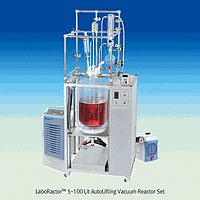
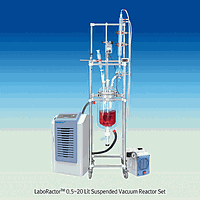
This category brings together reactor systems used for liquid-phase reactions, scale-up studies, formulation work, and general lab process applications. Whether the requirement is a compact bench reactor for small-batch development or a larger glass vessel configuration for higher working volumes, the focus is on practical selection: vessel size, lid material, heating capacity, and compatibility with the intended chemistry.

Where reactor systems fit in the laboratory workflow
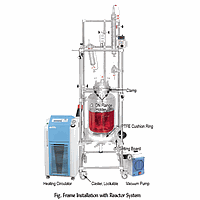
A reactor is typically selected when a process requires more control than a standard flask on a hotplate can provide. Common needs include consistent agitation, managed heating, better access through the lid for probes or additions, and a vessel design that supports repeatable reaction conditions. In research and industrial lab environments, this becomes important for synthesis, solvent handling, extraction-related steps, and reaction optimization.
Within a broader laboratory setup, reactor systems often work alongside supporting tools for material handling and safe operation. For example, moving larger vessels or heavy assemblies may be easier with suitable laboratory carts and trolleys, especially in shared lab spaces where equipment needs to be repositioned between benches or process areas.
Typical reactor configurations in this category
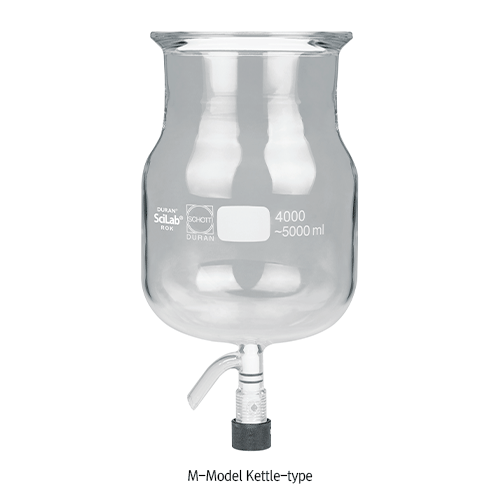
The available range in this category includes reactor sets built around round-bottom flask configurations with different working volumes and lid materials. The selection spans compact systems such as 2 L and 3 L units through mid-range 5 L, 10 L, and 20 L setups, up to larger 30 L and 50 L reactor formats. This helps laboratories choose equipment according to batch size, expected thermal load, and available installation space.
Examples from SciLab include the SL.Rea2573 REA-2MR 2Lit., SL.Rea2574 REA-3MR 3Lit., SL.Rea2575 REA-5MR 5Lit., SL.Rea2586 REA-10MR 10Lit., and SL.Rea2588 REA-50MR 50Lit. These models illustrate a progression in vessel capacity and heater power, which is useful when comparing systems for small-scale screening versus larger-volume reaction work.
Glass lids and PTFE lids: why the difference matters
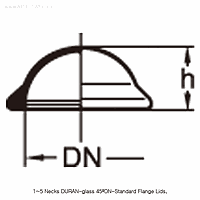
One of the practical selection points in this range is the lid material. Some reactor sets are supplied with glass lids, while others use PTFE lids. Both options support controlled reactor operation, but the most suitable choice depends on the process environment, the need for visibility, and the chemistry involved.
Glass lids are often preferred when visual monitoring is important and when users want a clear view of the vessel interior during reaction progress. PTFE lids may be considered when chemical resistance and sealing-related considerations are more prominent in the process. In this category, the distinction can be seen in models such as the SciLab SL.Rea2583 REA-2MR 2Lit. with PTFE lid and the SciLab SL.Rea2589 REA-30MR 30Lit. with PTFE lid, compared with multiple glass-lid variants across the 2 L to 50 L range.
How to choose the right reactor size and heating capacity
Reactor selection should begin with the intended working volume rather than the maximum vessel size alone. A smaller system may be more efficient for method development, frequent recipe changes, or low-volume synthesis. Larger reactors are more suitable when the process requires increased throughput, scale-up verification, or a wider operating window for thermal and mixing behavior.
Heating power is another key factor. In this category, heater ratings range from 450 W on smaller 2 L systems to 4000 W on larger 50 L units. That does not automatically make a higher-powered unit a better choice; it simply reflects the need to supply sufficient heat to larger reaction masses. Matching vessel volume and heating capacity to the process helps avoid underpowered setups on one side and unnecessary energy demand or oversized equipment on the other.
Representative products for different lab scenarios
For compact laboratory work, models such as the SciLab SL.Rea2573 and SL.Rea2583 in the 2 L class are suitable references when the priority is screening, formulation trials, or early-stage reaction development. The 3 L and 5 L options, including SL.Rea2574 and SL.Rea2575, offer a useful step up when the process needs a bit more batch volume without moving immediately to a large-footprint reactor.
For broader process evaluation, the 10 L and 20 L systems such as SL.Rea2576, SL.Rea2586, SL.Rea2577, and SL.Rea2587 sit in a practical middle range. Where higher-volume operation is needed, the 30 L SL.Rea2589 and the 50 L SL.Rea2578 or SL.Rea2588 provide larger-capacity reactor sets intended for more substantial batch work. These examples help buyers compare reactor families by scale rather than viewing each model as an isolated item.
Supporting equipment and broader lab considerations
Reactor performance is closely tied to the surrounding lab environment. Safe handling, heat management, operator access, and bench layout all influence daily usability. In some workflows, nearby equipment such as a burner or torch may still be part of the broader preparation process, although reactor-based heating is typically chosen when tighter control and more repeatable conditions are required.
Material compatibility should also be reviewed before purchase. Vessel construction, lid type, and overall configuration should align with the solvents, reagents, and process temperature range used in the lab. For teams building out or standardizing a laboratory platform, it can also be useful to review complementary brands in the same ecosystem, such as DaiHan or DURAN, depending on the wider equipment strategy already in place.
What to look for when comparing reactor sets online
When comparing products in this category, it helps to focus on a few core points: vessel volume, heater output, lid material, and the overall suitability of the reactor set for the intended workflow. Buyers should also consider whether the process is exploratory, routine, or scale-up oriented, since that changes how much flexibility and capacity are really needed.
Rather than selecting only by model name, evaluate how the system will be used day to day. A reactor that fits the batch size, chemistry, and operating style of the lab is usually the most practical choice. This category is designed to support that comparison process by presenting reactor systems across multiple capacities and configurations, making it easier to narrow down the right setup for controlled laboratory reaction work.
For laboratories that need dependable reaction control, the right reactor system is a balance of size, materials, and thermal capability. By comparing vessel scale, lid options, and application needs, buyers can identify a reactor set that supports safer handling, more consistent results, and a smoother path from trial batches to larger-volume work.
数量割引、まとめ買い価格の更新、新製品情報をメールでお届けします。
登録することで、当社の利用規約およびプライバシーポリシーに同意したものとみなされます。
認定専門家へ直接アクセス