実験器具洗浄機
Clean, repeatable washing is a basic requirement in many laboratories, especially where glassware and reusable vessels move through testing, preparation, and quality control workflows every day. Choosing the right Labware Washer category helps improve cleaning consistency, reduce manual handling, and support more controlled lab operations across research, industrial, and routine analytical environments.
On this page, you can explore laboratory washing equipment together with practical accessories and consumables that support day-to-day use. The range is particularly relevant for users who need structured cleaning processes for flasks, bottles, beakers, and other lab vessels while maintaining compatibility with baskets, racks, and cleaning agents used in dedicated washer systems.

Designed for laboratory cleaning workflows
A labware washer is typically used where manual washing is time-consuming, variable, or difficult to standardize. In laboratory settings, this type of equipment supports a more organized cleaning cycle for reusable items by combining mechanical washing action, controlled detergent use, and dedicated loading accessories.
Compared with general-purpose cleaning methods, a dedicated washer can help laboratories manage throughput more efficiently and reduce the risk of inconsistent cleaning from one batch to another. This is especially important in environments where vessel geometry, residue type, and handling frequency influence the overall washing process.
What is included in this category
This category is not limited to the washer unit alone. It also includes supporting items that play an important role in the full cleaning system, such as stainless steel baskets, wire racks, injection racks for various vessels, and liquid cleaning agents intended for washer-based processes.
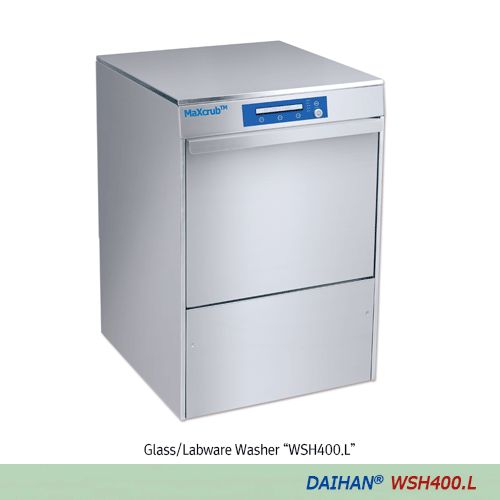
Examples from the current range include the DaiHan DH.WGW0401 Glassware Washer with STS Washing Basket, Wsh400.L, 120V, along with accessories such as the DaiHan DH.WGW01001 STS Wire Basket for Rail and the DaiHan DH.WGW01002 STS Injection Rack for Various Vessel. Consumables such as DaiHan DH.WGW02010 Potassium Hydroxide Liquid Cleaner and DH.WGW02011 Nonionic Surfactant Liquid Rinse help complete the wash and rinse sequence within a dedicated lab cleaning workflow.
Accessories matter as much as the washer itself
In practice, washing performance depends not only on the machine but also on how the load is arranged. Loading accessories such as wire baskets, wire racks, and injection racks help position glassware and vessels correctly so water and cleaning solution can reach the required surfaces more effectively.
For laboratories handling different container shapes, the right accessory configuration can make a meaningful difference in both cleaning coverage and workflow efficiency. A stainless steel rack or basket is often selected based on vessel size, quantity per cycle, and whether the cleaning process needs open support or more directed washing access for narrow-neck or specialized containers.
Where supporting mobility and workstation layout are important, related handling solutions such as lab carts and trolleys can also help move washed items, accessories, or supplies between preparation and cleaning areas.
Key points when selecting a labware washing solution
Selection usually starts with the type of labware being processed. Users should consider the dimensions and shape of the items, expected batch size, the kind of residue being removed, and whether accessories are needed to support injection-style or basket-style washing arrangements.
It is also important to think about the wider cleaning ecosystem, including detergent compatibility, rinse stages, and replacement parts that keep the washer operating as intended over time. For teams already using equipment from DaiHan, choosing matching washer accessories and consumables can simplify system compatibility and day-to-day maintenance.
Another practical factor is how the washer fits into laboratory workflow. Some users prioritize throughput and repeatability, while others focus on flexibility for mixed vessel types. In either case, looking beyond the main unit to include baskets, racks, and cleaning chemicals will usually lead to a more usable and sustainable setup.
Typical use cases in research and industrial labs
Laboratory glassware cleaning is relevant across academic labs, industrial QC laboratories, pharmaceutical support environments, food and beverage testing, and general research facilities. Any operation that repeatedly uses bottles, flasks, tubes, or other reusable vessels can benefit from a more defined washing process.
Dedicated washing systems are particularly useful where staff need to reduce manual scrubbing, improve process consistency, or prepare vessels for the next stage of testing and preparation. When residue type varies, users often rely on a combination of suitable washer loading accessories and purpose-matched liquid detergent or rinse solutions to support better cleaning results.
In broader laboratory workflows, these systems may sit alongside other preparation and handling tools. Depending on the application, users may also browse related laboratory categories such as burners and torches or laboratory blenders for adjacent sample preparation tasks.
Supported brands and product ecosystem
This category highlights products from established laboratory equipment manufacturers, including Burkle and DaiHan. Within the currently featured products, DaiHan is especially visible through washer units, baskets, racks, and washer-compatible liquid cleaning consumables.
That product mix is useful for buyers who are not only sourcing a washer, but also planning for regular operation, replacement accessories, and cleaning chemistry within the same laboratory equipment ecosystem. Instead of treating the washer as a standalone purchase, it is often more practical to evaluate the complete set of components needed for loading, washing, rinsing, and routine upkeep.
Choosing with long-term operation in mind
Routine usability often determines whether a labware washing setup performs well over time. A machine may fit the initial requirement, but everyday effectiveness depends on having the right baskets, racks, and consumables available when vessel types or cleaning loads change.
For this reason, many buyers review the category as a system rather than a single product page. Looking at the washer together with supporting accessories helps reduce compatibility uncertainty and makes it easier to build a practical workflow around the cleaning process.
If your laboratory needs more consistent handling of reusable glassware and vessels, this category provides a focused starting point for comparing washer units, wash accessories, and related consumables. A well-matched setup can support cleaner labware, smoother daily operation, and a more dependable laboratory cleaning routine.
数量割引、まとめ買い価格の更新、新製品情報をメールでお届けします。
登録することで、当社の利用規約およびプライバシーポリシーに同意したものとみなされます。
認定専門家へ直接アクセス