封止フィルム
Reliable sample handling often depends on small consumables that are easy to overlook. In routine laboratory work, a suitable sealing film helps reduce evaporation, limit contamination, and keep containers protected during short-term storage, transport, or day-to-day bench use.
This category brings together practical film options used across research, quality control, preparation, and general lab support workflows. Whether the need is basic disposable aluminum foil for covering vessels or a ceramic-coated foil for more demanding handling conditions, selecting the right format can improve convenience and consistency in the lab.

Where sealing film fits in lab workflows
Sealing film is commonly used as a protective covering for beakers, bowls, containers, and prepared samples when full closure systems are not required. In many laboratories, it serves as a fast and flexible way to cover openings during weighing, mixing, temporary holding, or transfer between workstations.
Compared with rigid caps or dedicated closures, film-based sealing materials are valued for their ease of use and adaptability to different vessel sizes. They are also useful when labs need a disposable option that supports clean handling and quick replacement between tasks.
Common product types in this category
The assortment here includes disposable aluminum foil formats in multiple widths, thicknesses, and roll lengths, as well as ceramic-coated foil for applications that may benefit from a different surface or handling characteristic. These products are not all intended for exactly the same task, so dimensions and construction matter when matching the film to the container and workflow.
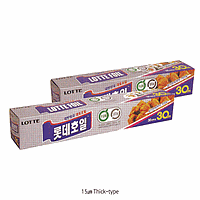
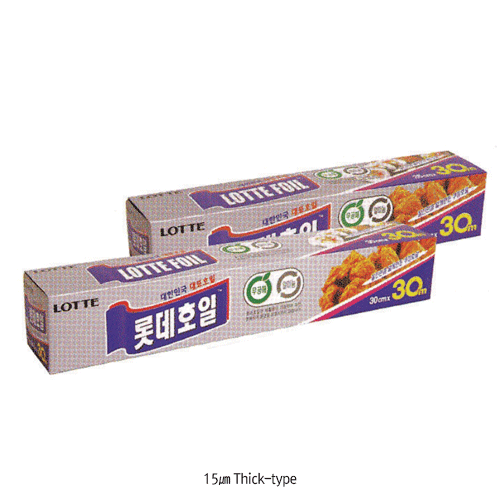
Examples from this category include LOTTE L5.470 for general disposable aluminum foil use, LOTTE SL2.Wra8007 in a longer 30 cm x 50 m roll format, and LOTTE L5.510 as a ceramic-coated foil option. For users comparing product families from the same supplier, the broader LOTTE range can provide additional context.
How to choose the right sealing film
The first step is to consider the container size and opening width. Roll width directly affects usability: narrower options such as 25 cm may be convenient for small vessels and bench tasks, while 30 cm or 33 cm formats can be more practical for wider containers or shared lab use.
Thickness is another useful selection point. Within this category, there are options such as 15 ㎛, 16 ㎛, and 18 ㎛ aluminum foil. In general terms, thickness can influence handling feel, tear resistance, and how the foil conforms during covering, while roll length affects replacement frequency and suitability for low- or high-consumption environments.
Users should also think about whether the application calls for simple temporary covering or a more specific film type. For example, a ceramic-coated foil such as LOTTE L5.510 may be considered when the workflow benefits from that construction, whereas standard disposable aluminum foil may be sufficient for routine covering and preparation tasks.
Representative options available
Several products in this category illustrate how sizing differences support different usage patterns. LOTTE SL2.Wra8001 and SL2.Wra8004 offer 25 cm width formats with different thicknesses, while SL2.Wra8002 and SL2.Wra8009 move to 30 cm width for broader coverage. SL2.Wra8010 provides a 33 cm width in a compact 30 m roll, which may be useful where wider coverage is needed without moving to a long industrial-style roll.
For higher consumption settings, products such as LOTTE L5.500 and SL2.Wra8011 offer 100 m roll lengths, reducing the need for frequent changes. These examples show why selection should not focus on product name alone; width, thickness, and roll length together determine how convenient the film will be in real lab use.
Related lab consumables and workflow context
Sealing film is often used alongside other everyday lab supplies rather than in isolation. In sample preparation or storage areas, teams may also work with lab bags for containment and organization, or with lab bowls where temporary covering is useful during weighing and mixing.
For certain preparation or packaging tasks, complementary materials such as adhesives may also be relevant depending on the process. The goal is not to replace dedicated closures in every situation, but to support flexible, efficient bench work with consumables that match the task.
Brand landscape in this category
LOTTE is a key manufacturer represented in the current product selection, particularly for disposable aluminum foil and ceramic-coated foil formats used in laboratory environments. The available range covers multiple widths and lengths, making it easier to align purchase decisions with consumption level and workspace needs.
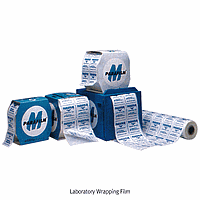
Depending on user preference and application style, buyers may also recognize names such as Parafilm M, Cleanwrap, and DaiHan in the broader sealing and laboratory consumables landscape. Even when comparing brands, the most practical buying criteria remain container compatibility, ease of handling, and whether the film is intended for routine disposable use or a more specialized requirement.
Practical purchasing considerations for B2B buyers
For procurement teams, consistency across departments is often as important as unit-level convenience. Standardizing on a few widths or roll lengths can simplify replenishment, reduce operator confusion, and support more predictable usage across laboratories, test rooms, or preparation areas.
It is also helpful to review how frequently the film is replaced and whether different benches need different formats. Smaller rolls can suit low-volume or space-constrained use, while longer rolls may be more efficient for central labs with steady throughput. A clear match between the product format and actual usage pattern usually leads to better day-to-day efficiency than choosing by price or size alone.
Finding a suitable sealing film for your lab
The right sealing film depends on how your team covers containers, how often the material is used, and what dimensions fit your routine work. For some laboratories, a standard disposable aluminum foil roll will handle everyday temporary covering effectively; for others, a different width, longer roll, or ceramic-coated type may be the better fit.
By comparing roll width, thickness, length, and material style within this category, buyers can narrow the selection to options that make sense for their workflow. A practical, well-matched sealing film helps support cleaner handling, smoother bench operations, and more consistent lab routines.
数量割引、まとめ買い価格の更新、新製品情報をメールでお届けします。
登録することで、当社の利用規約およびプライバシーポリシーに同意したものとみなされます。
認定専門家へ直接アクセス