Principle of coordination between pH - ORP variables and quantification in automatic system
In lines that require continuous chemical control such as water treatment, chlorine injection or acid neutralization, pH Sensors and ORP sensors and dosing pumps act as an automatic reflex system. The sensor acts as the eyes and ears, continuously recording changes in the solution, while the dosing pump is the adjusting arm, pumping chemicals according to the received signal. These two components are linked through the controller, forming a closed loop that helps the environment always maintain the desired balance.
Instead of relying on manual manipulation or intuitive estimation, this coordination mechanism allows reactions to occur immediately when concentrations change, limiting chemical waste and reducing processing errors. In fact, an industrial water treatment tank can be continuously adjusted hundreds of times a day without the need for technician intervention, simply by synchronizing the sensor signal with the pump pulse to add the solution.
The role of real-time feedback signals in neutralization process control
Real-time signals from sensors help the controller capture the smallest fluctuations and activate the metering pump in time. Therefore, the metering pump is operated according to real-time data, helping the amount of chemicals injected to always be correct with the solution status, avoiding errors due to manual intervention.
This feedback mechanism proves most valuable when the system has to deal with a constantly changing water source. Whenever the flow, temperature or composition of the water fluctuates, the sensor and pump work together to rebalance the pH without direct supervision. The data is displayed in real time on the control screen, making it easy for the technician to recognize abnormalities such as noise signals, clogged pumps or misaligned sensors. As a result, the entire process is kept stable and chemical consumption is significantly reduced.
Applications in industrial and laboratory water treatment systems
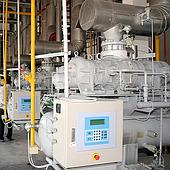
In water treatment plants, dosing pump systems combined with pH and ORP sensors are used to control the concentration of acid, alkali or chlorine during operation. The sensor records actual data from the water flow and sends it to the controller to calculate the amount of chemicals that need to be added. The dosing pump receives the command and adjusts immediately, helping the water always reach the desired pH level. This method helps the system operate stably, saves chemicals and does not depend on the operator's intuition.
On a smaller scale such as a laboratory, the operating principle remains the same but is finely tuned. Technicians can easily control the pump speed, the amount of solution and the injection time to simulate chemical or biological reactions accurately. Thanks to the ability to respond in real time, the system helps maintain a stable environment, avoiding errors during the testing process. Therefore, the sensor-integrated metering pump model is increasingly popular in both industrial production and research.
Some manufacturers such as Hanna Instruments have developed solutions that integrate sensors and pumps into one system, suitable for laboratory environments and small-scale applications. However, at the industrial level, pumps that can receive 4-20 mA or Modbus signals are needed for synchronization with PLCs and centralized monitoring.

Learn more about Hanna quantitative at: Learn about Hanna quantitative? Why are there so many users?