What Does a Cleanroom Differential Pressure Gauge Read, and Which Pa Range Passes Acceptance?
Decoding the standard differential pressure figures in EU GMP Annex 1 and ISO 14644, how to read HEPA/AHU filter clogging, and the error calculation for choosing the right measuring range for project handover.
1. A Differential Pressure Gauge Does Not Measure Dust, So Why Can It Still Control Dust in a Cleanroom?
A differential pressure gauge measures the pressure difference between 2 points, in Pascals (Pa). The particle counter is the instrument that measures dust. The two instruments answer two different questions: the particle counter tells you how many particles are in the room; the differential pressure gauge tells you whether the system is keeping dust out or letting it in, and whether the filter is still open or already clogged.
It works like a spirit level for the system: it does not measure the final result but the conditions that produce the result. A differential pressure gauge has 2 key duties:
Keeps cleanroom pressure higher than the neighboring less clean room so dust is pushed out instead of being drawn back into the room.
Continuously tracks the resistance of AHU, PAU and HEPA filters through the pressure difference before and after the filter media.
2. How Much Differential Pressure Between Rooms Is Enough, and What Happens When the Needle Drops?
The revised EU GMP Annex 1 guideline states that adjacent rooms of different cleanliness grades need a minimum pressure difference of 10 Pa (a guidance value). ISPE documents give a minimum of 10 to 15 Pa with the doors closed.
The room with the higher cleanliness grade always holds a more positive pressure than the room next to it. In airlocks between two grades, pressure sits at an intermediate level, forming a pressure cascade that directs air from the cleaner area toward the less clean area.
Risk when differential pressure drops to 0 or reverses: airflow runs backward, and dust and microorganisms from the corridor flood straight into the room. Industry documents classify a loss of differential pressure (even a momentary one) as a serious deviation that must be investigated, with its impact on the product batch assessed.
Note for electronics component cleanrooms: they usually follow the ISO 14644 standard together with the customer's own requirements, and the pressure difference applied follows the design documents exactly.
3. What Does Pressure Drop Across a Filter Tell You, and Why Not Replace Filters on a Schedule?
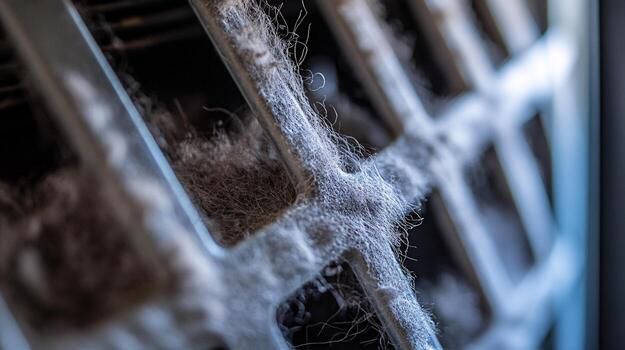
A new filter has low initial resistance. Dust builds up gradually, resistance rises, and the pressure difference across the filter rises with it. By reading the gauge, engineers know exactly whether the filter media has reached the time for replacement. Replacing filters on a fixed schedule easily falls into 2 bad cases:
- Replacing too early: wastes money on expensive HEPA filter media.
- Replacing too late: overloads the AHU fan, wastes electricity, and the reduced airflow makes the room stuffy and loses pressure.
Technical advice: record the differential pressure at the moment a new filter is installed (Initial Delta-P) as a baseline, monitor the trend periodically, and replace the filter when it reaches the final value (Final Delta-P) recommended by the manufacturer.
Reverse warning: a sudden abnormal drop in pressure across the filter is a sign of air bypass, a torn filter media or a leaking filter mounting frame. However, normal differential pressure does not prove the filter media is perfectly sealed; HEPA integrity still needs its own test (DOP/PAO test) in the acceptance procedure.
4. Which Pa Range to Choose, and Is ±2% Accuracy Enough for a Cleanroom?
The Dwyer Series 2000 (Magnehelic) mechanical differential pressure gauge indicates non-corrosive gas pressure, uses a frictionless magnetic-link movement, and has a published accuracy of ±2% of full scale (FS). The quick calculation below shows that choosing the right range decides the acceptance result:
Designed for measuring the pressure difference between cleanrooms and airlocks.
Measures the pressure difference across coarse filters (G4) and medium filters (F8).
Measures the pressure difference across high resistance HEPA/ULPA filter media.
Range selection analysis: the room pressure difference must be held at 10 to 15 Pa. With the 250 Pa range and an error of ±5 Pa, the reading cannot be trusted (the error equals half of the value to be measured). The 60 Pa range with an error of ±1.2 Pa fully meets the need. Conversely, the pressure drop across a filter is in the range of hundreds of Pa, so a 60 Pa range would be pegged off scale, and the 250 Pa or 500 Pa range must be used.
- Range: 0...60 Pa (room measurement)
- Accuracy: ±2% FS
- Frictionless Magnehelic movement
- No power needed, mounts on the room door face
- Range: 0...250 Pa (filter measurement)
- Accuracy: ±2% FS
- Maximum overpressure: 1.03 bar
- For HEPA boxes and AHUs
- Range: 0...500 Pa (high resistance filters)
- Accuracy: ±2% FS
- Operating temperature: -6.67 to 60°C
- Designed for industrial HVAC systems
5. Where to Install a Differential Pressure Gauge, and How to Connect the Tubing for a Correct Reading?
A differential pressure gauge has 2 ports: the High pressure port (H) and the Low pressure port (L), connected by silicone/PVC flexible tubing to the 2 points to be compared. The 4 critical installation rules are:
Place the tube end in a zone of stable air, away from supply air outlets, doors, and places where air blows directly into the tube end.
A needle-type gauge must be mounted in the specified orientation (vertical), and the Zero screw adjusted while both H/L ports are open freely to the air.
Keep the tubing short, not kinked, and leak-free. A single loose joint is enough to skew the reading by tens of Pascals.
Room pressure difference is read only with the door closed. Alarms on the BMS need a delay (15-30s) to avoid false alarms when the door is opened.
Related article: How Water Hammer Damages Pressure Gauges & How to Protect Measuring Points in Pipelines
6. Mechanical Gauge or Transmitter Sending Signals to the BMS, What Does GMP Require?
Mechanical gauges let staff read on the spot right at the room door, without depending on a power supply. High-grade cleanrooms (such as sterile pharmaceutical GMP Grade A/B) need continuous monitoring, alarming and data storage.
Annex 1 states clearly: the pressure difference between Grade B and adjacent areas must be monitored continuously; Grades C and D are monitored according to risk assessment. The most common solution today combines 2 layers:
- Layer 1 (On site): Dwyer Magnehelic mechanical gauge as a visual indicator for engineers to cross-check quickly.
- Layer 2 (Central): differential pressure transmitter with Analog output (4-20mA / 0-10V) or Modbus RTU sending signals to the BMS/SCADA system to store historical logs.
Every alarm from the BMS must have clear Upper/Lower limit thresholds set, together with a procedure for handling deviation records.
7. How Do Overpressure and Pressure Shock Damage Low-Range Differential Pressure Gauges?
A 60 Pa gauge is an extremely sensitive micro pressure instrument. Overpressure is the biggest destructive risk. A single compressed-air leak test of the ductwork, a sudden AHU fan start, or a slamming damper is enough to create a pressure pulse far beyond the 60 Pa range, bending the sealing diaphragm, shifting the zero, or completely destroying the internal mechanism.
8. What Do You Need to Prepare for the Acceptance and Calibration Records of Differential Pressure Instruments?
GMP and ISO inspection teams always ask for the legal documentation before looking at the actual readings. A standard acceptance file includes:
- List of differential pressure measuring points according to the pressure cascade matrix.
- Technical specifications of each instrument (Model, Pa range, published error).
- A valid Calibration Certificate from an ISO/IEC 17025 lab.
- Manual reading logs or data exported from the BMS.
- Report of the Pressure Recovery Test results after the door is opened.
9. Frequently Asked Questions (FAQ) About Cleanroom Differential Pressure Measurement
Micro differential pressure gauges are affected by the gravity acting on the internal mechanism. Mount the gauge in the fixed vertical orientation, then use a precision screwdriver to turn the Zero knob and bring the needle exactly to 0 before connecting the air tubing.
Not recommended. A 250 Pa gauge has an error of ±5 Pa (equal to ±2% FS). When measuring a 15 Pa level, the error already takes up 33% of the actual value, which is not reliable enough to pass GMP/ISO validation assessments.
Under pharmaceutical and electronics industry standards, the recommended calibration cycle is once every 12 months. For high-grade cleanrooms (Grade A/B), this cycle can be shortened to once every 6 months depending on the plant's internal SOP.
Are You Setting Up an HVAC System or Preparing for Cleanroom Acceptance?
Send your pressure cascade diagram and measuring point list to EMIN right away. EMIN's engineering team will advise on choosing the correct Pa range, support BMS connection and provide complete calibration and verification certificates for project handover!
Explore EMIN's Differential Pressure Gauge Catalog →