For full functionality of this site it is necessary to enable JavaScript.
EMIN.VN
0

What Is Amplification? How Does It Support Spectrum Analysis and Radio Frequency?

2025年11月25日 16時14分24秒

Have you ever wondered how tiny signals can be boosted to power a wide range of modern electronic devices? Power amplification helps you understand how signals are utilized in the fields of spectrum analysis and radio frequency (RF).


Amplification technique in signal processing

Amplification is the process of increasing the amplitude of an electronic signal without losing its fundamental properties. This allows the signal to retain its original content while having a larger amplitude, making it easier to process, transmit, or measure. The Power amplifier TekBox TBLNA-110M-50 enables weak signals to be amplified to levels more easily handled by spectrum analyzers or radio receivers.

A key aspect of amplification is balancing signal boost with limiting added noise. The DC-Coupled technology in the TekBox TBLNA-110M-50 reduces input noise, preserving the amplified signal's near-original state. This is crucial in spectrum analysis for accurately identifying frequency components in the signal. DC-coupled amplifiers inherently reduce low-frequency noise and offset, improving signal fidelity as compared to AC-coupled approaches, which can introduce capacitive coupling limitations or increased complexity.
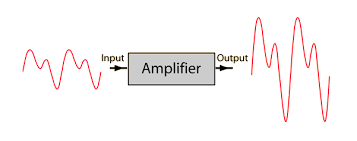
Amplification technique

How to support for amplification in spectrum analysis and radio frequency

In spectrum analysis systems or radio frequency measuring devices, amplification is not merely increasing signal amplitude but also helps measure and analyze very low-level signals. Amplifiers raise small signals to a level where measurement devices like spectrum analyzers can accurately read and analyze them. This is particularly useful for analyzing frequency components in radio waves, allowing detection of weak signals that are masked or unwanted frequency interferences.

Moreover, amplification in spectrum analysis circuits helps detect and measure harmonic distortion and intermodulation, thus improving the performance of radio systems and transmission.

Power amplifier TekBox TBLNA-110M-50

Conclusion

Amplification is the process of boosting signal amplitude to help weak signals become strong enough for accurate processing and analysis, especially important in spectrum analysis and radio frequency. This technique not only strengthens the signal but also preserves fidelity, enabling detection of weak signals and unwanted noise, thereby improving signal transmission quality and measurement reliability.

関連ニュース

Distinguishing Between DFT and WFT in Coating Thickness Measurement
2026年07月09日 14時40分30秒

Many projects encounter a situation where a freshly applied coating looks perfectly uniform and paint consumption matches the estimate, yet additional coating is required during inspection because the thickness is insufficient. This leads many to suspect measurement errors or equipment inaccuracy, whereas the actual cause is a confusion between WFT (Wet Film Thickness) and DFT (Dry Film Thickness)

Can a car paint thickness gauge detect if a vehicle has been in a collision?
2026年07月08日 16時56分01秒

Many used car buyers often spend a considerable amount of time examining the paintwork, the gaps between body panels, or the overall condition of the exterior. However, these signs can be skillfully masked following repairs; precise color matching and careful polishing can make the vehicle appear almost factory-original.

Is Ultrasonic Welding Waterproof? Find out with the experts!
2026年07月07日 10時35分50秒

Water resistance is a common requirement for a wide range of modern products, spanning industrial sensors, outdoor LED lights, medical devices, and water filter cartridges to electronic components and automotive parts. When exploring manufacturing technologies, many businesses often ask the same question: can ultrasonic welding truly create a watertight seal?

Why Is the Ultrasonic Weld Not Airtight? Causes and Solutions
2026年07月07日 09時47分07秒

A satisfactory ultrasonic weld must form a uniform bond across the entire contact surface. The presence of gaps, edge separation, or partial adhesion significantly compromises airtightness, watertightness, and mechanical strength. This is a common issue in the manufacturing of plastics, electronic components, packaging, and medical devices, particularly following a product changeover or an adjustment of welding parameters on the production line.

お得な情報を受け取る

数量割引、まとめ買い価格の更新、新製品情報をメールでお届けします。

登録することで、当社の利用規約およびプライバシーポリシーに同意したものとみなされます。

クイックサポート

認定専門家へ直接アクセス