Choosing the right square not only improves measurement accuracy but also helps optimize equipment investment and operating costs.
Steel Engineer's Squares – A Practical Choice for Manufacturing
Steel squares are manufactured from alloy steel or stainless steel, with precision-ground measuring surfaces that form an accurate 90-degree angle. They are widely used in machine shops due to their durability and versatility.
During machining and assembly operations, technicians commonly use steel squares to verify the perpendicularity of workpieces, fixtures, machine components, and assembled structures. Their greatest advantages are portability and resistance to impact. They can be easily moved between workstations without requiring special handling procedures.
However, steel is still affected by temperature variations. Over time, measuring edges may also wear if the tool is not properly maintained and periodically calibrated.
Granite Squares – A Solution for High-Precision Measurement
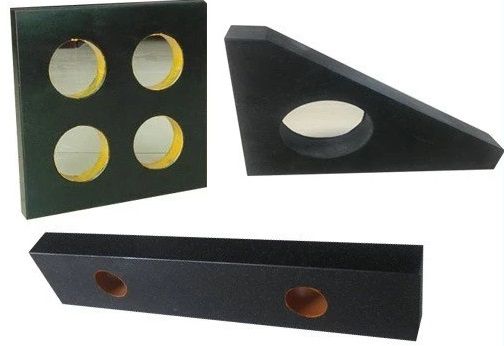
Granite squares are manufactured from natural granite, a material known for its excellent dimensional stability and tight tolerances. Granite is widely used in the production of surface plates, reference standards, molds, precision components, and calibration equipment. As a result, granite squares are commonly found in QC departments and calibration laboratories.
One of granite's key advantages is its low sensitivity to temperature changes. It is also resistant to corrosion and offers excellent vibration-damping properties. These characteristics help maintain measurement accuracy over extended periods.
The trade-off is a higher purchase cost and greater handling requirements. Although granite provides superior stability, it can chip or crack if subjected to strong impacts.
Which Type of Square Should You Choose?
If your primary task involves routine inspections on production lines, machine assembly, or maintenance work, a steel engineer's square is usually the more practical option. It is durable, easy to use, and sufficiently accurate for most day-to-day inspection requirements.
On the other hand, when high-precision angular verification is required, or when the tool is used as a reference standard in a metrology environment, a granite square provides greater measurement stability. For this reason, it is commonly used in QA departments, QC laboratories, and calibration facilities.
Many manufacturers use both types together. Steel squares are employed for daily production inspections, while granite squares are reserved for final verification and reference measurements.
When selecting a square, companies should consider tolerance requirements, working conditions, and the intended application. Investing in the right measuring tool from the outset helps improve measurement reliability and minimizes errors throughout machining and assembly processes.