Fresh lotus seed quality can vary substantially among varieties, and amylose content is one factor associated with product quality and taste. For processors, researchers, and food quality teams, measuring this variation can support more informed evaluation of fresh material before subsequent processing.
A study of fresh lotus seeds examined whether hyperspectral camera could be used to estimate amylose content rapidly and without destroying the samples. The work compared spectral pre-processing approaches and prediction models, providing a practical example of how spectral and image information may be used in food quality analysis.
Why Amylose Content Matters in Fresh Lotus Seeds
Lotus seed amylose content differs across varieties. In the study, samples included Xuanlian, Guangchanglian, Jianxuan 36, Mantianxing, Space lotus, and Xianglian, all collected in Fujian Province. This variation makes amylose evaluation relevant when comparing fresh lotus seed material for quality-related purposes.
Conventional amylose measurement methods mentioned in the study include iodine colorimetry and iodine affinity titration. These laboratory methods can require considerable time and labor and may be influenced by experimental conditions. A non-destructive approach has the potential to complement laboratory analysis where faster assessment is needed.
How Hyperspectral Imaging Was Applied
Hyperspectral imaging combines image data with spectral data. Rather than relying only on a standard visual image, it records information across a range of wavelengths. In this study, the imaging system FS-13 collected data from 400 nm to 1000 nm with a stated spectral resolution of 2.5 nm.
The system included a hyperspectral imager, light source, stage, black box, and data acquisition software. The reported setup used a platform speed of 3.5 mm/s, an exposure time of 30 ms, and a lens positioned 40 cm above the moving platform. Black and white correction was performed before spectral collection.
After harvest, fresh seeds were stored in liquid nitrogen for transportation and then refrigerated at 4 °C for 12 hours before testing. These handling steps form part of the reported experimental conditions and should be considered when interpreting the results.
Spectral Data Processing and Feature Selection
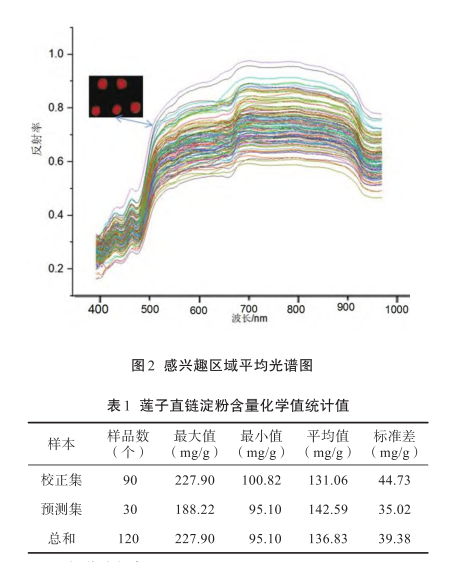
The analysis used the average spectrum from each sample region of interest. To reduce the effects of noise and external stray light, the study compared several spectral pre-processing methods: first derivative, second derivative, Savitzky-Golay smoothing, multiple scattering correction (MSC), and standard normal variable conversion.
The usable spectral range after removing end noise was reported as 400 nm to 971 nm. The spectra showed similar overall trends among samples, with an upward shift between 460 nm and 570 nm and notable absorption in the 500 nm to 920 nm range. The study discussed these patterns in relation to water bands and molecular groups associated with amylose.
The best modeling result in the evaluation was obtained after applying first derivative processing together with MSC. Successive projections algorithm (SPA) was then used to select nine feature bands for model development.
Reported Amylose Range and Model Results
The calibration set showed a broad amylose range in the fresh lotus seed samples. The reported maximum was 227.90 mg/g, the minimum was 100.82 mg/g, and the standard deviation was 44.73 mg/g. The prediction samples fell within the calibration-sample range, which the study considered a reasonable sample division.
For the partial least squares regression (PLSR) model using the selected feature bands, the calibration-set correlation coefficient was 0.835 and the prediction-set correlation coefficient was 0.856. The reported RMSEC was 1.802, RMSEP was 1.752, and RPD was 1.944. A separate PLSR model developed with the RC method reported an RMSEP of 1.897 and an RPD of 1.761.
Implications for Food Quality Analysis
This research demonstrates an approach for estimating fresh lotus seed amylose content through hyperspectral imaging and spectral modeling. Its findings point toward the potential development of online detection instruments for amylose analysis. The results are specific to the samples, conditions, data processing, and models evaluated in the study, so further validation would be needed for other materials or operating environments.
For food quality applications, the value of this approach lies in combining non-destructive sample handling with spectral information. It offers a framework for investigating faster amylose assessment while retaining laboratory reference methods as part of model development and verification.