Current Segmentation of the Budget Handheld Oscilloscope Market
The market for budget handheld oscilloscopes is divided into three main segments, suiting different budgets. Under 1 Million VND (or equivalent: approx. 40 USD): Devices like the FNIRSI DSO152 are only suitable for basic use by beginners. They feature a bandwidth of 10–50 MHz (often nominal), a small 2.8-inch screen, and convenient lithium battery use.
1–2 Million VND (approx. 40–80 USD): This segment is more popular, featuring budget handheld oscilloscopes like the HANMATEK HO11 or Zoyi ZT-702S. These models often add an integrated multimeter, measuring up to 1000V DC, but the sampling rate is only around 48 MSa/s. They are suitable for basic car repair or checking Arduino circuits.
2–4 Million VND (approx. 80–160 USD): This near-premium group, such as the Bside O2, is still referred to as a budget handheld oscilloscope compared to the general market. They offer improved accuracy but still lack advanced features. Choose your segment based on your needs, but don't rush to buy the cheapest.
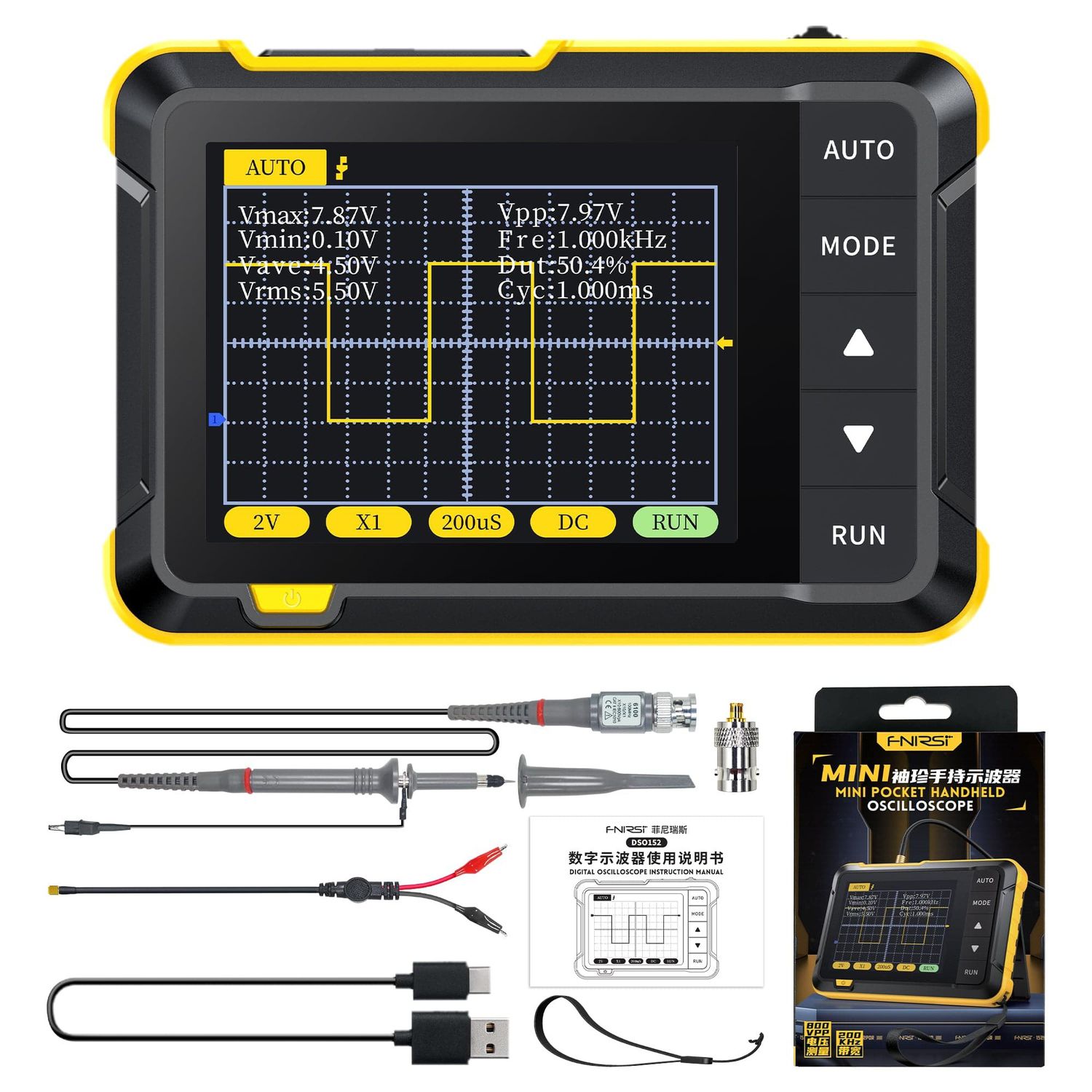
Why Are Some Handheld Oscilloscopes So Cheap?
The low price of a budget handheld oscilloscope is achieved by sacrificing basic features and prioritizing a compact size. They typically only have 1–2 channels, with a true bandwidth of 1–10 MHz, rather than the advertised 50 MHz. This results in significant deviation when measuring high-frequency signals, such as PWM waves in motors.
Furthermore, accuracy is poor due to inexpensive ADCs and shallow memory (8K–32K points). If you measure a 1 MHz sine wave, the amplitude might be off by 20–30%, making it unreliable for professional diagnostics. Reviews from Hackaday often point out poor probe compensation, leading to visible distortion of square waves.
The battery and display are also simplified. Budget handheld oscilloscopes use basic LCD screens, making them hard to read in sunlight, and the battery life is only 4–6 hours. They lack channel isolation, making them vulnerable to damage if high-voltage circuits are measured.
There is also a line of handheld oscilloscopes that, while smaller and more expensive, offer significantly superior performance, such as the Chauvin Arnoux CA 942
Additionally, the software lacks updates, and the Chinese interface can be difficult to use. Users often encounter unstable triggers and random waveform loss. That is why a budget handheld oscilloscope is only suitable for personal use, not professional work. In summary, the low price comes at the cost of low reliability, resulting in wasted money if long-term accuracy is required.Quality Assured Handheld Oscilloscopes
Fortunately, there are slightly upgraded handheld oscilloscopes that offer significantly better quality.
OWON HDS160 (around 3–4 million VND) is a top choice. It features a true 1 MHz bandwidth, a 60,000-count True RMS multimeter, measuring 1000V DC / 750V AC, and 10A DC/AC. It has a sharp 2.8-inch IPS screen, long-lasting lithium battery, and automatic measurement of , and frequency.Next, the OWON HDS2202S (200 MHz) combines a scope and a generator. It offers a high sampling rate and a friendly English interface, ideal for technicians.
Fluke 125B or Hantek DSO8072E are also worth considering. They boast high accuracy and powerful software, but the OWON HDS160 stands out for its versatility: smart probe auto-recognition, which helps prevent errors.
Practical example with OWON HDS160: When measuring an Arduino circuit, the 1 kHz square wave is sharp, and the multimeter confirms the voltage is exactly 5V. Used outdoors, the IPS screen remains clear, and the battery lasts 8 hours.
The Hantek 2C42 is a mid-range option. With 40–100 MHz bandwidth, it is reasonably priced and superior to typical budget handheld oscilloscopes.
Basic budget handheld oscilloscopes may suit novices but often lead to disappointment due to a lack of accuracy and functionality. Upgrade to mid-range models for real value, covering everything from repair to research.