Definition and Classification of Wrenches:
There are many types available on the market, each designed for a specific use.

Open-end wrenches are the most basic and commonly seen type. With two open ends, they are suitable for working in tight spaces. However, due to their loose fit, they are less effective for firm tightening compared to box-end wrenches.
Box-end wrenches have a closed-loop design that fully grips the nut, providing even force distribution and reducing slippage.
For those needing precise torque control, torque wrenches are a suitable option. Equipped with a gauge, they allow users to apply force according to technical requirements, especially useful in machinery and equipment assembly.
There are also specialized types like ratcheting or self-adjusting wrenches, ideal for specific applications.
Most wrenches are made from high-grade carbon steel, chrome vanadium steel, or stainless steel, ensuring durability, strength, and corrosion resistance. They are widely used in fields such as mechanics, automotive repair, construction, and electrical assembly.
What is an Adjustable Wrench? Structure, Advantages, and Disadvantages

An adjustable wrench, developed from traditional wrenches, features an adjustable jaw that fits nuts of various sizes. This flexibility allows it to replace multiple fixed-size wrenches.
It consists of a handle, adjustment gear, movable jaw, fixed jaw, and adjustment screw. These components work together for versatile use in different scenarios.
Its main advantage is flexibility, saving space and cost when multiple sizes are needed. It is easy to use and affordable for most users.
However, it has lower precision than fixed wrenches. Uneven tightening can scratch nuts and reduce efficiency. Clamping force is also less consistent.
Types of Adjustable Wrenches
- Straight-jaw adjustable wrench
Has two straight jaws and a simple design. Only fits fixed-size bolts and cannot adjust for different sizes.
- Angled-jaw adjustable wrench
Features an angled jaw for better access in tight spaces. More flexible but may have lower precision.
- Toothed adjustable wrench
Uses a toothed mechanism for fast tightening without frequent adjustments. Saves time but is less suitable for varied bolt sizes.
- Self-adjusting wrench
Automatically adjusts to bolt size. Convenient for different bolts, but more expensive and harder to maintain.
- Multi-function wrench
Combines multiple functions, usable as both a wrench and an adjustable wrench. Space-saving and cost-efficient but may lack the precision of specialized tools.
Differences Between Wrenches and Adjustable Wrenches
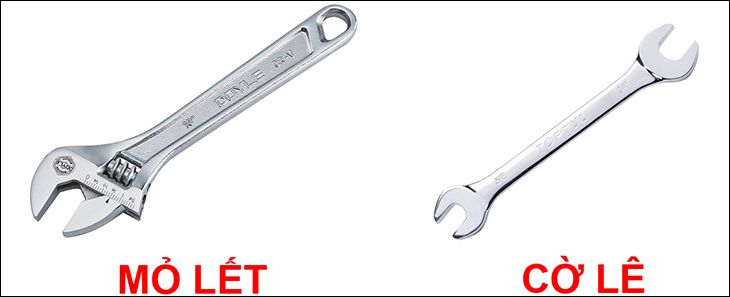
Both tools are commonly used in assembly and repair but have different designs and usage.
Wrenches are fixed-size tools, typically with open or box ends. Each fits a specific bolt size, offering firm grip and stable force, ideal for precision tasks.
Adjustable wrenches have movable jaws that fit multiple bolt sizes. Useful in fieldwork or when carrying many tools is impractical.
Important Usage Notes
With wrenches, always use the correct size. A poor fit can cause slippage and damage the bolt.
With adjustable wrenches, ensure the jaws tightly grip the nut before applying force. Loose grip increases the risk of slipping or deforming the bolt.
Avoid using excessive force. Both tools are not built for over-torque. Too much force may damage the tool or bolt.
Popular Brands at EMIN
Adjustable wrenches: SATA, PROSKIT, STANLEY
Wrenches: ASAKI, YATO, SATA
Conclusion
There are various types of wrenches and adjustable wrenches designed for different uses. For detailed advice, contact EMIN Vietnam for support.