Do air bubbles appear when stirring and affect the results?
Seeing a small layer of bubbles on the surface of a solution, most users usually continue their work without much concern. However, in many laboratory tests, the amount of gas entrained in the sample is a detail that can make a difference between two analytical results.
Some solutions are almost unaffected by the appearance of a small amount of bubbles during stirring. Conversely, there are applications where even a small amount of gas in the sample is enough to alter the measured value or affect the repeatability of the results.
Where do the bubbles come from?
Most air bubbles form when swirling currents on the surface of the solution draw air from the outside into the container. This often occurs when the stirring speed is set higher than necessary or the size of the stirring rod is not suitable for the sample volume.
Some solutions also tend to retain air longer than normal. Samples containing proteins, polymers, surfactants, or viscosity-enhancing additives are more prone to foaming than distilled water or simple solvents.
Temperature also contributes to this phenomenon. When the solution is heated during stirring, the physical properties of the sample change, and the likelihood of foam formation can increase significantly.
When do air bubbles start affecting the results?
If the purpose is simply to dissolve chemicals or prepare a standard solution, a small amount of foam appearing for a short time usually doesn't make a significant difference.
The story changes when the sample is moved to subsequent measurement or analysis steps. Air bubbles present in the solution can alter the actual volume of the sample, affecting homogeneity or creating errors in certain physical measurements.
Determining viscosity, density, electrical conductivity, or other parameters related to dissolved components is often more sensitive to this phenomenon. The more gas present in the sample, the greater the likelihood of discrepancies between tests.
Does more foam mean more effective stirring?
A cup of solution with strong swirling and a lot of foam often gives the impression that the stirring process is going very well. In reality, the amount of foam doesn't directly reflect the effectiveness of mixing.
The goal of stirring is to help distribute the components evenly throughout the solution. When the swirling is too strong, some of the system's energy is used to draw air from the outside into the sample.
As a result, the amount of foam increases, but the mixing efficiency may not improve accordingly. In many cases, reducing the stirring speed to a more appropriate level yields more stable results.
Why do bubbles still appear even after the speed has been reduced?
This phenomenon often leads many people to mistakenly believe that the stirrer is malfunctioning.
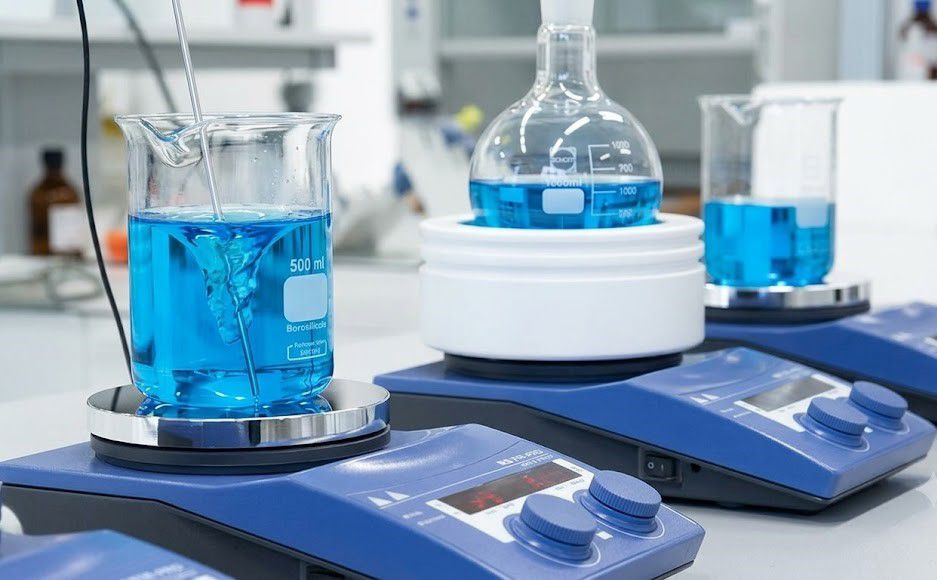
In reality, the properties of the solution are the determining factor in many cases. Some samples have the ability to retain air for a very long time, so even when the stirring speed is adjusted appropriately, foam will still remain on the surface or suspended in the solution.
The size of the stirring bar also significantly affects the flow formed inside the beaker. A stirring bar that is too small often creates a deeper vortex to maintain mixing, thereby increasing the likelihood of air being drawn from the surface.
In applications requiring precise stirring control, choosing equipment capable of maintaining a stable speed, such as the DLAB MS-H280-Pro, allows operators to control working conditions more easily, especially when handling samples sensitive to foaming.
Read more related articles: Magnetic stir bar loses magnetism, how to fix it quickly?
How can we reduce air bubbles?
The simplest solution is to reduce the stirring speed to a level sufficient to maintain uniform fluid movement.
If the phenomenon persists, check the size of the stirring rod, the sample volume, and the shape of the container. A suitable combination usually results in a more stable flow and limits the amount of air trapped below.
For tests requiring high accuracy, the sample is often left undisturbed after stirring to allow any remaining air to escape before measurement or analysis.
Air bubbles are sometimes just minor details that appear during sample preparation. However, in many laboratory applications, this small detail is the cause of discrepancies in test results that operators may not immediately notice.