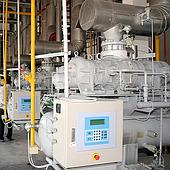
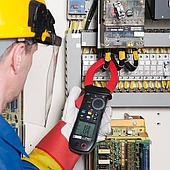
The performance meter is a digital device that allows you to select up to 11 different measurement units, suitable for each specific requirement such as H2O, psi, bar, mbar, kPa, inHg, mmHg, ozin2, ftH2O, kg/cm²...
The device is widely used in testing air pressure, pumps, filters, boilers, hydraulic systems, water and gas pipes. In addition, it is also used to control the gas ratio during fuel combustion and adjust the operation of automatic vehicles.
First, let's find out what water pressure is?
Water pressure is the force that water exerts on a surface or object through a pipe system, and directly affects the speed of flow in the pipe. On the ground, water pressure depends on the strength and height of the water level compared to the measuring point, thereby determining the water pressure at each specific location.

In fact, water pressure plays an essential role in the work of supplying domestic water and operating daily equipment. With sufficient capacity, water can be led from the tank to the upper floors of a house, apartment building, or provide equipment such as washing machines, faucets, showers and light drainage systems.
In addition to daily life, water pressure also plays an important role in the field of engineering. Measuring and controlling pressure helps determine the water flow in the supply system, affecting the performance of equipment such as pumps or control valves installed in the pipeline. When the pressure increases, the amount of water flowing through will be larger and the ability to carry water further is also significantly improved.
What is a pressure gauge?
What is pressure? Unit of pressure measurement
Pressure, usually denoted by p or P, is a physical quantity that represents the force acting on a unit area perpendicular to the surface of a given object.
In the SI system of units, the unit of pressure is the Newton per square meter, called the Pascal with the symbol Pa. Since one Pascal is a very small value, the unit of pressure is often converted at the rate of 1 kilopascal equal to 1000 Pascals.
Pressure is calculated by the formula:
P= F/S
Where P is pressure, F is the force acting on the surface, and S is the surface area bearing the force.
Pressure gauge structure
The pressure gauge is a modern device consisting of three main components: the main machine, the silicon tube and the pressure sensor probe.
The main machine is integrated with a data processor located inside. The outside is a shell with a display screen and control keys that allow users to set and switch between pressure measurement units.
The pressure sensor probe is the part that directly contacts the surface to be measured, acting as a pressure recording sensor.
The sealed silicone tube and vacuum environment help transmit the signal from the sensor head to the main machine for processing.
Working principle of pressure gauge
When the sensor probe is placed on the surface of the device to be measured, the sensor will operate based on the principle of surface tension. The pressure exerted will deform the membrane inside the probe and the processor will analyze that deformation to determine the pressure value.
The signal is output from the sensor probe in the range of four to twenty milliamps, transmitted to the main unit for processing and displaying the pressure result on the screen.
Pressure gauge application
Pressure gauges are widely used in many different fields, from industrial production, research, experimentation to education.
In industry, pressure gauges are indispensable equipment in processes such as food processing, oil refining, and petrochemicals. Thanks to the ability to accurately monitor pressure in tanks and filtration systems, the device helps businesses control the production process, ensure safety and maintain output quality.
Pressure gauges are also used to check the pressure of gas, water, oil, liquids and solvents in tanks or pipelines. Continuous pressure monitoring helps prevent problems arising from pressure exceeding the allowable threshold.
In research and laboratory environments, pressure gauges support the development of new products, ensuring that operating parameters are strictly controlled. In universities and educational institutions, this device is also an important tool for teaching and practice in the laboratory.
One of the popular pressure measuring devices today is the Testo 510 differential pressure measuring device. The device has a compact design, light weight, and is convenient to use in many different locations. In addition to measuring differential pressure, the device can also be combined with a pitot tube to measure air flow velocity, providing high accuracy with an error of only ±0.03 hPa in the range from 0 to 0.30 hPa and ±0.05 hPa from 0.31 to 1.00 hPa.

The Testo 510 pressure measuring device supports flexible conversion between measurement units such as hPa, mbar, Pa, mmH2O, mmHg, inH2O, inHg, psi, m/s and fpm, meeting the requirements of use in many different fields.
See more types of pressure gauges currently distributed at EMIN: Gas and liquid pressure measuring device