When looking up the melting point of iron, copper, or sulfur, you can easily find a specific figure. However, for polymers, the result is typically a fairly wide temperature range. For instance, polyethylene (PE) may melt between approximately 115°C and 135°C, whereas polypropylene (PP) falls within the 130–171°C range.
This is not due to errors in the literature, nor does it stem from different manufacturers using different standards. The inherent nature of polymers makes it difficult to assign them a single, precise melting point in the way one does for small-molecule compounds.
Is the melting point of a polymer similar to that of a metal or a pure compound?
Polymers are formed from numerous repeating units linked together into long chains. Even within the same material, molecular chain lengths vary, meaning the internal structure is not perfectly uniform.
As the temperature rises, different regions of the material soften at varying rates. Some areas begin to transition into a viscous flow state, while others retain their original structure. This process continues until the entire material has transitioned into a molten state.
Consequently, polymers are typically characterized by a melting range rather than a single, specific value.
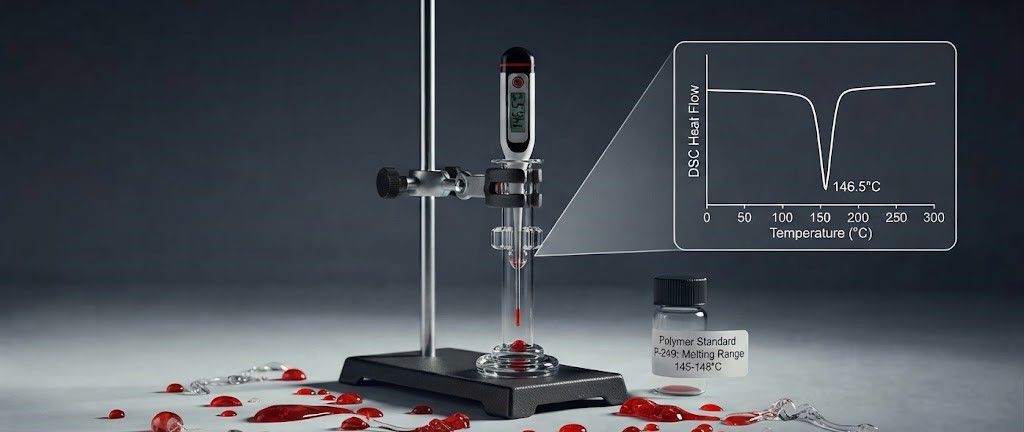
Melting points of common polymers
Each type of polymer has a unique molecular structure, resulting in a distinct melting temperature range.
+ PE (Polyethylene): approximately 115–135°C
+ PP (Polypropylene): approximately 130–171°C
+ PVC (Polyvinyl Chloride): approximately 100–260°C, depending on additives and the specific PVC grade
+ PA6, PA66 (Nylon): approximately 215–265°C
+ PC (Polycarbonate): approximately 220–230°C
The values above are for reference only. Polymers used in manufacturing often contain stabilizers, plasticizers, glass fibers, or other additives; therefore, actual temperatures may vary significantly between manufacturers.
How do thermoplastic polymers and thermosetting polymers differ when heated?
Not all polymers can melt.
Thermoplastics soften as the temperature rises, eventually transitioning into a viscous, fluid state that allows them to be reshaped repeatedly. They are widely used in processes such as injection molding, extrusion, and 3D printing.
In contrast, thermosetting polymers (thermosets) form a highly stable, cross-linked network upon curing. When subjected to further heating, the material does not liquefy; instead, it begins to decompose, discolor, burn, or lose its structural integrity.
Therefore, if a polymer does not melt but simply burns or decomposes when heated, it is likely a thermoset.
Related news: Why Does a Sample Have a Wide Melting Range? 5 Common Causes and How to Fix Them
Why do melting temperatures differ for the same type of polymer?
Even when comparing samples of the same material such as PE or PP measurement results can still differ.
This is typically due to a combination of factors:
- Differences in polymer molecular weight.
- Variations in the degree of crystallinity.
- Differences in additive composition between material grades.
- The impact of prior processing conditions on internal structure.
- Inconsistent sample purity.
For this reason, technical specifications are always presented as temperature ranges rather than absolute values.
What should be considered when measuring the melting point of a polymer?
Since polymers soften gradually over a temperature range, measurements must be performed consistently to accurately determine the onset and completion of the melting process.
Key considerations include:
+ Preparing samples of uniform size.
+ Removing any dust or impurities from the surface.
+ Increasing the temperature at an appropriate rate; avoid heating too rapidly, as this can cause a significant discrepancy between the displayed temperature and the actual sample temperature.
+ Observing the entire phase transition process rather than simply noting when the material begins to soften.
In materials research laboratories or plastic raw material quality control settings, automatic melting point apparatuses allow for more consistent monitoring of this entire process compared to manual observation methods.
What is the significance of a polymer's melting point in manufacturing?
This parameter directly affects the processing process and the quality of the final product.
If the molding temperature is too low, the polymer does not fully transition to a viscous melt state; consequently, the material struggles to fill the mold, making defects likely. Conversely, excessive heating over a prolonged period can degrade the polymer's mechanical properties or trigger decomposition.
Additionally, the melting point is a crucial parameter for:
+ Selecting conditions for injection molding, extrusion, or film blowing.
+ Comparing quality across different batches of raw material.
+ Assessing the impact of additives on thermal properties.
+ Supporting the research and development of new polymer materials.
For materials exhibiting unusual melting ranges or significant deviations from published specifications, measurement results can also indicate changes in the composition or quality of the input material.