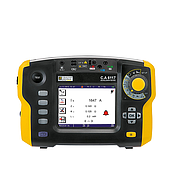
Paint coating thickness gauge separates the paint layer and zinc layer on galvanized steel. The PosiTector 6000 FNDS is designed to display these individual layer thicknesses from a single non-destructive reading.
This approach addresses a key limitation of methods that calculate one layer by subtracting readings: zinc thickness can vary across a galvanized part or structure.

What is a duplex coating system?
A duplex coating system typically combines paint or powder coating over galvanized steel. It brings together zinc-based cathodic protection and a barrier coating intended to limit electrolyte contact with the steel.
Steel corrosion occurs when an electrolyte connects anodes and cathodes on the steel surface, forming a corrosion cell that produces rust. Zinc acts as a sacrificial anode, while paint or another protective coating provides a barrier.
- Galvanizing may be hot-dip, electro, or zinc spray metallizing.
- The outer paint or powder layer can provide color coding and an aesthetic finish.
- The combined system can extend the life of the coating system and underlying substrate, while delaying maintenance and touch-up needs.
Why must paint and zinc thickness be measured separately?
Separate paint and zinc measurements help evaluate the individual layers in a duplex system rather than only the total coating build. This is important because galvanized zinc thickness is not necessarily uniform over an entire component or structure.
The thickness, roughness, chemistry, and design of the steel being galvanized can affect the resulting zinc coating thickness. A calculation based on an assumed constant zinc layer may therefore not represent conditions at every measurement location.

How do conventional duplex thickness methods work?
Conventional methods commonly use two measurements and a subtraction calculation. One approach uses a magnetic coating thickness gage, such as PosiTector 6000 F1 or PosiTest DFTF, to measure zinc thickness and then the total paint-plus-zinc thickness; the difference is treated as paint thickness.
Another approach uses a combination magnetic and eddy-current probe such as PosiTector 6000 FN3. An eddy-current reading is used for paint thickness, a magnetic reading provides total system thickness, and the difference is treated as zinc thickness.
Both approaches depend on an assumption that the zinc thickness does not vary across the structure. They also require two readings and a calculation for each measurement point.
How does PosiTector 6000 FNDS1 measure duplex coating thickness?
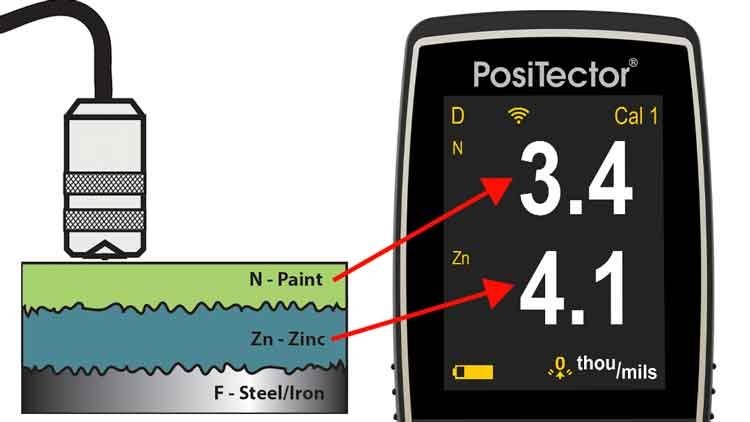
In Duplex mode, PosiTector 6000 FNDS1 uses magnetic and eddy-current principles simultaneously to calculate and display the individual paint and zinc layer thicknesses. The measurement is non-destructive and obtained in one reading.
The magnetic principle measures the combined paint-and-zinc thickness over a ferrous substrate. The eddy-current principle measures paint thickness over the non-ferrous zinc coating, then the instrument calculates zinc thickness by subtracting paint thickness from the combined measurement.
When can PosiTector 6000 FNDS1 be used outside Duplex mode?
Outside Duplex mode, PosiTector 6000 FNDS1 operates as a conventional combination ferrous/non-ferrous instrument, similar to a PosiTector 6000 FNS probe. It is intended for measuring non-magnetic coatings over steel and non-conductive coatings over non-ferrous metal substrates.
The appropriate mode depends on the coating stack being inspected. Duplex mode applies where paint is present over zinc on a ferrous steel substrate; conventional combination operation applies to the stated ferrous and non-ferrous substrate applications.
What should be considered when selecting a duplex thickness measurement method?
Select a method based on whether individual paint and zinc values are needed at each location and whether variation in zinc thickness must be considered. A one-reading duplex measurement avoids relying on a fixed zinc-thickness assumption in the subtraction methods described above.
For inspection work, the measurement method should also match the substrate and coating arrangement. Distinguishing ferrous steel, non-ferrous zinc, and the outer coating layer is central to the measurement principles used by PosiTector 6000 FNDS1.