Initially, most people assume the problem stems from inaccurate measuring equipment or inexperienced operation. However, upon closer inspection, the cause is often the least noticed: vibrations from the platform transmitted to the surveying platform.
This is why surveying platforms used for precise measurements often feature not only a granite surface but also a separate anti-vibration system.
Errors are sometimes not due to the equipment you are using to measure
In a real-world production environment, the floor is rarely completely "quiet." CNC machines run continuously, forklifts move, air compressors are switched on and off, and even a few people walking near the measurement area can create very small vibrations transmitted through the concrete floor.
Normally, almost no one can feel these vibrations. But when using a dial gauge or measuring parts with small tolerances, things start to change.
Many technicians encounter situations like this:
+ The first measurement is correct.
+ The second measurement is off by a few microns.
+ Changing the position of the part causes a slight change in the reading.
It's frustrating because the error isn't large enough to be immediately noticeable, but it's enough to make the inspection results inconsistent. This is especially common in precision machining workshops or when inspecting jigs, molds, and CNC parts.
A good granite countertop isn't necessarily enough
Many people, when choosing a surveying table, focus almost entirely on the stone surface. Flatness, imported or domestic stone, black granite or gray granite…
These factors are indeed important. Natural granite has excellent stability, minimal deformation, high load-bearing capacity, and is almost the standard material for precision surveying tables.
However, if the base is not stable enough, even the best stone surface will struggle to perform its function effectively.
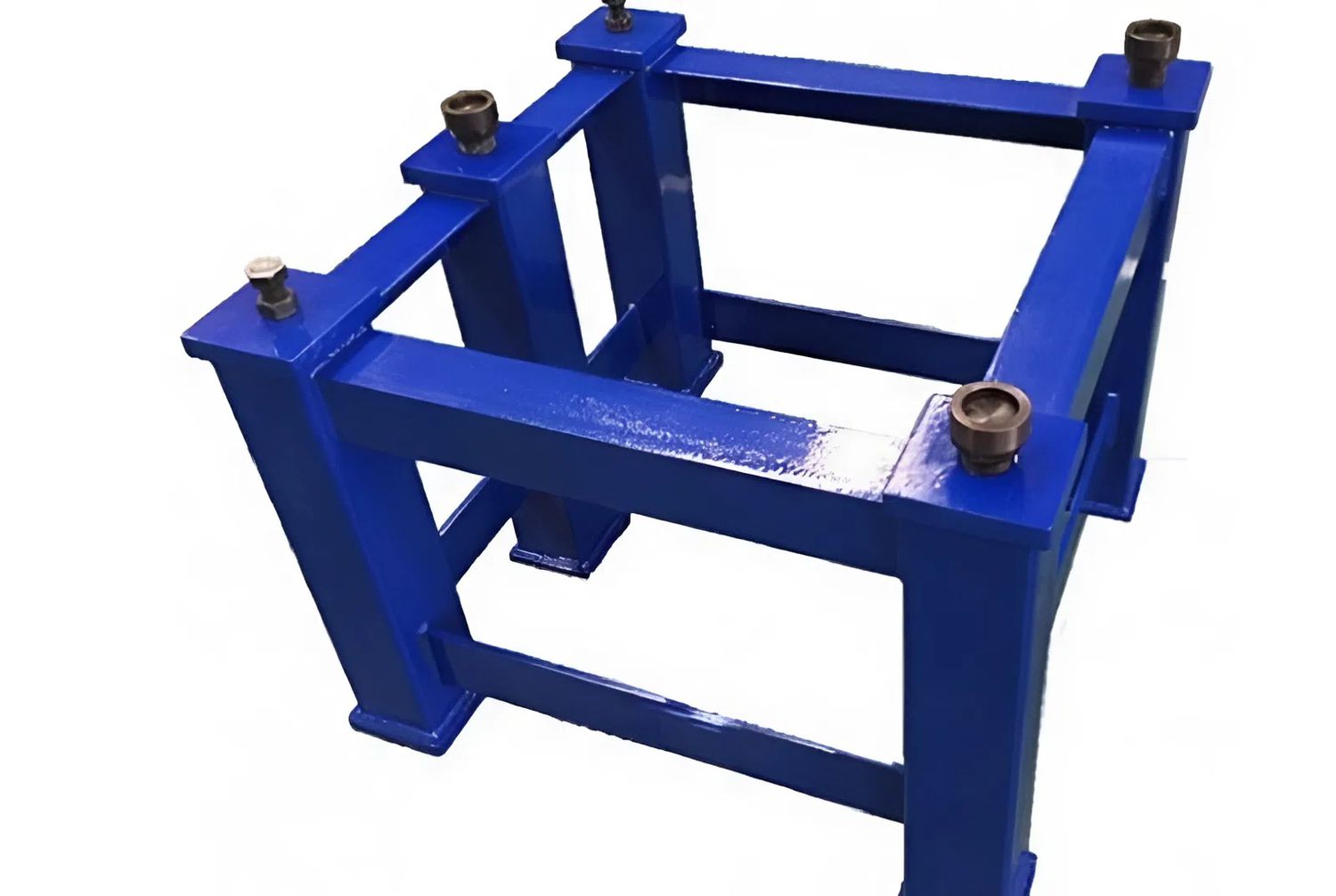
To put it simply, a perfectly aligned tabletop placed on a vibrating surface is like placing a measuring tape on a surface that constantly oscillates slightly.
That's why in professional QC rooms, anti-vibration feet are usually included as standard equipment from the start instead of being purchased separately.
Why is vibration damping so important?
The difficulty with vibration lies in the fact that it doesn't appear as a "vibrating, noticeable" vibration. Most vibrations are small but continuous oscillations.
It is these small oscillations that easily cause measurement results to drift slightly over time.
When the anti-vibration feet are in operation, the vibrations from the floor are absorbed before being transmitted to the workpiece. This makes the granite surface more stable when placing workpieces or performing measurements.
The most noticeable differences are often seen when using:
+ Dial gauges
+ Height gauges
+ Runout testers
+ Flatness testers
+ Measuring machines for small tolerance mechanical parts
Many technicians, after switching to a workpiece with anti-vibration feet, often notice that the measuring needle is much more stable, and the feeling of placing workpieces is much more secure.
Some workshops only realize the problem after increasing machining accuracy
Interestingly, many workshops that previously used conventional surface tables were fine. However, problems only arose when they started receiving orders requiring higher tolerances.
At this point, errors of a few microns began to directly affect product quality.
Things previously considered insignificant, such as ground vibration, frame stiffness, or table leveling, now significantly impact inspection results.
This is also why many businesses, when upgrading CNC machines or investing in new measurement equipment, often upgrade their surface tables as well.
Because if the measurement surface is not stable, even the best equipment will struggle to produce consistent results.
Choose the right anti-vibration feet
Many people think vibration damping is simply adding rubber pads under the table legs, but in reality, each environment requires a different approach.
Some places only need basic vibration damping to reduce minor oscillations. Other places, located near large processing machines, require heavy-duty legs and much better vibration damping.
The size of the workpiece also has a significant impact. A small granite workpiece used for basic inspection will be completely different from a large workpiece used for mold measurement or inspecting long details.
In addition to vibration reduction, the frame must also bear the load evenly to prevent the workpiece from becoming misaligned after prolonged use. That's why specialized workpieces often look simple, but their underlying structure is very carefully constructed.
Previously, the workbench was often considered an accessory for placing measuring equipment. But in today's precision machining workshops, it has become almost an integral part of the quality control system.
A good granite surface provides a standard measuring platform. But to maintain that stability in a real-world production environment, the anti-vibration feet have become an almost inseparable component.