Concept of earth resistance
Earth resistance is basically the resistance of a cube-shaped block of earth with dimensions of 1m³, through which current flows from one side to the opposite side. Measuring ground resistance is very important during construction, ensuring the safety of lightning protection devices. After measuring the ground resistance value, the technician will proceed to connect the lightning protection system for household appliances, electric poles, and buildings to ensure safety.
Concept of earth resistance
Earth resistance is basically the resistance of a cube-shaped block of earth with dimensions of 1m³, through which current flows from one side to the opposite side. Measuring ground resistance is very important during construction, ensuring the safety of lightning protection devices. After measuring the ground resistance value, the technician will proceed to connect the lightning protection system for household appliances, electric poles, and buildings to ensure safety.
Why is it necessary to measure ground resistance?
In essence, measuring ground resistance for lightning protection systems is to evaluate the safety status of the system, ensure safety for users and avoid the risk of fire and explosion. Besides, measuring ground resistance also helps minimize damage and increase the life of grounding equipment. Currently, earth resistance measurement is calculated and applied according to Vietnamese standard TCVN 4756:1989.
Characteristics of earth resistance meters
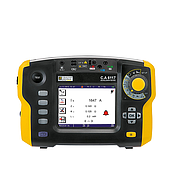
Earth resistance meters are mostly designed as handheld, making it easy for users to conduct measurements.
Earth resistance measuring instruments are used to test and predict insulation resistance, as well as the performance of insulating materials or equipment. This device has a flexible structure, suitable for many different applications. With a compact design, users can easily conduct measurements and receive results quickly and with high accuracy.
This meter also works as a multi-function power meter. For example, the Hioki FT6380 Earth Clamp Meter enables ground resistance measurements for multi-platform systems, measuring leakage current with high sensitivity and 0.01 mA resolution (within 20.00 mA ), and measure load current up to 60.0 A.
Refer to the product at: EMIN earth resistance meter
What applications does the earth resistance meter have?
In the construction industry, this device helps users evaluate the quality of works during construction. Using a ground resistance meter, users can check and ensure the safety of the project.
In the electricity industry, this device allows for periodic inspection, assessment, maintenance, repair, and proactive troubleshooting. With multi-function measurement features, the earth resistance measuring device helps save costs and improve work efficiency.
Conclude
To buy earth resistance measurement equipment, you can refer to EMIN - the leading unit in importing and distributing genuine resistance measurement products at competitive prices. EMIN's consulting staff has extensive knowledge and understanding of products and will help you choose the right equipment for your needs.