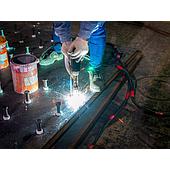
What is static electricity?
Static electricity is a natural phenomenon that occurs when there is an interaction between two oppositely charged charges. Common in areas where many electrical devices operate regularly, causing the static electricity phenomenon to become stronger. Static electricity is not only dangerous for humans but can also damage electronic devices.
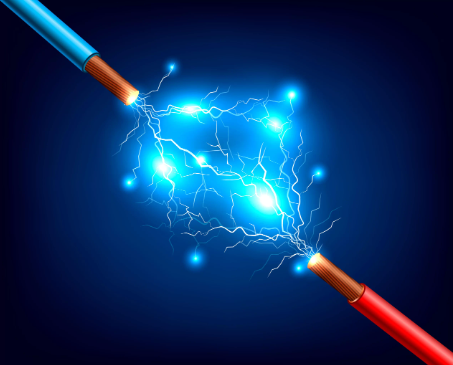
Static electricity phenomenon
This is an imbalance of charge on the surface of the material, and this charge will build up until released through an electric current or discharge. Unlike electric current, static electricity does not move through a conductor to transmit energy.
This phenomenon usually occurs when two surfaces come into contact and then separate, and at least one of the two surfaces has high resistivity. We easily recognize the effects of static electricity in everyday life, when we can feel, hear, or see the spark that occurs when excess charge is released near a large conductor, such as a wire. grounding.
Cause of static electricity
When two objects come into contact and then separate, charge will move from one object to the other, causing one object to accumulate positive charge, and the other object to accumulate negative charge.
Static electricity can also form from the external environment. For example, in dry air conditions, lacking water molecules to neutralize the charge, static electricity will occur more easily. Temperature, humidity and type of material also play an important part in the formation of static electricity.
Harmful effects of static electricity

For humans
The first harmful effect that static electricity causes to humans is the unpleasant feeling from a small electric shock. Occurs when touching door handles or metal surfaces, especially in winter. Although this shock is not usually dangerous, it can still make people feel uneasy and uncomfortable. Go
In industrial environments, static electricity can pose greater risks, especially when working with flammable chemicals or sensitive electronic equipment. A strong electric shock can trigger unwanted chemical reactions or damage important components, leading to the risk of serious workplace accidents.
For industrial production
In the field of industrial production, static electricity can seriously impact product quality and labor safety. One of the biggest dangers of static electricity is its ability to damage electronic components. When these components are exposed to static electricity, they can explode or stop working, leading to significant damage to the manufacturing process.
For example, in the computer chip manufacturing industry, components are very sensitive to static electricity. If this phenomenon is not well controlled, product errors may occur, even disrupting the entire production line, causing huge financial losses for companies and businesses.
Introducing the AP&T Electrostatic Meter
AP&T AP-YV1301 static electricity meter
AP-YV1301 is for those who need to accurately control small charge levels, with a measurement range from 0.001KV to ±2,000KV. Suitable in environments where static electricity control is required at a granular level, such as the manufacture of electronic components or products sensitive to static electricity. With its compact size and ease of use, AP-YV1301 is suitable for applications that require high precision, but is still easy to operate and store.
AP&T AP-YV1302 static electricity meter
AP-YV1302 has a wider measurement range, from 0.01KV to ±20.00KV, making it a suitable option for businesses that need to solve problems related to static electricity in large production. With the ability to measure higher charges, this product is suitable for industries that require high levels of static control such as plastic manufacturing, packaging or complex electronic devices. The automatic power off feature after 180 seconds helps save energy and ensures the device is always ready to operate when needed.
AP&T AP-YV1303 static electricity meter
With an extremely wide measurement range of up to ±200.0KV, AP-YV1303 is suitable for industrial environments that require large charge control. If you work in manufacturing or industries involving flammable chemicals, where the risk of fire and explosion due to static electricity is always present, AP-YV1303 will be the optimal solution to help control and prevent prevent possible incidents.