What is RMS and why is it important when measuring alternating current?
First of all, you need to understand this method. The RMS (Root Mean Square) measurement method is a standard feature found on most multimeters and clamp meters today. In addition to the name RMS, you will sometimes see it referred to as the average effective value or MEAN value.
In practice, RMS is often expressed in units:
+ V RMS: effective value of voltage
+ I RMS: effective value of current
Understand RMS in two ways:
Mathematical definition: RMS is calculated by squaring the instantaneous values of current or voltage → taking the average → then taking the square root. With a pure sine wave, the RMS result will be 0.707 times the peak value.
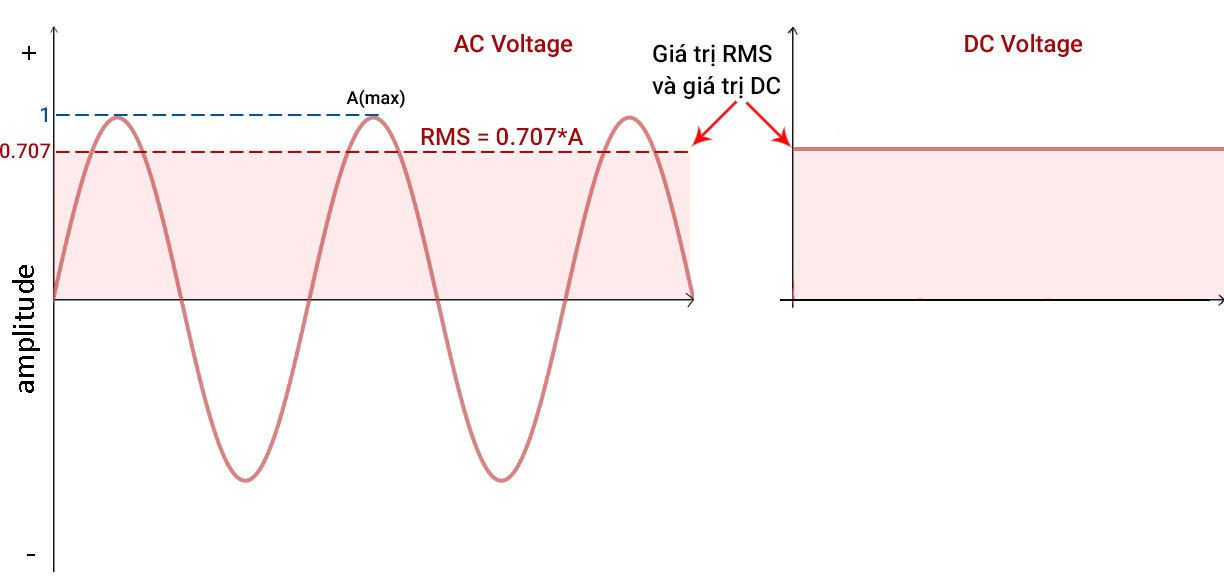
A simpler way to understand: RMS is a way to convert alternating current (AC) to direct current (DC) with the same ability to generate work, that is, to produce the same amount of heat if passing through the same resistance.
When is True RMS value used?
When using the RMS measurement method, you will only get accurate results if the electrical signal has a pure, regular sinusoidal waveform, without distortion or noise. This is the ideal waveform often mentioned in technical documents.
However, in reality, electrical signals rarely maintain a perfect shape. They are often affected by many factors such as voltage spikes, noise, signal distortion or harmonic components. When measuring these signals with conventional meters, the results can be quite skewed.
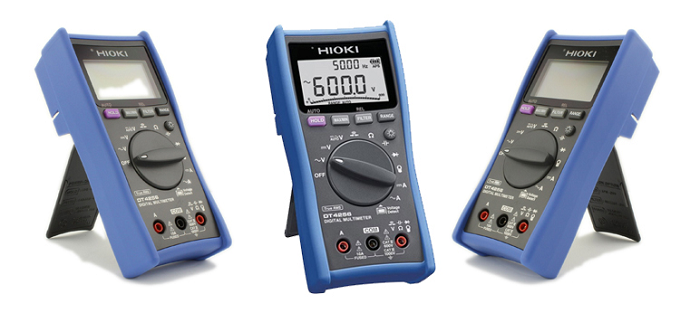
For such complex signals, you need a measuring device that can handle them more accurately. That is a multimeter or clamp meter that supports True RMS measurement. Only then will the measured value reflect the true nature of the signal running in the circuit.
In short, if you are working with an AC signal whose waveform is no longer intact like a basic sinusoid, using a measuring device that supports True RMS is absolutely necessary. The next section will give you a clearer view of the specific situations that need to be applied.
In short, what is the True RMS measurement method?
True RMS measurement method, also known as true effective value measurement, allows the measuring device to accurately record even when the electrical signal is unstable. Small fluctuations, noise or wave distortion are also fully reflected in the measurement results.
In other words, while the conventional RMS measurement method only gives the average value and ignores unusual changes, True RMS will record all of those variations. Thanks to that, you will get the most accurate and realistic data when working with complex electrical signals.
Some common devices used to measure True RMS values
In an era where accuracy is increasingly being prioritized, measuring devices with True RMS capabilities are becoming more and more popular. There are many options on the market today, from digital multimeters, clamp meters, to desktop clocks or handheld oscilloscopes, all of which have versions that support True RMS measurements.
Examples include:
- UNI‑T UT216C AC/DC 600A Clamp Meter with True RMS feature accurately measures both AC and DC
- HIOKI CM4003 Clamp Meter is specialized for checking leakage current, measuring RMS very accurately in the range of 6mA to 200A
- SANWA RD701 True RMS multimeter, 0.3% accuracy, integrated K temperature measurement
- VICTOR VC8045‑II desktop multimeter
- GW INSTEK GDM-8255A Dual Display Digital Multimeter with True RMS ACV and ACA measurement, readings up to 5½ digits
- KEYSIGHT U1610A handheld oscilloscope (100Mhz, 2 channels, 1GSa/s)
However, in reality, the two most commonly used devices are still handheld multimeters and clamp meters. Both are compact, easy to carry, simple to operate, and are almost indispensable items for any electrical technician. These are also the two most suitable tools for measuring RMS values flexibly and accurately in many different working situations.
Today's applications require True RMS meters
After going through all the theory above, you probably have a good idea of what RMS is, the difference between RMS and True RMS measurement methods, and what devices can support this feature. However, you may still be wondering in what specific situations True RMS will be applied in practice.
Here are a few typical examples where True RMS measurement is really necessary to ensure measurement accuracy.
- Motors and equipment that use frequency converters such as air conditioners, refrigerators, elevators, motors and speed control systems
- Electrical ballasts used in fluorescent or LED lamps
- Electronic devices that consume non-linear power such as computers or switching power supplies
- HVAC central air conditioning systems with continuously varying electrical loads
- Hard drives and some other sensitive electronic devices with unstable power supplies
So, you have learned quite a bit about the True RMS measurement feature, the difference with the conventional RMS measurement method as well as the devices and situations where this function should be used. If you are in need of equipping a multimeter or clamp meter that supports True RMS, do not hesitate to contact us for more detailed advice and choose the right product for your work.