Hardness is a parameter found in most mechanical drawings, material standards, and quality control procedures. From cutting blades and dies to gears and aerospace components, hardness values directly affect wear resistance, surface strength, and service life.
When learning about hardness testing, users often encounter three of the most common methods: Rockwell, Brinell, and Vickers. All three are widely used in industry but do not serve the same purpose. Many inaccurate measurement results stem not from the equipment but from applying the wrong method to the material being tested.
So, what are the differences between Rockwell, Brinell, and Vickers? In which cases should each method be used?
Why do we get different results when measuring hardness?
Many people believe that hardness is simply a number. In reality, the method used to derive that number is what determines it.
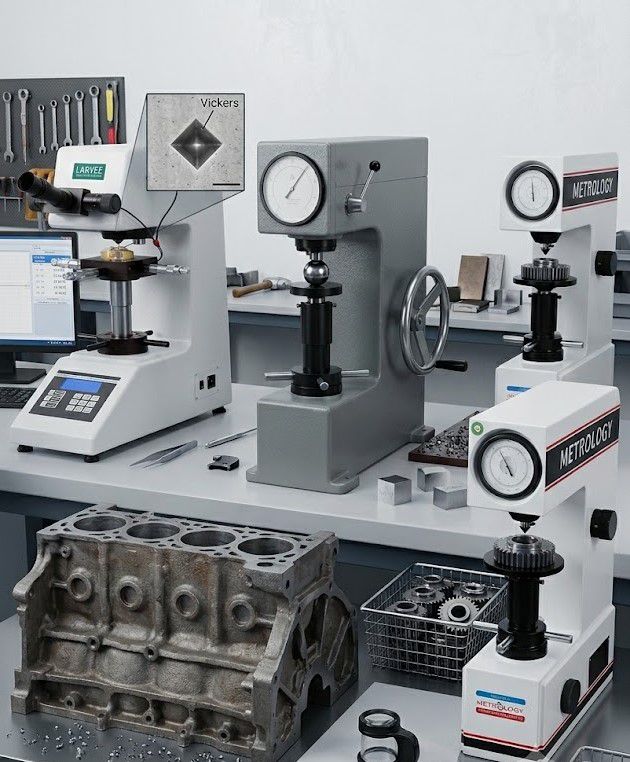
Rockwell assesses hardness based on the depth of indentation created after applying a load. Brinell measures the diameter of the indentation from a steel or alloy ball. Vickers uses a square-shaped diamond tip and measures the lengths of the two diagonals of the indentation using an optical system.
Because the principles are completely different, the results obtained are also different. A component can be expressed in HRC, HB, or HV depending on the testing method applied.
That's also why values like 60 HRC, 600 HV, or 280 HB cannot be placed side-by-side and compared directly.
Why is Rockwell most commonly used in factories?
If you walk into any machine shop or QC room, you'll likely encounter a Rockwell hardness tester first, all thanks to its speed. A heat-treated part often needs immediate quality testing before moving on to the next stage. In that context, taking a few minutes to prepare a sample or observe the indentation under a microscope isn't a practical solution.
Rockwell allows for almost instantaneous results. The operator simply places the sample on the test bench, applies a load, and receives the hardness value directly from the device.
Molds, gears, drive shafts, cutting tools, and heat-treated steel are commonly tested using this method. Models like the HR-150A are chosen by many businesses due to their ability to meet the daily testing needs of large sample volumes.
If you're looking to delve deeper into the Rockwell system, the article "How Do HRC, HRB, and HRA Scales Differ in Hardness Measurement?" will help you clearly distinguish each scale and its corresponding material range.
Why are casting materials often measured in Brinell?
Cast iron and many heavy industrial materials often have a large grain structure and are not as uniform as finely machined steel.
In this case, a very small indentation sometimes only reflects the characteristics of a localized area of the material instead of the entire part. Brinell was developed to address precisely this problem.
The large size of the ball and the high load create a significantly wider indentation than Rockwell. Thanks to the larger measurement area, the results obtained are more representative of the entire material.
This is why the metallurgical, casting, and structural steel industries still maintain Brinell as an important standard. Large parts, relatively rough surfaces, or heterogeneous material structures often yield more reliable results when measured using HBE-3000 and equivalent Brinell systems.
How did Vickers solve the problems that Rockwell and Brinell struggled with?
Imagine you need to assess the hardness of a coating only a few tens of micrometers thick or a very small part. In this case, both Rockwell and Brinell are limited because the indentation created can be larger than the area being tested. And of course, Vickers systems are designed for such situations.
The square-shaped diamond tip creates a very small indentation while maintaining high accuracy. Therefore, this method can assess PVD coatings, CVD coatings, engineering ceramics, electronic components, composite materials, or laboratory research samples.
In materials research, the requirement goes beyond simply knowing whether a material is hard or soft; it also involves evaluating the change in hardness between different structural layers. This is why systems like the HVS-30 are commonly found in R&D labs and specialized testing centers.
So how do the accuracy of Rockwell, Brinell, and Vickers differ?
This is a question that frequently arises when businesses are preparing to invest in equipment.
Vickers is often considered the best for its measurement capabilities, using optical systems to determine indentation size. Applications involving research or evaluation of thin coatings almost always favor this method. Brinell excels on cast materials or materials with irregular structures, where a large indentation provides better representative value.
Rockwell, on the other hand, doesn't pursue maximum accuracy but focuses on repeatability, speed, and production efficiency.
In other words, the most suitable method is often not the most theoretically accurate method, but rather the one that accurately reflects the characteristics of the material being tested.
Should businesses choose Rockwell, Brinell, or Vickers?
The answer depends on the type of material most frequently encountered in the production process. A mold making or steel heat treatment unit typically utilizes Rockwell machines more effectively.
Large cast iron foundries or steel structure manufacturers often prefer Brinell because the results accurately reflect material properties. Research labs, materials science laboratories, or electronics component manufacturers tend to choose Vickers due to its ability to accurately measure on small parts and thin coatings.
Investing in the right method from the start not only saves on equipment costs but also significantly reduces disputes related to product quality during testing.
Frequently asked questions
Can Rockwell measure the hardness of ultrahard materials?
Yes. The HRA and HRC scales were developed to evaluate a wide range of materials with very high hardness, such as hardened steel or special alloys.
Which material is Brinell best suited for?
Cast iron, cast steel, forged materials, and parts with large grain structures are the most common applications of the Brinell method.
When should Vickers be used?
Vickers is particularly well-suited for thin coatings, ultrahard materials, small-sized components, and research requiring high precision.
Which method has the highest investment cost?
Typically, Vickers systems have a higher investment cost because they require the combination of microscopes and specialized optical measurement systems.
Can Rockwell be used for plastics?
Several Rockwell scales are applied to polymer materials and engineering plastics according to the specific standards of each industry.
Conclude
Rockwell, Brinell, and Vickers all hold unique positions in the field of material hardness testing. Rockwell stands out for its fast testing speed, Brinell is suitable for cast materials and materials with coarse structures, while Vickers offers high accuracy on small parts and thin coatings.
Understanding the characteristics of each method helps businesses effectively utilize equipment lines such as the HR-150A, HBE-3000, and HVS-30, and select the right testing solution for each specific application.