A programmable DC power supply is selected by first matching its voltage, current, and total power capability to the device under test (DUT). The right choice also depends on whether the load changes quickly, how much output accuracy matters, and whether remote control or automated testing is required.
Rather than choosing only by maximum output, evaluate the complete test requirement: electrical range, output behavior, protection, interface options, and likely future expansion. This helps avoid unstable tests, unsuitable output performance, or a system that cannot support later automation.
Summary: Match voltage, current, and power to the DUT. Check accuracy, noise, and transient response for the application. Choose interfaces and protections that fit the test workflow. Consider expansion needs before committing to a configuration.
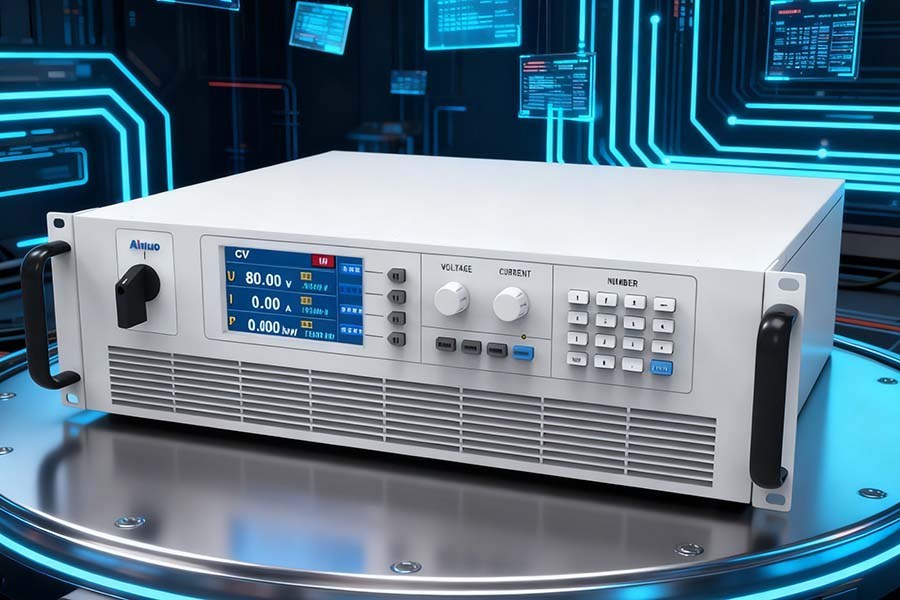
What is a programmable DC power supply?
A programmable DC power supply is an electronic instrument that delivers controlled DC voltage or current to circuits and devices. Unlike a fixed supply, it allows output settings to be managed through a digital interface, software, or remote commands.
This capability is useful where repeatable settings or automated sequences are needed, such as electronics development, power-management testing, research work, and production tests. Depending on the unit, remote interfaces may include USB, LAN/Ethernet, GPIB, or RS-232.
Which electrical ratings should a programmable DC power supply cover?
The supply must cover the DUT’s maximum operating voltage, current, and power demand, including inrush current and peak demand where relevant. Voltage range defines the highest DC voltage available, while current range defines the available output current.
Total power is calculated as P = V × I. For example, 60 W can correspond to 30 V × 2 A or 15 V × 4 A; the voltage-current combination required by the DUT matters, not only the wattage figure.
A practical selection approach is to allow roughly 10–20% headroom above the expected maximum load. This margin can support reliability and accommodate expected changes in testing needs.
Why do accuracy, resolution, noise, and transient response matter?
Accuracy indicates how closely the actual output matches the set value, while resolution is the smallest setting increment available. Both are important for sensitive circuits, calibration activities, sensor testing, and other work that requires precise output control.
Low output noise and ripple are particularly relevant to analog or RF work because unwanted output variation can affect circuit behavior or measurements. The source describes laboratory requirements that may include voltage accuracy of ±0.01% and noise below 1 mVrms, but the required level depends on the DUT and test method.
Transient response matters when the load changes suddenly, as with pulsed circuits or battery-charging cycles. A supply with fast response is intended to limit substantial voltage dips or overshoot during rapid load variations.
How do linear and switching programmable DC power supplies differ?
Linear and switching designs involve different trade-offs. Linear supplies are associated with low noise, low ripple, and stability, whereas switching supplies are associated with higher efficiency, smaller size, and lower heat generation.
| Design | Key advantages | Key limitations | Typical fit stated in the source |
|---|---|---|---|
| Linear power supply | Low noise and ripple; strong stability | Larger, heavier, and less efficient; produces more heat | Precision laboratory testing and sensitive analog circuits |
| Switching power supply | Higher efficiency; smaller, lighter, and lower heat generation | Higher noise and ripple can affect sensitive circuits | Production environments and high-power applications |
Which control interfaces and software functions should be checked?
Choose the interface based on the way the supply will be used. USB, LAN/Ethernet, GPIB, and RS-232 are listed interface options for remote control, and the needed option depends on the existing bench or automated test system.
For automated work, verify that the intended system supports the required software integration. Relevant capabilities can include SDKs, scripting support, data logging, waveform generation, and suitable APIs or drivers for test environments.
Which protection functions are important for the DUT and supply?
Protection functions help reduce the risk of damage to both the programmable DC power supply and the DUT. Key functions to evaluate are over-voltage protection (OVP), over-current protection (OCP), over-temperature protection (OTP), and short-circuit protection.
Automatic shutdown or alarms can add a further safeguard when an abnormal condition occurs. The specific protection settings and thresholds should suit the sensitivity and operating limits of the DUT.
How should future capacity and usability affect the choice?
Future capacity matters when testing may later require higher voltage, higher current, multiple channels, or integration into a larger automated system. Multi-channel or modular arrangements may be relevant when test requirements are expected to grow.
For repeated bench tasks, assess the practical operating features as well. Displays, touch panels, front-panel controls, and preset memory can affect setup speed and ease of use, especially in a busy laboratory workflow.
What should be reviewed before making a final selection?
Before selecting a unit, compare its electrical range, power rating, output quality, transient behavior, control method, protection functions, and fit with the planned test process. Also review available manuals, example code, application notes, firmware updates, warranty, and support where integration is complex.
A lower-cost option may not be suitable if its specifications cannot support the test requirement. The most appropriate DC power supply is the one that meets the DUT’s actual electrical and control needs without relying on unsupported assumptions.