Concrete relative humidity is measured by placing an electronic in-situ RH probe in a drilled hole within the slab. Under ASTM F2170, the test includes selecting locations, preparing the slab and ambient conditions, drilling to the applicable depth, allowing equilibration, and documenting the readings.
This approach measures conditions inside the concrete rather than only at its surface. It is relevant before protective coatings or floor finishes are applied, because moisture beneath those materials may contribute to discoloration, cupping, buckling, blistering, adhesive failure, or mold growth.
Why is in-situ RH testing used for concrete moisture measurement?
In-situ RH testing directly measures moisture conditions within the concrete slab using a probe placed in a drilled hole. The method described by ASTM F2170 is presented as an industry standard for determining relative humidity in concrete floor slabs with in-situ probes.
Unlike a surface-only test, an in-situ probe assesses conditions at the test depth. The source information states that this measurement is not dependent on concrete mix, aggregate type, slab thickness, or surface condition in the same way as a surface measurement.
How do calcium chloride tests, electronic meters, and in-situ probes differ?
These methods evaluate concrete moisture differently: calcium chloride tests collect moisture at the surface, electronic meters measure electrical impedance, and in-situ probes measure relative humidity inside a drilled hole. The choice matters because each method addresses different conditions and limitations.
- Anhydrous calcium chloride tests: These weigh salt after it absorbs moisture from an enclosed surface area. The source notes concerns about surface-only measurement, sensitivity to ambient conditions, and the lack of a practical calibration route traceable to national standards.
- Non-destructive electronic meters: Devices such as PosiTest CMM measure electrical impedance associated with concrete moisture in the top ¾ inch of a slab. Concrete composition and reinforcing materials such as rebar can affect readings; the source describes these meters as comparators or companions to in-situ RH probes rather than tools for quantitative moisture content.
- In-situ RH probes: These are installed in drilled holes to measure conditions within the slab. They can be calibrated with traceability to national standards according to the source material.
How many concrete RH probes are required under ASTM F2170?
The source states that ASTM F2170 requires three probes for the first 1,000 square feet (100 square meters), plus one additional probe for each additional 1,000 square feet (100 square meters). It also states that one test must be located within 3 feet (1 meter) of each exterior wall.
Before testing, the slab and the ambient conditions should be at service conditions for at least 48 hours. Recording probe locations on a floor plan can help retain the location information required for the test record.
What drilling depth is used for an in-situ concrete RH test?
The drilling depth depends on whether the slab dries from one side or two sides. For a slab drying from one side, such as slab-on-grade, the stated depth is 40% of slab thickness; for a slab drying from two sides, such as a suspended slab, it is 20%.
The process described in the source uses a hammer drill and a ¾-inch drill bit. Debris is removed from the hole, and the drilling time is documented before the probe is installed.
When can in-situ RH readings be recorded after probe installation?
Although the probe begins measuring when installed, ASTM F2170 requires a 24-hour equilibration period before readings are recorded, according to the source. This allows conditions in the test hole to equilibrate.
After that period, in-situ humidity, temperature, date, and time can be recorded without opening the hole or removing the probe. Ambient temperature and humidity above the hole are also required as part of the described testing process.
How does PosiTector CMM IS support concrete RH testing?
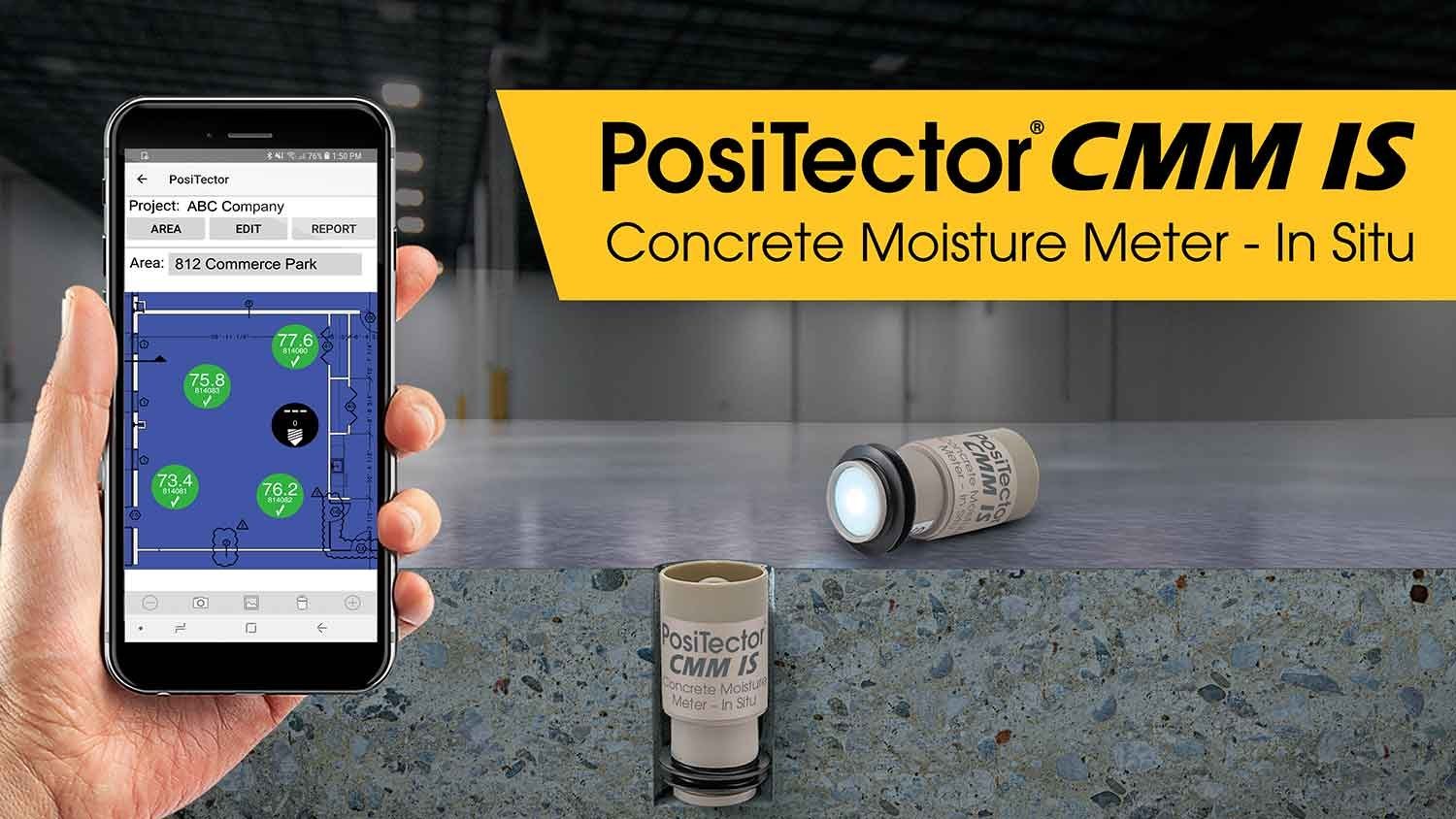
PosiTector CMM IS is an in-situ concrete moisture meter designed to measure concrete relative humidity in accordance with ASTM F2170. Its reusable probes use Bluetooth Low Energy to transmit measurements to the PosiTector App or to a compatible PosiTector Advanced gage with serial numbers 784,000 and greater.
Each probe includes a calibration check salt and chamber for conditioning and storage. The source states that ASTM F2170 requires probe calibration within one year after initial use and verification within 30 days of use with a saturated salt solution.
Which PosiTector CMM IS kit configuration suits the test area?
The Basic Kit is described for areas up to 1,000 square feet (100 square meters) and includes three probes. The Complete Kit includes five probes and is described for areas up to 3,000 square feet (300 square meters).
The Pro Kit includes the items in the Complete Kit plus a PosiTector DPM Advanced gage for measuring ambient temperature and humidity above the drilled hole. The gage can receive and record in-situ humidity and temperature alongside ambient measurements, while its surface temperature sensor can be used for concrete temperature measurement.
What should be included in an ASTM F2170 concrete RH report?
A complete report should retain the probe data required by the standard, including the recorded in-situ readings and the relevant ambient conditions. The PosiTector App can map probe locations, add metadata and notes, and generate a PDF inspection report from collected data.
When testing is complete, the reusable PosiTector CMM IS probe can be removed with the extraction tool and the hole filled with a suitable patching compound. Stored readings from a PosiTector Advanced gage can also be downloaded through PosiSoft software.