Dollies should be prepared to create a consistent, strong bond between the dolly and the bonding adhesive before a pull-off adhesion test. The available study identifies abrasion, removal of loose debris, and careful handling as practical controls for reducing unintended adhesive-to-dolly failures.
For the disposable aluminum dollies examined with the PosiTest AT, abrasion using a Scotch-Brite™ pad followed by wiping with a dry cloth produced the strongest and most repeatable results in that investigation. Preparation should nevertheless follow the method supplied for the specific dolly, adhesive, and test equipment.
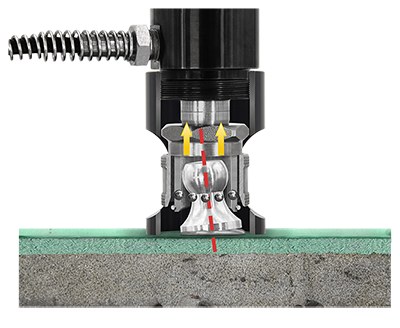
What does a pull-off adhesion test measure?
A pull-off adhesion test measures the force required to pull a defined area of coating away from its substrate. The reading provides a direct indication of adhesion between the coating and substrate, provided the test setup does not fail first at the adhesive-to-dolly interface.
In a portable tester, the flat face of a pull stub, also called a dolly, is bonded to the coating. Once the bonding adhesive has cured, an actuator connects to the dolly and applies increasing pressure until separation occurs.
Why does dolly preparation affect pull-off adhesion test results?
Dolly preparation affects results because a weak or contaminated dolly-to-adhesive bond can cause separation at that interface instead of evaluating the coating system. Avoiding this unintended failure makes the reported pull-off result more meaningful and more predictable.
Abrasive preparation changes the dolly surface profile, increasing the area available for bonding and removing oxidation or rust. Cleaning then removes loose particles generated during abrasion, while degreasing addresses oils or grease that may be transferred during handling.
What are the main steps in preparing a test dolly?
The three commonly described preparation steps are degreasing, abrasion, and cleaning. Their importance can vary with the dolly material, its supplied condition, the adhesive, and the manufacturer’s validated procedure.
- Degreasing: removes trace oils and grease from the surface that will be bonded.
- Abrasion: modifies the surface profile and can remove oxidation or rust.
- Cleaning: removes loose debris, especially particles created by abrasion.
Some dollies are machined and packaged in a way that may reduce the need for degreasing before use, provided they are handled carefully. However, loose debris after abrasion still needs attention because applying a dolly directly after abrasion without cleaning was associated with lower average adhesive-to-dolly bond strength in the reported comparisons.
Which abrasion method performed best for the aluminum dollies studied?
For the disposable aluminum dollies in the reported experiment, abrasion with a Scotch-Brite™ pad delivered the highest overall adhesive-to-dolly bond strength. Fine-grit sandpaper ranked second, while machine-flattened and end-milled dollies showed the weakest bonds and frequent failure at the dolly interface.
The study suggests that the three-dimensional abrasive pad may produce a surface microstructure that better supports adhesive bonding. Sandpaper showed greater variation between pull-offs, potentially because aluminum accumulated on the abrasive surface and made the resulting surface profile less uniform.
Is wiping the dolly with a dry cloth sufficient after abrasion?
For the carefully handled, abraded aluminum dollies in this study, wiping with a dry cloth after Scotch-Brite™ abrasion was sufficient to support strong adhesive-to-dolly bonding. Alcohol-swab cleaning followed by a dry wipe showed a negligible difference in the reported cleaning comparison.
This finding is limited to the materials and conditions evaluated; it is not a universal substitute for the preparation instructions for every dolly type. Carbon steel, stainless steel, other aluminum finishes, adhesives, and coating systems can require different validated practices.
Does oxidation time matter after preparing aluminum dollies?
Oxidation time had a relatively minor effect on bond strength for the aluminum dollies studied after abrasion. The source attributes this limited difference to aluminum forming a thin oxide layer soon after exposure to air.
The same conclusion should not be assumed for other materials. The reported discussion notes that oxidation could have a more significant effect with other dolly materials, particularly carbon steel.
When should an aluminum dolly be reused?
An aluminum dolly should not be reused if damage, wear, or an uneven bonding surface prevents it from being returned to its original condition. Repeated sanding or machining to remove prior coating and adhesive can alter the surface, and high-pressure pull-offs can mark aluminum dollies through the quick coupling.
Disposable dollies may also be retained as evidence of a test result or as a quality record. Where reuse is considered, surface condition must be evaluated carefully because altered surfaces can introduce variation into later tests.
How can operators improve repeatability in pull-off adhesion testing?
Operators can improve repeatability by using a simple, consistent procedure that is appropriate for the equipment and materials: prepare the surface as instructed, remove debris, avoid contamination during handling, allow the bonding adhesive to cure, and inspect dollies for damage before use. The preparation method should be clear enough to be applied consistently between operators and applications.
Changes to abrasion method, cleaning practice, adhesive, or dolly material should be verified for the actual combination in use. The reported experiments show that a method that improves bonding in one material-and-adhesive combination may not be optimal for another.