Barcol hardness testing is an indentation method used to assess a material’s resistance to permanent deformation. It is relevant to mechanical engineering quality work involving rigid plastics, aluminum, aluminum alloys, copper, brass, and certain fiber-reinforced polymer composites. A higher Barcol reading indicates that the indentor penetrates less into the surface and therefore indicates a harder material.
Because results depend on stable positioning, surface contact, and consistent technique, a structured measurement process is essential. This guide explains the operating principle, practical test steps, accuracy verification, and standards cited for Barcol hardness measurement.
What Does Barcol Hardness Measure?
Material hardness describes resistance to permanent deformation, including bending, scratching, abrasion, or cutting. With an indentation instrument, a shaped indentor is pressed against a surface, and the depth of penetration provides a comparative indication of hardness. Greater penetration corresponds to a lower hardness value.
A portable Barcol hardness impressor combines an indicating display with an indentor. In the Barcol scale described for ASTM B648, one unit corresponds to 0.0076 mm (0.00030 in.) of indentor movement. A reading of 0 represents full penetration of 0.76 mm (0.03 in.), while a reading of 100 represents no penetration. These values illustrate why correct contact and specimen support are important to meaningful results.
Where Is Barcol Hardness Testing Used?
Barcol hardness testing supports quality assurance and quality control where a material must meet a defined hardness requirement. It is used for soft metals including aluminum, aluminum alloys, copper, and brass, as well as rigid plastics.
For some plastics and fiber-reinforced polymer composites, Barcol hardness can also help evaluate the degree of curing and cross-linking. As curing progresses, hardness increases until the maximum associated with the resin type is reached. The target value and acceptance criteria should be established for the specific material and application.
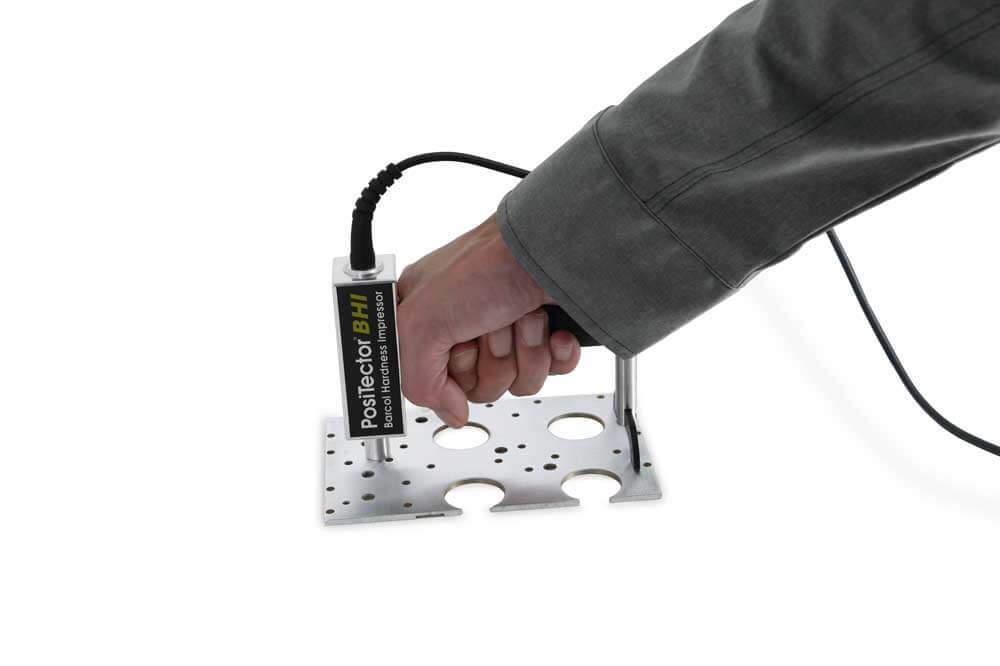
How to Measure Barcol Hardness
1. Prepare and support the test area
Select a hard, firm test location. The specimen must not bend or deform during the measurement. Thin or flexible material should be supported on a firm surface for the duration of the test; otherwise, the result may be falsely low.
Keep impressions at least 3 mm (1/8 in.) away from the part edge and from previous impressions. This spacing helps prevent an earlier indentation or an unsupported edge from influencing the next measurement.
2. Position the impressor correctly
Hold the instrument perpendicular to the test surface. On irregular or small components, shims may be used to raise the instrument leg as needed so the indentor can contact the surface squarely. A test stand may also be useful when maintaining perpendicular alignment is difficult.
3. Apply pressure without sliding
Set the legs and indentor foot flat on the test surface, then apply sufficient downward pressure to establish firm contact. Do not slide or scrape the instrument across the specimen. Sliding can create erroneous readings and may damage the indentor tip.
With the PosiTector BHI, the measurement timer can begin after the indentor is pressed firmly onto the surface. When the timer reaches zero, the display shows the measurement value. If memory is enabled, the reading can be stored for later review.
How to Verify Barcol Hardness Readings
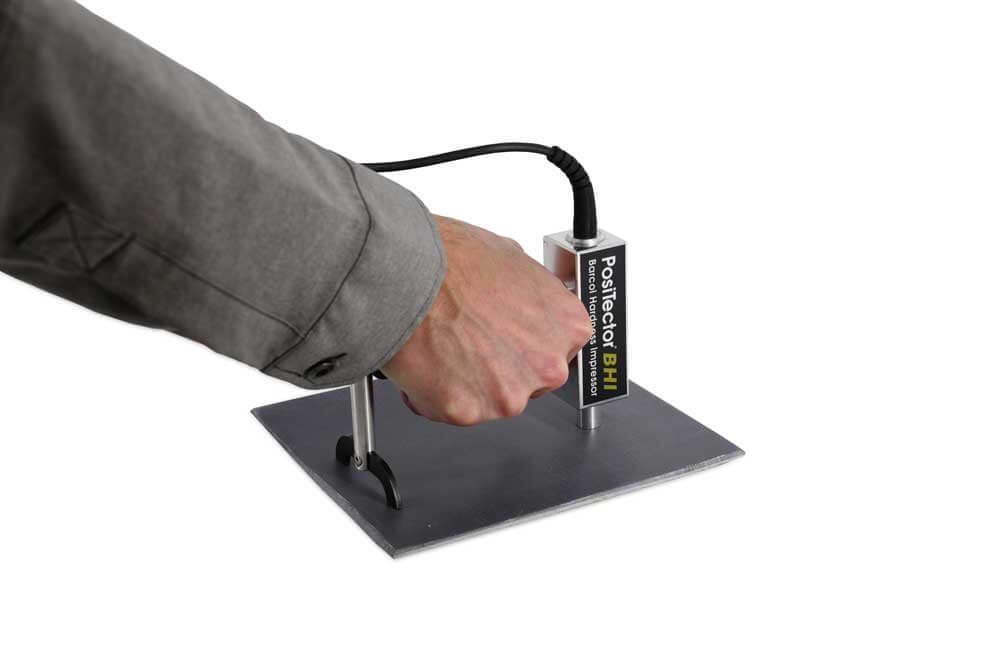
Accuracy checks should be performed at the beginning and end of each work shift using the supplied test disks and leveling plate. Place the leveling plate on a hard, flat surface, position the instrument legs on the plate, and place the test disk beneath the indentor tip.
Press the instrument firmly downward and observe the displayed reading. Take three to five readings on each test disk, maintaining at least 3 mm (1/8 in.) between impressions. Comparing multiple readings helps identify inconsistent positioning or contact before testing production parts.
Useful Features of the PosiTector BHI
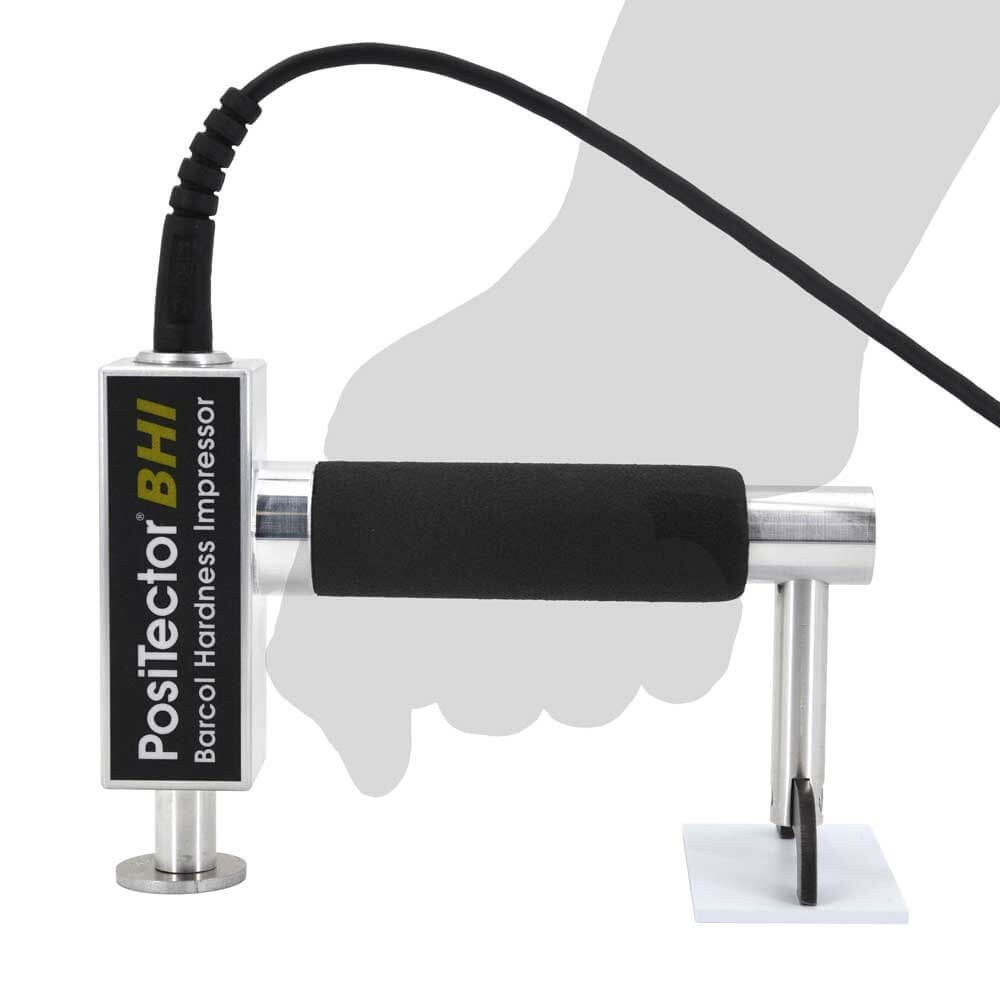
The PosiTector BHI is a digital Barcol hardness impressor designed for rigid plastics and soft metals. Its digital display avoids the need to interpret an analog scale. The instrument also includes onboard memory, a user-adjustable on-screen measurement timer, and a USB port for downloading stored readings.
Additional functions described for the instrument include continuous readings, on-screen statistics for average, standard deviation, minimum, and maximum values, plus a HiLo alarm for user-specified limits. The Advanced model includes Auto Sub-Batch, which can create a new sub-batch after a required number of readings is stored.
Barcol Hardness Standards to Consider
ASTM B648 for aluminum alloys
ASTM B648 covers determination of indentation hardness of aluminum alloys using a Barcol impressor. The procedure emphasizes placing the specimen on a flat, hard support, keeping the indentor perpendicular to the surface, applying pressure promptly for firm contact, and avoiding sliding or scraping.
ASTM D2583 for rigid plastics
ASTM D2583 covers indentation hardness of reinforced and non-reinforced rigid plastics using a Barcol impressor. As with metal testing, proper specimen support is critical because a soft backing surface can produce a false low reading.
Key Practices for Reliable Results
- Support the specimen on a hard, flat surface to prevent bending or deformation.
- Keep the instrument perpendicular to the test surface.
- Maintain at least 3 mm (1/8 in.) between impressions and from specimen edges.
- Apply pressure firmly without sliding or scraping the indentor.
- Verify instrument accuracy regularly with test disks and a leveling plate.
- Use the applicable material standard and defined acceptance criteria when evaluating results.
Following these controls helps make Barcol hardness testing more repeatable and useful for material inspection, process monitoring, and quality documentation.