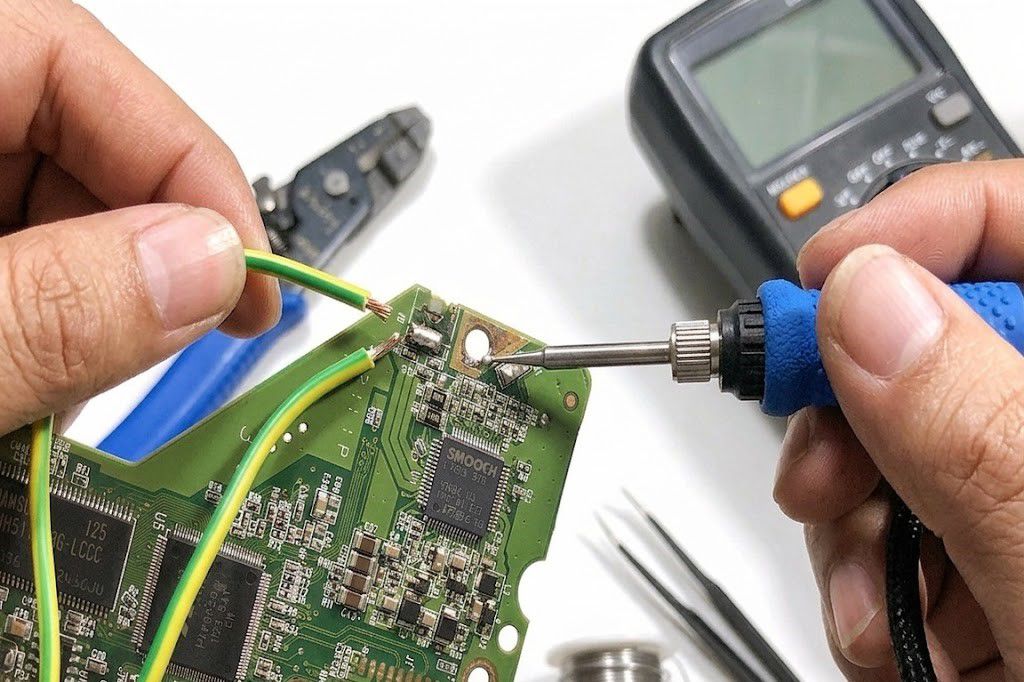
Solder failing to flow correctly is rarely caused by a single factor. Below are common scenarios, ranked by frequency, encountered when soldering signal wires to a PLC, attaching terminals in an electrical cabinet, or repairing a motor control board.
Is the soldering iron temperature sufficient, and sufficient in what sense?
The short answer: the temperature displayed on the soldering iron is not the actual temperature at the contact point. This is the most commonly overlooked factor.
Leaded solder melts at approximately 183°C, while lead-free solder requires 217–227°C. However, when the iron touches a large mass of metal such as a large terminal lug in an electrical cabinet or a thick copper trace on a power circuit heat is drawn away faster than the iron can replenish it. Consequently, the temperature at the solder joint drops below the melting point, even though the display still shows the correct set temperature.
A quick test: if the solder flows well on small component leads but clumps up on large ones, the issue is insufficient power output rather than an incorrect temperature setting. For joints involving large metal masses, it is better to use a higher-wattage iron (60W or more) or a soldering station with automatic heat compensation. Simply cranking the setting to 350–400°C is not the solution, as that level can burn off the flux before the solder has time to flow evenly.
An old soldering tip coated in a layer of black oxide can similarly impede heat transfer, even if the temperature reading remains accurate. Cleaning the tip with a damp sponge or brass wire wool before each soldering task helps prevent most of these issues.
Oxidized welding surfaces: signs and treatment
Component leads or pads that appear dull—with a grayish or brownish tint rather than a bright metallic sheen indicate oxidation. When solder touches such a surface, it tends to bead up and roll around rather than wetting and spreading, even when the temperature is sufficient.
Oxide layers form more rapidly than usual on wires stored for long periods, IC leads salvaged from old boards, or terminals kept in humid environments. The most common remedy is wiping the surface with isopropyl alcohol before soldering. In cases of severe oxidation, gently scrubbing with fine-grit sandpaper or a brass wire brush to expose the bright metal underneath followed by applying flux prepares the surface for soldering.
A distinction should be made: if the component leads are clean but the pads on an old circuit board are discolored, the issue often stems from the degradation of the pad's finish (such as the HASL coating) over time. Scrubbing is ineffective here; instead, liquid flux or a flux pen should be applied directly to the pads before soldering.
What errors are caused by a lack of flux or the use of the wrong type?
Flux serves to break down the thin oxide layer during soldering and reduce surface tension, allowing the solder to spread evenly. The flux core inside the solder wire burns off rapidly at high temperatures or when the soldering iron is held in one spot for too long; consequently, for joints requiring prolonged heating such as large capacitor leads or terminal lugs external flux application is almost always necessary rather than relying solely on the built-in core.
Signs of insufficient flux include solder that melts but fails to spread flat, resulting in a rough joint surface with tiny air bubbles. This differs from the clumping caused by oxidation or insufficient heat; therefore, if those two issues have been ruled out but the problem persists, try applying additional flux before questioning the equipment or soldering technique.
Important limitation: Highly active fluxes (such as those used for industrial soldering or copper piping) are unsuitable for electronic circuit boards because flux residue can corrode the circuitry over time if not thoroughly cleaned after soldering. For control boards and sensors, only non-corrosive flux (such as "no-clean" or mild RA types) should be used.
Solder wire quality
Solder wire with unspecified alloy ratios and no quality certification often contains impurities, causing the actual melting temperature to be tens of degrees higher than the figure stated on the packaging. A telltale sign is that, while using the same soldering iron and temperature settings, the solder melts normally once you switch to a different spool.
This is a useful troubleshooting step when you have already checked the temperature, surface conditions, and flux but still cannot identify the fault. For high-reliability applications such as soldering connections in electrical cabinets or motor control boards you should choose solder that clearly specifies its Sn/Pb ratio or lead-free alloy composition, rather than buying unbranded, low-cost solder sold by weight.
Incorrect welding techniques and common errors
Applying solder before the soldering iron has heated the component lead is the most common mistake made by beginners. The correct procedure is to touch the iron to the joint area for 1-2 seconds to heat both the component lead and the pad, then apply the solder to the point of contact between the iron and the surface avoiding direct contact between the solder and the iron's tip.
Holding the iron in place for too short a time or withdrawing it too early causes the solder to cool before it can flow properly, resulting in a "cold joint" that appears dull rather than shiny like a high-quality joint. Maintain a steady angle of approximately 45 degrees; avoid constantly shifting the iron, as changing the contact area leads to uneven heat transfer.
To what extent does the work environment have an impact?
High humidity causes flux to absorb moisture, thereby reducing its oxide-removing capability. Excessively low ambient temperatures can cause the solder joint to cool faster than the solder can solidify evenly, making it prone to micro-cracking (crazing), even though the solder flows normally during the process. While this effect is significant in mass-production facilities or coastal environments, it is rarely the primary issue for repair work performed at an indoor workbench.
Frequently Asked Questions
What causes solder to melt for just a few seconds and then immediately solidify? This is often caused by not holding the soldering iron in place long enough, or by the iron lacking the power to compensate for the heat loss to a large metal mass, causing the temperature to drop below the melting point immediately after the solder is removed.
Does turning up the soldering iron temperature always solve the problem? No. If the issue is surface oxidation or a lack of flux, increasing the temperature will only cause the flux to burn off faster and risk damaging heat-sensitive components, while the solder still won't spread evenly.
How can you distinguish between a cold solder joint and a joint that lacks flux? A "cold solder joint" typically appears dull with an uneven, bumpy surface because the solder solidifies before it can properly form. A joint lacking sufficient flux may still look shiny but will have a rough texture, contain tiny air bubbles, and fail to fully wet the component leads.
Is it necessary to clean off flux residue after soldering? Cleaning is not mandatory when using no-clean flux. However, with more active fluxes, it is advisable to wipe the area with isopropyl alcohol to prevent flux residue from corroding the circuit over time especially for boards located in humid electrical cabinets or near heat sources.
Most instances of solder failing to flow stem from one of the five categories of causes mentioned above; identifying the issue usually requires a process of elimination rather than guesswork. For repetitive tasks such as electrical cabinet maintenance or sensor board assembly using a soldering station with precise, stable temperature control significantly reduces these issues compared to a fixed-wattage handheld soldering iron.
For tasks like soldering signal wires, medium-sized terminals, or standard control boards, the QUICK 969D+ soldering station (70W, 100–480°C, with a real-time LCD temperature display) is an accessible choice that provides sufficient thermal compensation for most daily maintenance work. Conversely, for soldering points involving large masses of metal such as large terminals in electrical cabinets where heat dissipates rapidly the JBC CD-2BQF station (175W, 90–450°C) is more suitable due to its high power output and ability to maintain stable temperatures during continuous soldering.