For full functionality of this site it is necessary to enable JavaScript.
EMIN.VN
0

Golden Rules for Workplace Safety When Using High-Speed ​​Centrifuges

2026년 10월 05일 15시 40분 12초

A comprehensive occupational safety handbook integrating quantitative technical standards and international-standard emergency response procedures

Quantitative Technical Guide & Emergency Response Protocols according to International Standards (OSHA / COSHH)
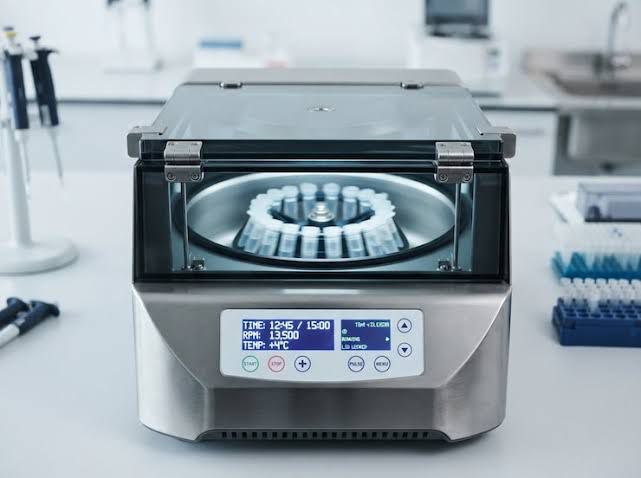
In molecular biology laboratories, medical testing centers, and industrial facilities, high-speed centrifuges (operating from 15,000 to over 30,000 RPM) are essential equipment, yet they pose the highest risk of major accidents if operated incorrectly. Given the extreme acceleration force exerted on samples, a minor oversight in load balancing or lid opening procedures can trigger rotor explosion, complete equipment destruction, and direct threats to technician safety.
High-speed centrifuge

1. Mandatory Technical Metrics for Load Balancing

Even the slightest eccentricity at speeds of tens of thousands of RPM generates massive destructive force on the drive shaft and bearings. Therefore, technicians must strictly adhere to the following quantitative parameters:

≤ 0.1g
Maximum allowable mass imbalance between opposing tubes
Gram (g)
Mandatory unit when counterbalancing different solvent types
≤ 2/3
Maximum sample fill limit per test tube

• Maximum Mass Imbalance

For high-speed centrifuges, the weight differential between two symmetrical tubes must not exceed 0.1 grams. High-precision analytical balances must be used for calibration—never estimate by eye.

• Liquid Counterbalance Rule for Differing Densities

When two samples contain different solvents (for example, one tube contains water while the other contains a chemical of higher or lower density), operators must balance by mass (in grams), and strictly never by volume (in mL).

• Safe Sample Fill Limit

Fill sample tubes to a maximum of 2/3 capacity. Overfilling causes hydrodynamic pressure build-up at high speeds, resulting in instant tube cap dislodgement or tube rupture.

2. Strict Safety Rules for Rotors and Centrifuge Tubes

• The "Run-In" Rule (Monitored Startup)

Upon powering on the unit, operators must remain present to observe the equipment for 1 to 2 minutes until it reaches the set target speed smoothly. Field statistics reveal that approximately 90% of rotor explosion accidents occur during this initial acceleration phase.

• Speed Derating Limits Based on Solvents

When utilizing high-density solvents (such as CsCl) or highly corrosive chemicals, the maximum allowable rotor speed must be derated according to the manufacturer's specification chart. Never run at the maximum RPM listed on the outer casing.

• Absolute Sealing Integrity

Always secure individual rotor lids firmly before closing the main outer chamber lid of the centrifuge.

3. Emergency Protocol: Handling Tube Ruptures or Severe Vibration

⚠️ ACTIVATE PROTOCOL IMMEDIATELY UPON LOUD POPPING SOUNDS, METALLIC IMPACT NOISE, OR SEVERE VIBRATION

Step 1 - Emergency Stop: Immediately press the STOP button on the control panel and quickly unplug the power cord from the wall outlet.
Step 2 - Strictly DO NOT Open the Lid Immediately: Opening the lid right after shutdown causes severe consequences due to rotational inertia and the release of toxic airborne particles.
Step 3 - Comply with Mandatory Isolation Wait Times:

• Standard Samples: Wait at least 15 to 30 minutes.

• Biohazardous / Pathogenic Samples (Biohazard): Mandatory wait time of at least 30 minutes.

Scientific Rationale: High operational speeds generate hazardous aerosol particles containing pathogens or volatile chemicals suspended within the chamber. Opening the lid prematurely releases these toxic clouds directly onto the operator's face and respiratory tract.

Step 4 - Safe Decontamination Cleanup: After the isolation wait time, technicians equipped with full PPE (respirators and thick protective gloves) must use forceps/tweezers to retrieve broken glass or plastic fragments. Decontaminate the rotor chamber with an appropriate disinfectant (e.g., 70% ethanol or diluted bleach solution). Avoid harsh high-chlorine cleaners that cause severe pitting corrosion on aluminum rotors.

Related article: Refrigerated Centrifuge Solutions in Healthcare & Aesthetics: The Gold Standard for Preserving Biological Samples

4. Equipment Lifecycle Management via Rotor Logbooks

Every high-speed centrifuge rotor has a strictly calculated service lifespan based on total run cycles or cumulative operating hours.

Operator Responsibility: Record complete entries in the logbook after every shift with mandatory data fields: Date of Operation — Speed (RPM) — Run Duration.

Metal Fatigue Warning: Once a rotor reaches the maximum rated cycle limit recommended by the manufacturer, it must be permanently decommissioned and scrapped. Internal metallic structures suffer from progressive metal fatigue, presenting catastrophic failure and explosion risks under extreme centrifugal forces if kept in service.
관련 뉴스

Ensuring the Safe Operation of Solar Power Systems
2026년 10월 05일 16시 23분 21초

To maximize effectiveness, insulation testing and grounding should be integrated into a closed-loop maintenance procedure. This synchronized combination not only helps detect potential risks early but also creates a robust protective barrier for investors' assets, optimizing the ROI for the entire solar energy project

Refrigerated Centrifuge Solutions for Healthcare and Aesthetics: The Gold Standard for Preserving Biological Samples
2026년 10월 05일 14시 57분 20초

In clinical testing and the preparation of platelet-rich plasma (PRP), the success of the procedure depends entirely on the precision of sample separation. The EMIN refrigerated centrifuge effectively eliminates the issue of sample denaturation caused by frictional heat through an active cooling mechanism, thereby maximizing the preservation of enzymatic and cellular biological activity

Early Detection of Solar Power Generation Loss
2026년 10월 05일 14시 36분 35초

By assessing the impact of dust and shading alongside routinely archiving I-V curve data and thermal images, technical teams can easily identify early performance degradation trends in individual PV strings. As a result, businesses can schedule cleaning, trim obstructions, or focus on repairing precise fault locations rather than incurring costs from widespread inspections or premature panel replacements—thereby optimizing power output and extending the lifespan of the entire solar project.

Ultrasonic Technology for Leak Detection
2026년 10월 05일 10시 56분 05초

Ultrasonic cameras allow technicians to locate sources of ultrasonic sound through visual imaging. Instead of inspecting every connection or relying on hearing to locate a leak, operators can quickly scan a large area, identify anomalies on the screen, and save inspection data for maintenance purposes.

혜택 소식 받아보기

대량 할인, 도매 가격 업데이트 및 신제품 소식을 이메일로 받아보세요.

구독하면 당사의 서비스 이용약관 및 개인정보 처리방침에 동의하는 것으로 간주됩니다.

빠른 지원

인증된 전문가에게 직접 연결