
Currently, the application of gas leak detectors has become a popular trend, to limit and prevent unfortunate situations from occurring. So, what is a gas leak detector? Which type of gas leak detector is effective in accurately detecting fires and explosions?
Using smart gas leak alarm devices helps users easily recognize and promptly respond to potential risks when there is a gas leak. At the same time, it also reduces the risk of fire and explosion that gas leaks can cause. For that reason, let's learn about safe and reliable gas leak detectors in this article.
So what is a gas leak alarm?
This is a type of standalone sensor that detects gases in a specific space, often as part of a comprehensive safety system. Gas leak alarm devices have the ability to trigger sound warnings at locations where there is a gas leak, thereby helping people evacuate that area quickly and safely.
What types of gas leak alarms are there on the market?
Handheld gas leak alarm device
Advantage:
- Compact design, sturdy handheld, flexible in measuring in any position.
- The product has a wide application in industry, used in many different positions such as monitoring oil drilling activities and production processes, as well as in fire fighting.
- Easily detect flammable and harmful gases and a decrease in oxygen ratio to warn everyone.
- High reliability and stability.
- Supports many included features.
- There is a variety of prices, suitable for usage needs.
Defect:
- Depending on the model, the ability to measure gas types will be limited.
- Can easily wear out supplies (sensor probe).
Fixed gas leak alarm device
Which type is good and which type should I buy accordingly:
Both handheld gas detectors and fixed gas leak detectors have their own advantages and limitations. If you only use it in family kitchens or small locations, a fixed gas leak detector is a reasonable choice.
Meanwhile, handheld detectors are portable, so they are very suitable for construction projects or field research work. This provides convenience, while also providing quick and accurate measurement results, helping to save time and ensure better safety.
Below are the Top 3 best-selling EMIN gas leak meters you can refer to:
Kimo FG110 handheld gas leak detector

Kimo FG110 gas leak detector has a compact, convenient design and is very easy to use. This product is equipped with precise sensors to help detect and measure gases quickly and with high accuracy.
Furthermore, this gas leak meter is also capable of identifying different gases such as methane (CH4), LPG (including isobutane and isopropanol) and other flammable gases such as hydrocarbons.
Specifications:
Measuring range:
- PPM: from 0 … 10 000 ppm (GPL: from 0 … 1800)
- %VOL: from 0-1 %VOL
- %LEL: from 0-20% LEL
Accuracy: 20% of full measurement range
Resolution:
- PPM: 1ppm
- %VOL: 0.001%VOL
- %LEL: 0.01%LEL
Measuring head: Semiconductor sensor
Display:
- 4 lines, LCD display. Dimensions 50 x 36 mm
- 2 lines of 5 numbers with 7 segments (values)
- 2 lines of 5 numbers with 16 segments (units)
Measuring head: Flexible, 330mm long
Materials: ABS, protection level IP54
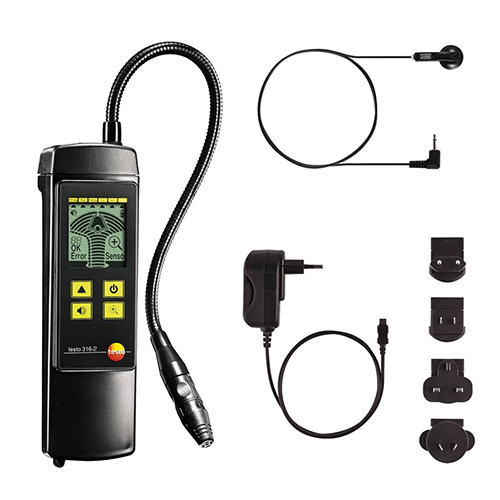
Gas detector CH4 C3H8 H2 Testo 316-2

The Testo 316-2 gas detector is specifically designed for use in work related to the assessment of air quality and emissions, such as in the environmental and oil and gas sectors. This device is equipped with flexible sensors, allowing measurements in hard-to-reach locations and displaying the maximum level of gas leakage.
This is a gas leak detector that allows monitoring dangerous gas concentrations through audio and visual warnings on the display screen, bringing high convenience and efficiency.
Specifications
Methane (CH₄)
Measuring range: 10 ppm to 4.0 Vol.%
Low response threshold: 10 ppm
First alarm limit: 200 ppm
2nd alarm limit: 10000 ppm
Propane (C₃H₈)
Measuring range: 10 ppm to 1.9 Vol.%
Resolution: 10 ppm
Alarm limit 1: 100 ppm
Alarm limit 2: 5000 ppm
Testo 316-EX gas leak detector

The Testo 316-EX gas leak detector is designed with sturdy materials, and has the ability to continuously measure, helping users track and monitor the gas situation in real time.
In particular, Testo 316-EX has high sensitivity to the ppm level, allowing the detection of flammable and explosive gases accurately and reliably. This ensures maximum safety when using this device.
Specifications:
CH4 measuring range: 0 ppm ~ 2 Vol.% CH4
C3H8 measuring range: 0 ~ 1.0 Vol.% C3H8
H2 leakage measuring range: 1 ppm ~ 2.0 Vol.% H2
IP protection level: IP54
Battery: 2 AA batteries, 10 hour battery life
Reaction time: 14 seconds
Dimensions: 135 x 45 x 25 mm
Weight: 200 g
Included accessories: testo 316-EX main unit, battery, carrying case




