That's also why weight-type pressure gauges are still widely used in many laboratories and calibration centers, even though electronic devices have advanced significantly.
Recently, Fluke further expanded its high-pressure gauge line with the P3100 HP series, a line of ultra-high pressure hydraulic gauges developed for calibration applications up to 60,000 psi.
This series currently includes three models:
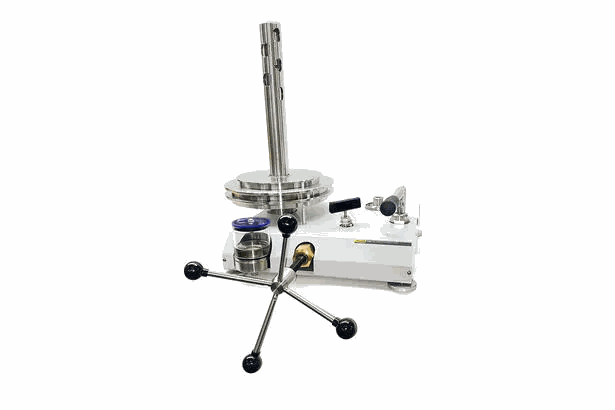
The P3100 HP Series is developed for very high pressure applications
Unlike many conventional pressure calibration systems, the P3100 HP Series is geared towards applications requiring testing and calibration at extremely high pressure levels.
The three models in the series currently have the following pressure ranges:
- P3117: up to 30,000 psi or 2000 bar
- P3118: up to 40,000 psi or 2600 bar
- P3119: up to 60,000 psi or 4000 bar
These pressure levels are commonly found in:
- Industrial hydraulic systems
- Oil and gas equipment
- High-pressure valves
- Pressure transmitters
- Pressure switches
- Specialized pressure sensors
In environments requiring periodic calibration or clear traceability, weight-type pressure calibration devices remain highly valued due to their long-term stability and ability to generate precise pressure based on mechanical principles.
The device operates on the principle of pressure-balancing pistons
The P3100 HP Series utilizes the piston gauge principle, meaning the pressure generated within the system balances the known load acting on a piston with a predetermined effective area.
Simply put, the system generates a standard pressure level by combining:
- a high-precision piston and cylinder assembly
- a set of standard weights
- a hydraulic pressure generation system
Thanks to this mechanism, users can create a stable reference pressure level to test pressure measuring equipment requiring calibration. This design is still preferred by many laboratories due to its high mechanical stability and minimal susceptibility to electronic errors over time.
Fluke places a strong emphasis on real-world operational experience
Beyond its specifications, the P3100 HP Series demonstrates Fluke's strong focus on practical usability during daily operation.
Equipment used:
- 4-arm rotary shaft pressure generating system
- Lever-operated priming pump
- Overpressure safety valve
- Front oil level indicator
- Integrated oil collection tray for easier cleaning after use
The entire system is housed in a robust protective casing made of reinforced composite material. The machine also features adjustable leveling feet and a spirit level for precise balance adjustment before operation.
Another useful feature is the piston's mid-float indicator, which helps users determine the appropriate "mid-float" state for increased accuracy during measurements. These details may seem minor, but the practical experience is significantly different when operating at very high pressures continuously for extended periods.
The system generates very high pressure without the need for a booster
A notable feature of the P3100 HP Series is its ability to generate the entire working pressure range without the need for a separate booster.
This design helps to:
- reduce the number of components in the system
- simplify operation
- minimize the occurrence of errors
- increase stability during long-term operation
In addition, the four-handle rotary mechanism also makes pressure generation smoother and reduces the feeling of heaviness when operating at high pressure.
The piston and cylinder assembly is designed for long-term stability
The most crucial part of a weight-type pressure calibration device is almost always the piston and cylinder assembly.
On the P3100 HP Series, the piston is made from high-quality tungsten carbide to increase long-term stability, reduce pressure-induced deformation, and minimize the effects of ambient temperature changes.
The cylinder also uses tungsten carbide material with a structure suitable for very high-pressure environments.
This part directly affects: accuracy, repeatability of measurement results, and stability over long periods of use. Therefore, many high-end pressure calibration devices invest heavily in piston and cylinder materials instead of just focusing on increasing the operating pressure range.
Accuracy up to 0.02% of the measured value
The P3100 HP Series has a standard measurement uncertainty of ±0.02% of the measured value or ±0.001% of the entire measurement range, whichever is greater.
Notably, this level of accuracy is achieved without the use of pressure correction factors under standard environmental conditions.
Additionally, Fluke offers an option to enhance accuracy to ±0.015% of the measured value when using the PressCal software to apply the necessary correction factors.
In very high-pressure applications, small inaccuracies can sometimes significantly impact the reproducibility of calibrations or evaluation requirements in the calibration lab. Fluke supports localized gravitational acceleration correction. A unique feature of the P3100 HP Series is that Fluke supports correction to the actual gravitational acceleration at the application location at no extra cost.
In weight-type pressure calibration devices, small differences in gravitational acceleration between geographical areas can also affect calibration results if very high accuracy is required.
If the user does not provide a local gravitational acceleration value, the device will be calibrated to the standard value: 980.665 cm/s². This is a point that many beginners often overlook, but it is crucial in high-precision pressure calibration systems.
The set of weights and accompanying accessories is designed with considerable detail
The P3100 HP Series uses non-magnetic steel weights for increased stability and long-term corrosion resistance.
Each weight is marked with:
- device serial number
- corresponding nominal pressure value
Users can select the pressure unit as:
- psi
- bar
- MPa
Additionally, Fluke also offers:
- Unit conversion weight set
- Pressure gauge division weight set
- PressCal software
- P5516-400M high-pressure comparator pump
The P3100 HP Series is geared towards pressure calibration systems
With a pressure range up to 4000 bar, very high accuracy, and a design focused on long-term stability, the P3100 HP Series is suitable for:
- Pressure calibration laboratories
- Testing centers
- Oil and gas industry
- Industrial hydraulics
- Energy
- High-pressure sensor manufacturing
This is not a device for general pressure measurement needs, but rather geared towards systems requiring accurate calibration and stable operation over long periods. Fluke's continued expansion of its ultra-high pressure calibration device line also demonstrates the strong growth in demand for precise pressure calibration in heavy industry in recent years.