For decades, steel strapping combined with steel strapping tools has been the standard solution for securing heavy loads, ceramic tile pallets, sawn timber, and metal coils. However, advances in high-strength polymer materials (Polyester – PET), together with a new generation of high-tension battery-powered plastic strapping machine, are transforming the packaging cost structure in industrial facilities.
Switching from steel strapping to PET plastic strapping is not simply a matter of changing consumables. It involves a fundamental change in load-retention mechanisms, end-of-line packaging procedures, and occupational safety. The following technical analysis helps production and procurement departments determine the appropriate application boundaries for these two solutions.
Load Retention Mechanisms: Steel's Static Rigidity vs. PET's Elastic Memory
A common mistake when evaluating packaging materials is to focus solely on their static tensile breaking strength as stated in technical specifications. Steel strapping has high tensile strength but almost no elongation (only approximately 1%–2%). When palletized loads are subjected to vibrations during truck transportation, sudden braking forces, or gradual volume shrinkage over time (such as freshly cut timber drying or carton boxes becoming compressed at the corners when stacked), steel strapping cannot contract to accommodate the new dimensions of the package. As a result, the strap becomes loose, loses its holding force, and allows the load to shift.
In contrast, PET plastic strapping features elastic memory and an impact absorption capacity approximately 4–5 times greater than that of steel strapping. When tensioned using a dedicated plastic strapping tool, PET strapping elongates within its elastic limit (approximately 10%–15%) and generates a continuous restoring force directed toward the center of the package. If the load tends to shrink or settle during storage, the PET strap immediately contracts to maintain a tight fit, preventing load movement without requiring retensioning.
Technical Specifications and Operating Cost Comparison: Steel vs. PET Plastic Strapping
To evaluate the practical benefits of switching from conventional steel strapping systems to high-strength plastic strapping tools, the following table summarizes the mechanical properties and operating characteristics of both solutions for medium- to heavy-duty loads:
| Specifications / Criteria | Steel Strapping & Steel Strapping Tools | PET Plastic Strapping & Battery-Powered Strapping Tools |
|---|---|---|
| Impact absorption capacity | Low (1%–2% elongation); prone to sudden breakage under localized shock or when packages are dropped. | High (10%–15% elongation); effectively distributes impact forces and maintains tension as the load shrinks. |
| Joint locking mechanism | Uses metal seals (strapping buckles) or direct notched crimping on the steel strap. | Direct vibration friction welding, achieving joint strength of 75%–85% of the original strap strength, without requiring metal seals. |
| Corrosion resistance and cargo protection | Prone to rust in humid environments or during long-term storage, potentially staining carton boxes, wood, and paper surfaces. | Resistant to water, chemicals, and UV radiation; does not rust or scratch package edges. |
| Occupational safety | Sharp edges can cut hands; dangerous recoil (whiplash) during strap cutting when unpacking can cause serious injuries. | Smooth, safer edges with no hazardous recoil during strapping or removal. |
| Material cost and weight | Higher cost per meter; heavy coils (25–50 kg per coil) are difficult to move around warehouses. | Saves 25%–35% in material costs per meter of strapping; weighs up to six times less than steel strapping. |
| Packaging operation speed | Slow when using manual tensioners and crimping tools (three separate operations). | Three-in-one operation (tensioning – welding – cutting) with battery-powered tools, completing one strapping joint in just 3–4 seconds. |
| Optimal application range | Steel strapping should be retained when: • Packaging hot steel billets or metal pipes with surface temperatures above 80°C. • Securing goods with extremely sharp edges (steel plates, structural steel sections) without protective corner guards. | PET strapping is recommended when: • Securing heavy cartons, wooden crates, ceramic and roof tile packages, ceramics, plywood, and fiber bales. • Securing goods on export pallets transported by sea or stored in cold storage facilities. |
Equipment Requirements for Replacing Steel Strapping Without Compromising Load Retention
To achieve an equivalent replacement for 16 mm–19 mm steel strapping, the packaging system must simultaneously meet the following two technical requirements:
First, use virgin PET strapping with a thickness of 0.8–1.27 mm and a width of 16 mm or 19 mm. Recycled PET strapping containing excessive impurities may exhibit inconsistent elongation and is more likely to delaminate at the welded joint under high tensile loads.
Second, the equipment must use a high-frequency vibration friction welding mechanism with a minimum tensioning force of 2,500 N. In practical warehouse operations and end-of-line packaging, battery-powered handheld plastic strapping tools such as the SIGNODE BXT3-16 (maximum tensioning force of 2,500 N for 13–16 mm straps) or the SIGNODE BXT3-19 (maximum tensioning force of 4,500 N for 16–19 mm straps) are standard configurations for directly replacing conventional steel strapping tool sets.
Thanks to their brushless motors and high-capacity Li-ion batteries, these tools maintain consistent tensioning force from the first strapping joint to the last, without depending on the operator's physical strength.
Technical Considerations When Switching from Steel to PET Strapping
When implementing this change on an existing production line, the engineering department needs to readjust the corner protection arrangement for packaged loads. Although PET strapping does not deform carton boxes as easily as steel strapping, applying a tensioning force of 3,500–4,500 N directly to the edges of five-ply or seven-ply cardboard boxes can still cause the strap to cut deeply into the box walls. This reduces the package circumference and causes the strap to become loose. The recommended solution is to install V-shaped paper corner protectors at the points where the straps pass over the package, thereby distributing contact pressure more evenly.
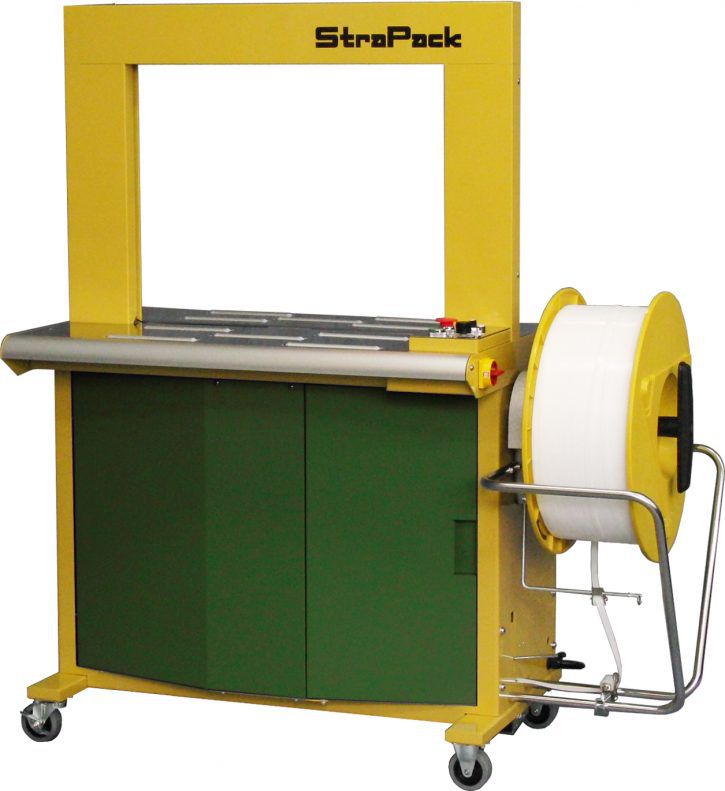
In addition, for high-speed carton packaging lines that do not require high tensioning forces (below 700 N), businesses do not need to invest in high-power battery-operated tools. Instead, they can optimize their packaging systems using the Strapack SQ-800 or automatic strapping systems integrated with conveyors to fully automate strap feeding, cutting, and welding operations.
For consultation on calculating equivalent tensioning forces between steel and PET strapping, as well as hands-on experience with genuine battery-powered, semi-automatic, and automatic strapping machines from Signode, Strapack, Orgapack, and Cyklop, please contact the engineering team at EMIN Vietnam.