
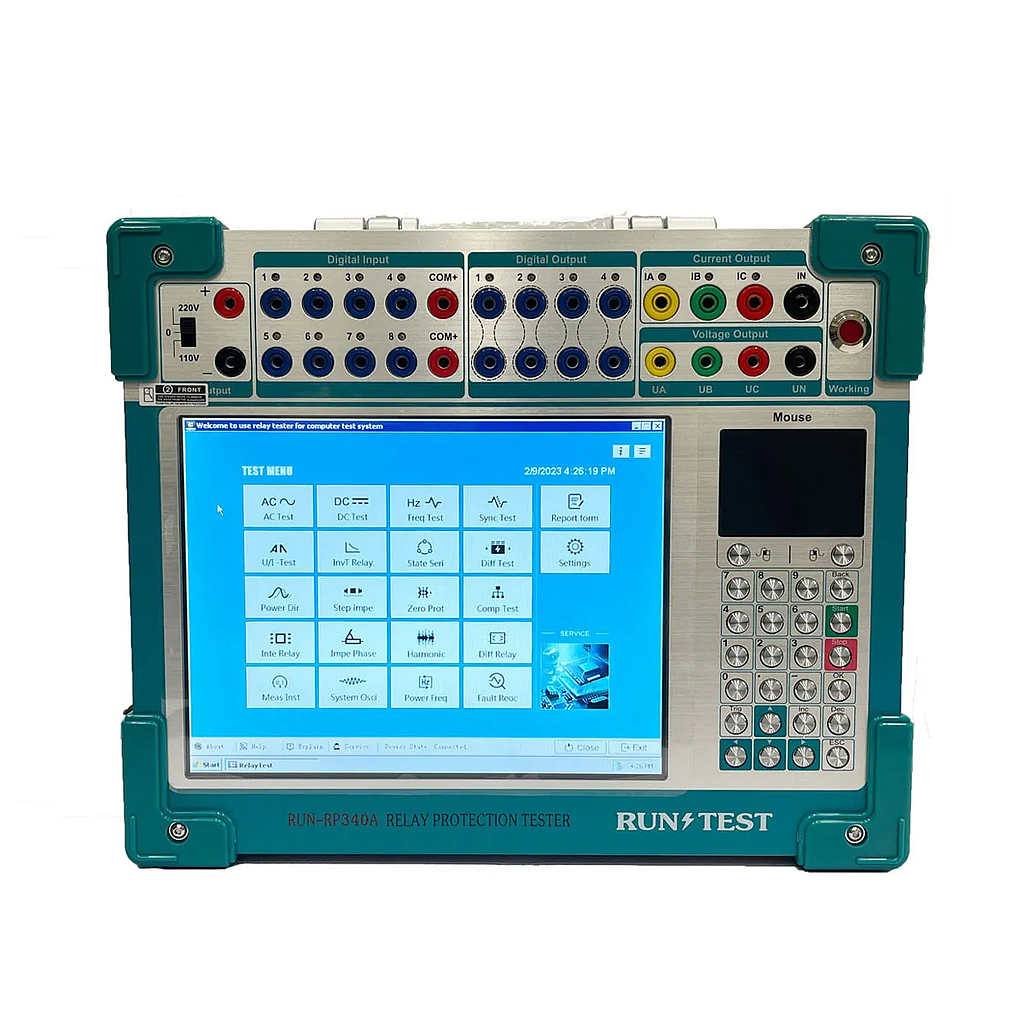
Run Test RUN-RP340A Secondary Injection 3 Phase 40A Microcomputer Protection Relay Tester (40A)
AC current Output
Single phase current output (RMS): 0 -- 40A / phase, accuracy: 0.2% ± 5mA
Three current in parallel output (RMS): 0 -- 120A / three phase in phase parallel output
Duty Cycle: 10A
Maximum output power per phase: 400VA
Maximum output power of three phase parallel current: 1000VA
Max. allowable output working time of triple parallel current: 10s
Frequency Range: 0 -- 1000Hz, accuracy: 0.01Hz
Harmonic number: 2—20 times
Phase: 0—360°, Accuracy: 0.1°
DC current Output
DC current output: 0--±10A / phase, accuracy: 0.2% ± 5mA
AC voltage output
Single phase voltage output (RMS): 0 -- ±125V / phase, accuracy: 0.2% ± 5mV
Line voltage output (RMS): 0--250V
Phase voltage / line voltage output power: 75VA / 100VA
Frequency range: 0 -- 1000Hz, accuracy: 0.001Hz
Harmonic wave: 2—20 times
Phase: 0—360°, Accuracy: 0.1°
DC voltage output
Single phase voltage output amplitude: 0--±150V, accuracy: 0.2% ± 5mV
Output amplitude of line voltage: 0--±300V
Phase voltage / line voltage output power: 90VA / 180VA
Numbers of Switch & Measuring time range
Switch input terminal: 8 channels
Air contact: 1 – 20 mA, 24 V, internal active output of the device
Potential reversal:
Passive contact: low resistance short circuit signal
Active contact: 0–250V DC
Switch output terminal: 4 pairs, no contact, breaking capacity: 110V / 2A, 220V / 1A
Others
Time frame: 1ms -- 9999s, measuring accuracy: 1ms
Dimension: 338 × 168 × 305 mm
Power Supply: AC220V±10%, 50Hz, 10A
Secondary Injection Test Program: Secondary Current Injector Microcomputer 3 Phase Relay Protection Tester
The relay protection tester can test a variety of single relays such as AC and DC, current, voltage, intermediate, self-holding, signal, etc. and the entire group of relay protection screens, and can test the pull-in voltage (current) value and release voltage (current) value of various relays. This Tester is in our Secondary Injection Test Program.
Microcomputer relay protection test device is an important test tool to ensure the safe and reliable operation of power system.
Most experiments can be carried out, and it has more powerful operation functions when connected to a computer. Small size and high precision.
Features of Relay & Protection Microcomputer Test Set
1. 4 phase voltage and 3 phase current output. It can test not only various traditional relays and protection devices, but also various modern microcomputer protections, especially for transformer differential protection and standby automatic switching device. The test is more convenient and perfect.
2. Classic Windows system operation interface, friendly man-machine interface, easy and fast operation; high performance embedded industrial control computer and 8.4-inch resolution 800 × 600 TFT true color display screen, can provide rich and intuitive information, including the current working state of the equipment and various help information.
3. Self-recovery function to avoid system crash caused by illegal shutdown or mis operation.
4. Equipped with ultra-thin industrial keyboard and photoelectric mouse, it can complete all kinds of operations through keyboard or mouse just like PC.
5. The main control board adopts DSP + FPGA structure and 16 bit DAC output. It can generate 2000 high density sine wave per cycle for fundamental wave, which greatly improves the quality of waveform and the accuracy of the tester.
6. The high-fidelity linear power amplifier ensures the accuracy of small current and the stability of large current.
7. USB interface is used to communicate with PC directly without any connecting line.
8. It has the function of GPS synchronization test. The device can be built-in GPS synchronous card (optional) and connected with PC through RS232 port to realize synchronous test of two testers in different places.
9. Equipped with independent dedicated DC auxiliary voltage source output, the output voltage is 110V (1A), 220V (0.6A). It can be used for relays or protection devices that need DC power supply.
10. It has the function of software self-calibration, which avoids opening the case to calibrate the accuracy by adjusting the potentiometer, thus greatly improving the stability of accuracy.
인증된 전문가에게 직접 연결