Initially, using glue, heat pressing, or other technological processes worked quite well because the products weren't large. One person could handle many sections without clearly defined boundaries. But as the quantity steadily increased each day, things that were previously small started to take significantly more time.
Some days were inconsistent. Batches had to be reworked because the surface wasn't perfect. A few slightly uneven details were enough to make the product look less uniform than before. Not to mention, if done continuously for a long time, the quality between batches sometimes started to vary quite noticeably.
From that point onwards, ultrasonic welding machines began to appear more frequently in discussions between workshops and technical departments.
However, for many, this equipment still felt somewhat distant. Many workshops thought that ultrasonic welding was only suitable for large factories or high-scale production lines. Meanwhile, in recent years, many more compact models have appeared increasingly in plastic, accessories, electronics, or packaging workshops.
As the numbers increase, the old ways of doing things often start to slow down, is that true?
When production was low, manual processes didn't make a huge difference. Some manual tasks were relatively quick because the operators were used to them.
But as products started coming out continuously every day, things gradually changed, becoming more difficult to control. Some processes required waiting for the adhesive to stabilize. Sometimes the product needed to be re-pressed because the surface wasn't even. Minor errors that were rare before now occurred more frequently.
Especially in products requiring high uniformity, even slight variations in pressure or processing time between operations can result in noticeably different finished products.
Many factories only begin to pay more attention to maintaining consistent quality during continuous production at this stage, instead of just focusing on meeting deadlines.
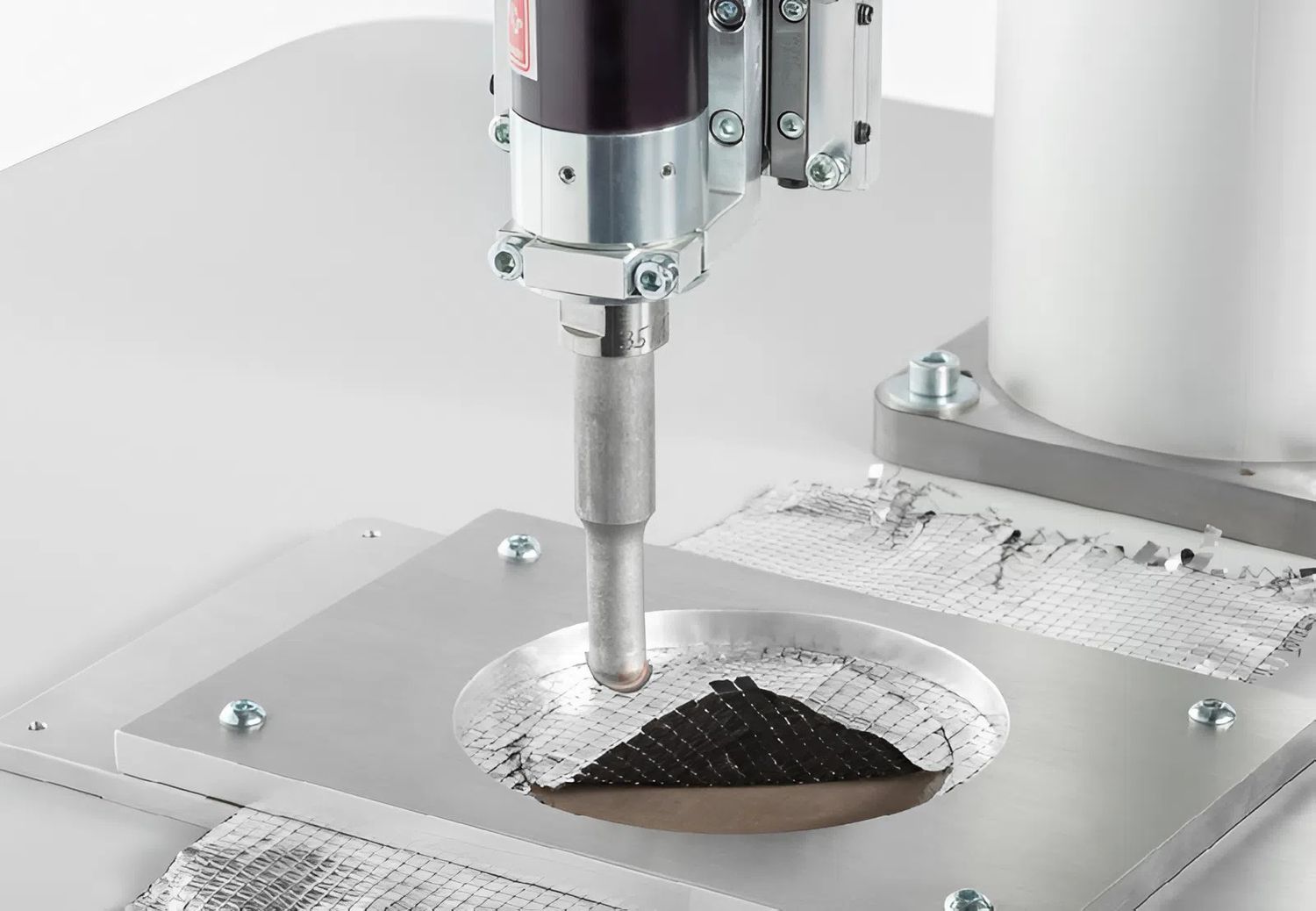
Ultrasonic welding machines have attracted attention because they produce significantly neater welds
Compared to traditional bonding or heat pressing methods, ultrasonic welding typically creates a bond quite quickly at the contact point between materials. The resulting surface is also cleaner, so many products require almost no further processing.
This is more noticeable in small plastic parts or products requiring relatively high aesthetic standards. As production increases, eliminating a subsequent processing step can sometimes save more time than initially anticipated.
Some factories, after switching to ultrasonic welding, have noticed a significant improvement in product uniformity. The welds are more stable, with less misalignment between batches, and there's less reliance on the skill of the workers in each small step of the process.
This difference is often much more apparent with long-term, continuous orders compared to smaller production runs.
What makes many workshops hesitate the most is still the initial investment
Despite considerable interest, not every workshop decides to invest in specialized equipment right from the start.
For smaller workshops, purchasing new equipment always requires careful consideration. Many aren't overly concerned about whether the machines will work, but rather whether their current production capacity is sufficient to fully utilize the machines' capabilities.
Some are still running many different small-scale projects and don't yet need extremely high processing speeds. Others constantly change their designs, making investing in specialized equipment feel premature.
Besides the cost of the machine, many people also consider:
- the time needed to get used to operation
- suitability for the current product
- the cost of changing molds or welding heads
- the possibility of expansion if orders increase later
These are all very normal concerns, especially for factories that are gradually developing rather than operating on a fixed production line.
Read more: How does ultrasonic frequency affect welding quality?
Some workshops have noticed a significant improvement in product stability even after only a short period of use
The most noticeable difference is often not the speed, but the uniformity of the products.
When the quantity increases, maintaining consistent connections between hundreds or thousands of products becomes difficult if it relies too heavily on manual manipulation. Even slight variations in pressure or processing time can sometimes result in noticeably different finished products.
Once the machine is properly calibrated, vibrations and forces are generally much more stable than with purely manual operation. As a result, products from batches are more consistent and require less rework.
In some small plastics or accessories factories, time savings aren't always the most important consideration. Instead, they prioritize reducing errors and maintaining consistent quality during long-term, continuous production.
Not every factory that invests early will see a significant difference
However, there are still quite a few cases where early investment isn't necessary.
If the product changes frequently, the quantity of each model isn't large, or the current processing method is still stable, then ultrasonic welding may not create a significant gap compared to the old method.
Some workshops are still better suited to traditional methods because their scale isn't large enough to see a clear difference in time or stability between the two options.
Therefore, many people don't view ultrasonic welding machines as simply "better to have one," but rather as a suitable upgrade when the old methods become more time-consuming and harder to maintain consistent quality.
Many small workshops now no longer consider ultrasonic welding to be an unattainable piece of equipment
Previously, many people thought ultrasonic welding machines were only found in large factories or high-scale production lines. However, in recent years, more compact models have become increasingly common in small and medium-sized workshops.
As products require higher quality finishes, production volume increases, or customers demand greater consistency, many workshops are paying more attention to equipment that helps maintain consistent quality over the long term.
Therefore, investing in an ultrasonic welding machine doesn't always depend on the size of the workshop. More importantly, it's about when the old processing methods are no longer suitable.