Differences in measurement scope and utility
The 150mm version is suitable for small details, components, or general daily measurement tasks. Thanks to its compact and lightweight design, it's easy to carry and convenient for quick checks in the workshop or on-site.
In contrast, the 200mm measuring tape expands the measuring range to include larger details such as shafts, molds, or surfaces exceeding the limits of the 150mm version. However, the longer body requires a bit more comfortable working space.
Stability when measured over a wide range
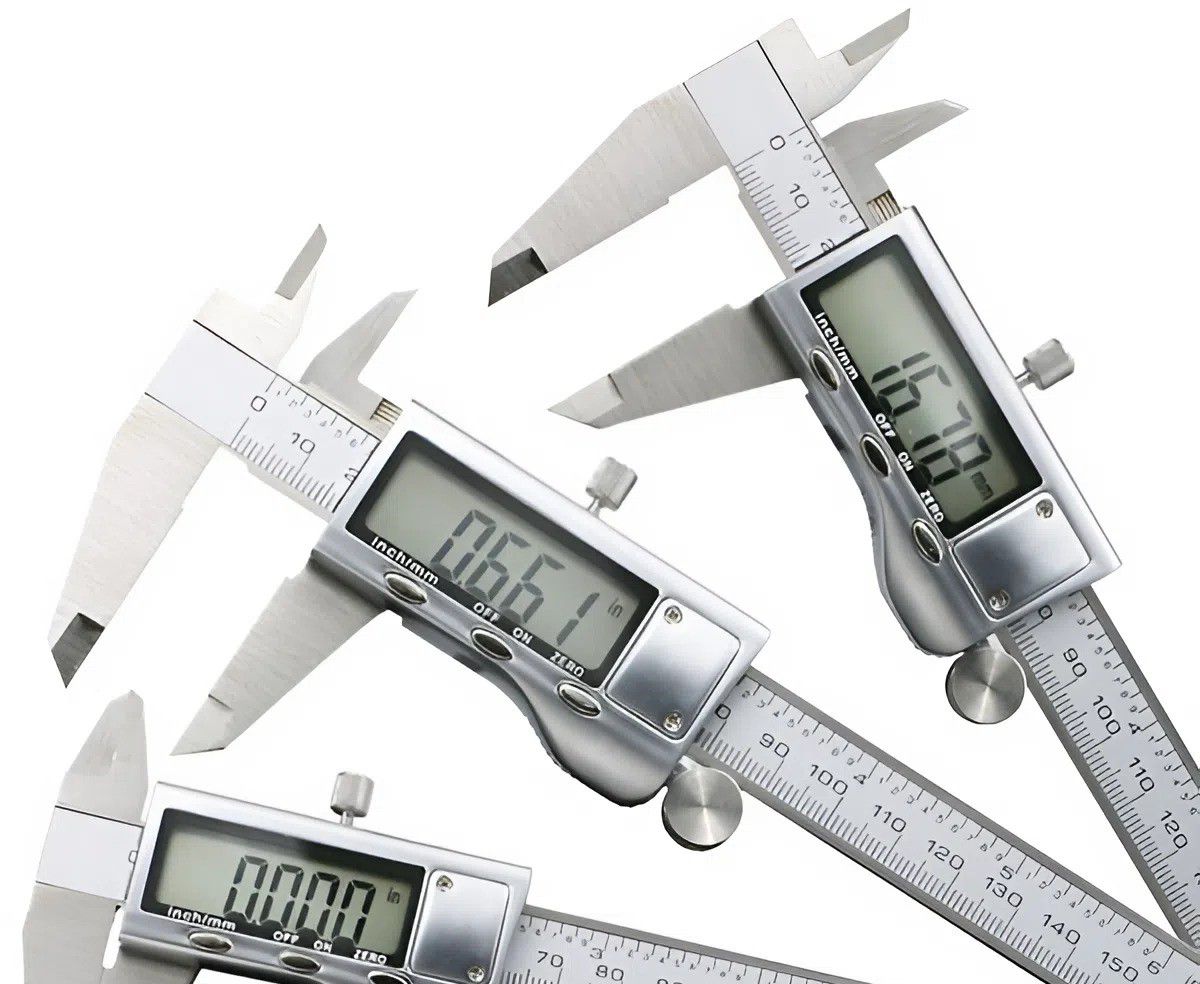
Basically, the accuracy difference between the two types is not significant if they come from reputable manufacturers. However, when measuring over a large range (nearly 150–200mm), the 200mm ruler usually feels more solid and stable, minimizing errors during operation.
If working in environments with a lot of oil, grease, dust, or coolant, it is advisable to prioritize rulers that are waterproof and dustproof to ensure long-term durability.
Additionally, depending on your usage habits, you can choose:
- Electronic ruler: Easy to read, fast, suitable for repeated measurements.
- Mechanical ruler: Battery-free, durable, suitable for harsh environments.
Check out some popular models.
150mm Calipers: You can consider models such as the Mitutoyo 530-312 (mechanical) or the Mitutoyo 500-196-30 (electronic). These are popular, easy-to-use models suitable for everyday measurement needs and are currently available at EMIN.
200mm Calipers: For a larger measuring range, you can consider the Mitutoyo 530-114 (mechanical) or the Insize 1108-200. These models are well-suited for working with larger parts and are also available at EMIN.
Balancing needs and costs
Generally, a 200mm measuring tape is more expensive than a 150mm version, but this difference isn't significant in the long run. For tasks primarily involving small and medium-sized details, the 150mm version is still sufficient, allowing for quick and easy operation and optimizing initial investment costs.
Conversely, if you frequently encounter larger details, choosing a 200mm measuring tape will give you more control during work. You won't need to switch tools mid-way or encounter measurement limitations, thus making the work smoother and saving time.
In summary, no single type is superior in every case; what matters is suitability to your needs. The 150mm version is compact and suitable for general daily tasks. The 200mm version is more suitable for measuring larger details.
If you're unsure which type to choose, you can base your decision on your specific work requirements or consult EMIN for more information to find a reasonable solution that balances efficiency and cost.