You may not know the general structure of a circuit breaker
Circuit breakers have many names and functions that have been improved over time. However, their basic structure remains the same, consisting of two or three contacts. When the circuit is closed, the contacts operate in this order: arcing contact, auxiliary contact, and finally main contact. Conversely, when the circuit is interrupted, the order of operation is reversed, from the main contact to the auxiliary contact and finally to the arcing contact.
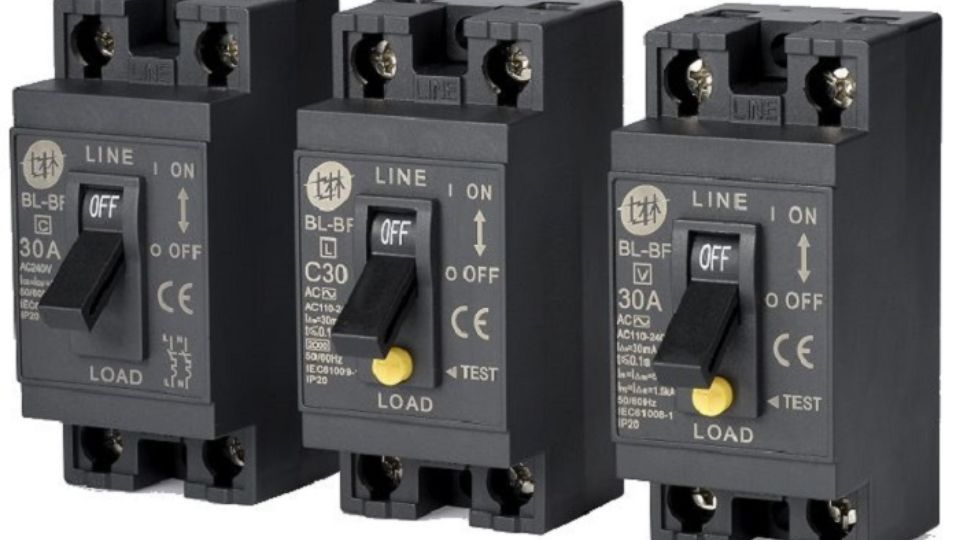
This design helps protect the entire electrical system, minimizing the effects of arcing by limiting it to one contact, keeping the remaining contacts safe. With the three-contact circuit breaker, the arcing contact and auxiliary contact also play the role of isolating the main contact, ensuring optimal protection for the system.
Detailed structure of MCCB
MCCB (molded block circuit breaker) is designed to handle high temperature and overcurrent situations, ensuring electrical system safety. When the temperature changes, the bimetallic contact in the MCCB will expand or contract. Under normal conditions, the contact allows current to flow, but when overloaded, the link will heat up and automatically cut off the circuit to protect the system.
MCCB includes the following main components:
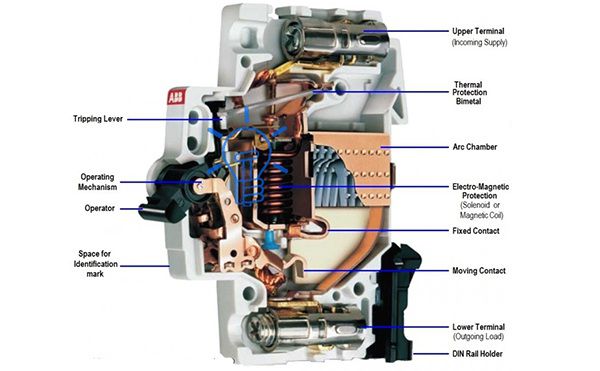
- Frame: The outer shell of the MCCB, made from glass Polyester, has good electrical insulation and protects the internal contacts.
- How to operate: Used to turn the device on/off and keep the handle in the correct position. When the MCCB encounters an error, the automatic operation will be interrupted and needs to be performed manually.
- Circuit breaker: Important part that helps disconnect MCCB in case of short circuit or overload.
- Handle: Allows technicians to manually turn on/off MCCB, especially useful when equipment maintenance is needed.
- Terminal: The point where the wires connect, where the wires need to be tightened to ensure good contact.
- Arc extinguisher: When the contact is disconnected, an electric arc will appear, and the arc extinguisher helps split the arc to reduce the risk of damage.
Detailed structure of MCB
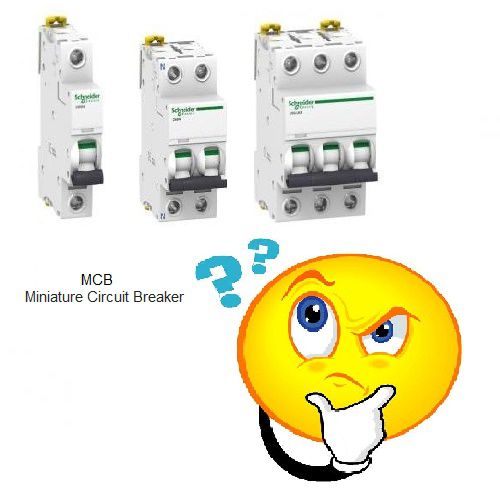
MCB (circuit breaker) is designed with 5 main parts: contacts, switching actuator, protective hook, arc extinguisher and shell. In addition, MCBs are classified into circuit breakers such as MCBs 1P, 2P, 3P, and 4P, suitable for many different applications.
- Contacts: MCB includes three main contacts: main contact, auxiliary contact and arc contact. In some cases, the two-level contact type MCB only includes main and arc contacts.
- Closing and cutting transmission mechanism: Can be operated manually or electromechanically. Manual switching is suitable for small currents, while electromechanical is used when currents are larger.
- Protection hooks: Includes two main types: electronic hooks and thermal relay hooks, which help protect the device against overload and short circuit.
- Optical stamping pool: There are two main types: semi-closed and open. The semi-closed type is usually placed in an MCB housing and has a vent hole, while the open type is used for voltages around 100V.
- Shell: High quality insulating plastic shell, both protecting the internal components and ensuring user safety.
Difference between MCB and MCCB
| Thiết bị | MCB (Miniature Circuit Breaker) | MCCB (Molded Case Circuit Breaker) | |
| Tên gọi | Bộ ngắt mạch thu nhỏ | Bộ ngắt mạch vỏ đúc | |
| Phiên bản | Đơn, 2 cực, 3 cực | Đơn, 2 cực, 4 cực | |
| Khả năng ngắt dòng | Tối đa 1800 amps | 10k – 200k amps | |
| Dòng định mức | Lên đến 100 amps | 10 – 200 amps | |
| Cơ chế mạnh ngắt | Cố định 1 vị trí | Có khả năng di chuyển | |
| Khả năng điều khiển từ xa | Không hỗ trợ | Có hỗ trợ qua dây sunt | |
| Ứng dụng | Mạch điện dân dụng, dòng thấp | Mạch điện công nghiệp, dòng nặng | |
| Chức năng bảo vệ | Bảo vệ quá dòng | Bảo vệ quá dòng, ngắn mạch, nhiệt độ cao |