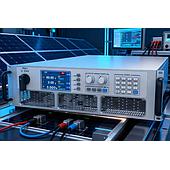
Electronic loads for EV and energy storage testing simulate controlled electrical demand, allowing engineers to evaluate batteries, charging equipment, power electronics, and storage systems before deployment. They draw a defined current or power from a source instead of supplying power to it.
In EV and energy-storage work, this controlled demand helps reproduce steady operation, changing load conditions, and selected fault scenarios. The resulting tests can help teams assess system response, thermal behavior, efficiency, and protective functions in a repeatable setting.
Summary: Electronic loads can operate in CC, CV, CR, and CP modes. They are used to test EV batteries, BMSs, onboard and fast chargers, plus battery energy storage systems. Programmable load profiles help reproduce changing operating demand.
What is an electronic load in EV and energy storage testing?
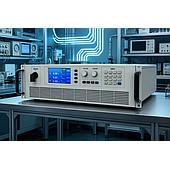
An electronic load is a programmable device that draws controlled current or power from a power source to simulate electrical demand. Unlike a passive resistor load, it can be set to operate in constant current (CC), constant voltage (CV), constant resistance (CR), or constant power (CP) modes.
This flexibility is useful when a test needs to represent more than one operating state. For example, an EV battery may encounter changing demand during acceleration, regenerative braking, and idle periods, while an energy storage system may respond to varying grid demand.
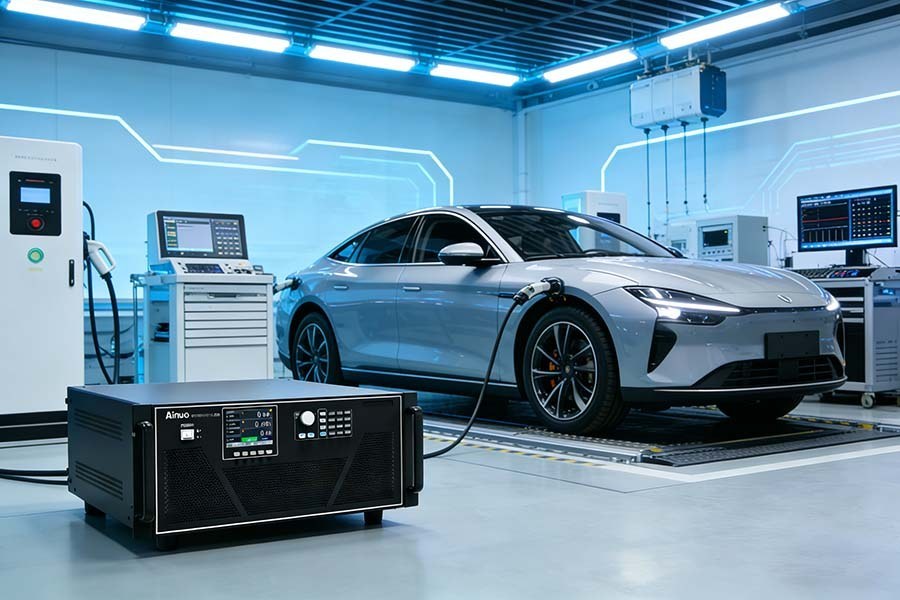
Which EV components can electronic loads help test?
Electronic loads can help test EV battery packs, battery management systems (BMSs), onboard chargers (OBCs), and charging-system power electronics. They create controlled, repeatable conditions so engineers can observe how each component responds.
| EV component | How an electronic load is used | What the test can examine |
|---|---|---|
| Battery pack | Simulates controlled discharge cycles and changing load profiles | Capacity, efficiency, and thermal behavior |
| Battery management system | Applies precise, repeatable conditions | Response to overcurrent, overvoltage, and temperature changes |
| Onboard charger | Simulates the battery during charger operation | Efficiency, stability, and response to different input conditions |
| Fast-charging equipment | Replicates changing battery voltage and current behavior | Behavior during partial charging, rapid charging, and interruptions |
Why are electronic loads used for EV battery and BMS validation?
Electronic loads enable controlled discharge testing that can represent different driving patterns, including city traffic, highway cruising, and stop-and-go operation. Varying the load profile gives engineers a way to evaluate battery behavior across a range of conditions rather than at one fixed demand.
For BMS validation, the same repeatability helps verify whether the system reacts as expected when conditions approach or cross specified limits. The source examples include overcurrent, overvoltage, and temperature fluctuations.
Note: An electronic load simulates the demand placed on a battery or power source. Test results depend on the selected load profile and the system being evaluated.
How do electronic loads support fast-charger testing?
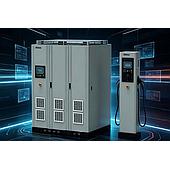
Electronic loads simulate the battery-side demand of an EV charger, including changing voltage and current characteristics during charging. This lets engineers observe charger behavior under partial-charge, rapid-charge, and sudden-interruption scenarios.
They can also be used to evaluate charging-station power conversion components such as rectifiers and DC-DC converters. With controlled load conditions, test teams can measure efficiency, identify losses, and assess stability or heat-related behavior during development.
How are electronic loads used in energy storage system testing?
In battery energy storage systems (BESS), an electronic load can simulate grid demand by drawing power from the storage system in a controlled way. This supports evaluation during peak demand, load fluctuations, and emergency scenarios described in the source material.
Electronic loads can also help assess how storage works with renewable-energy equipment. For a solar inverter and storage arrangement, varying simulated demand can be used to examine energy flow and the interaction between the inverter and the storage system.

What role do electronic loads play in safety and reliability testing?
Electronic loads allow fault-oriented conditions, such as overloads or short circuits, to be simulated in a controlled environment. Engineers can then observe system response and identify where protective measures may be needed before a product reaches the market.
They also support long-duration testing through consistent load profiles over extended periods. Such testing can help reveal component degradation, thermal stress, and efficiency loss that may not appear during a short test.
When is a programmable load profile especially useful?
A programmable load is especially useful when the operating demand changes rapidly or follows a sequence of states. EV applications are a clear example because battery demand can change between acceleration, braking, and idle operation.
Programmable sequences and automated test scripts can reduce manual intervention and support repeated evaluation of multiple systems. This is relevant when test environments need to apply the same conditions consistently across battery, charger, or energy-storage assessments.