
For full functionality of this site it is necessary to enable JavaScript.
EMIN.VN
0

What role does the application hold time play when testing the ignition system's Hipot?

2025년 12월 16일 15시 41분 16초

The Hipot test is a dielectric test used to assess the insulation capacity of equipment. When the test voltage is maintained for a sufficient duration and at a level higher than normal operating conditions, the voltage withstand capability of the ignition system becomes more apparent. This directly affects the safety of the equipment during operation.

The significance of timing application for ignition devices

Components such as ignition coils, spark plugs, or high-voltage units must operate under large, repeated electrical surges. The voltage hold time is the period during which the Hipot device maintains the test voltage on the sample. A sufficiently long period will help detect potential weaknesses in the insulation.
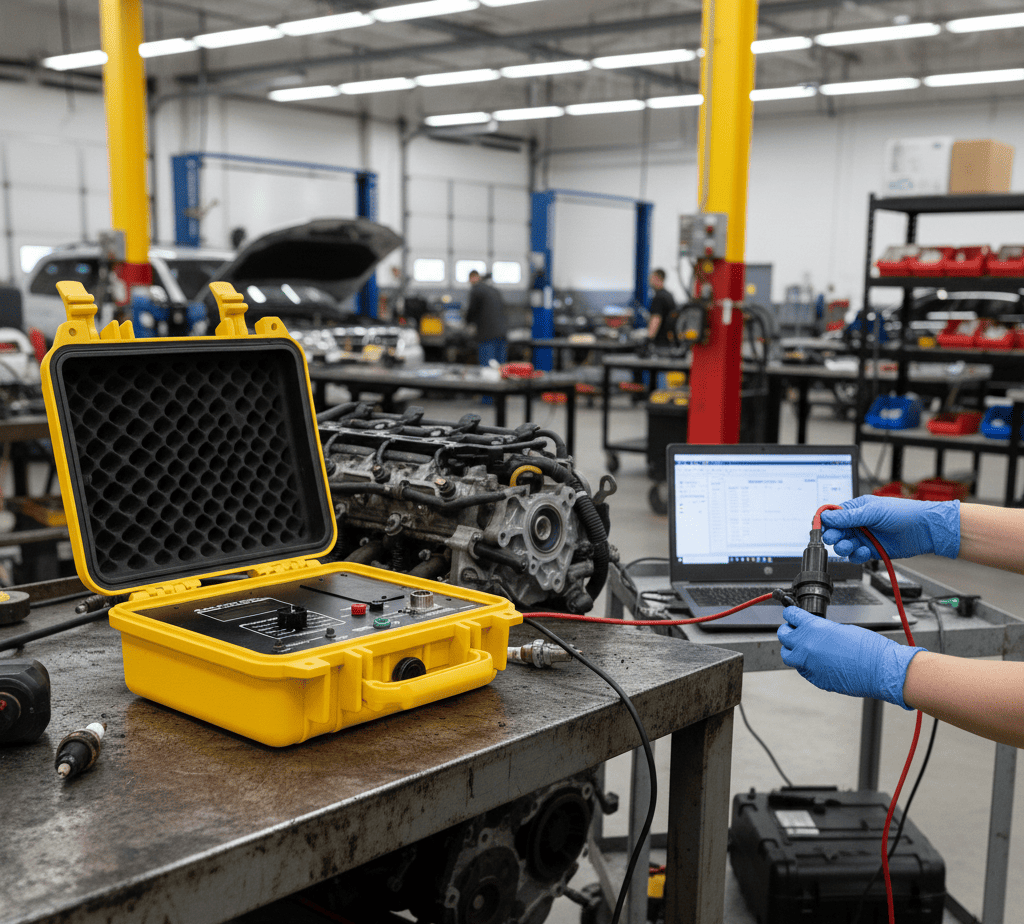
Tiny imperfections such as small cracks, residual air bubbles, or substandard connections are often difficult to detect with the naked eye. When a high voltage is maintained continuously for several seconds, these weaknesses become more apparent, helping to reduce the risk of discharge or short circuits later on.

In the DC Hipot test, a large capacitive current usually appears in the initial power-on phase. If the measurement is ended too early, the results are easily inaccurate because the capacitive current has not yet stabilized. When the voltage is maintained for a sufficient amount of time, the capacitive current gradually decreases, and the leakage current through the insulation layer accurately reflects the state of the component. This forms the basis for evaluating its long-term voltage withstand capability.

In addition, many international and domestic safety standards clearly specify the voltage maintenance time during hipot testing. This requirement aims to ensure that the product meets safety conditions before being put into practical use.

Typical voltage holding time

The voltage holding time depends on the purpose of the test. For routine testing to detect defects arising from mass production, the common holding time is 1-3 seconds. For design evaluation tests, the time can be extended to 60 seconds to fully observe insulation behavior.

For ignition devices, routine tests with short durations of one to three seconds are commonly used to balance testing speed with basic safety requirements.

Ignition testing equipment that assists in controlling the Hipot timing.

To effectively control voltage hold time, ignition testing equipment from experienced manufacturers helps maintain a stable voltage throughout the test. These devices allow for flexible voltage hold time settings, thereby aiding in the detection of insulation faults that only appear when the voltage is maintained for a sufficiently long period.

Some models, such as the AMPTEC RESEARCH 620MC or Valhalla Scientific 4314 AF, meet this requirement well, allowing for in-depth testing of issues such as material cracking, air bubbles, or insulation degradation. Higher-end models like the AMPTEC RESEARCH 641RS even support full automation of the process, from voltage application and holding to measurement and providing pass/fail results, reducing reliance on manual operation.

Investing in appropriate ignition testing equipment helps control the voltage hold time during hipot testing, thereby enhancing product safety from the research phase to mass production. To learn more about hipot testing solutions and specialized ignition testing equipment, please contact EMIN for a detailed discussion.

관련 뉴스

Formula for Converting TOC to COD for Wastewater
2026년 10월 14일 11시 27분 30초

This article addresses various questions in turn, covering whether conversion is permitted, how to establish the K-factor, when the factor ceases to be valid, and which equipment is suitable

Guide to Selecting Case and Sensor Materials for Pressure Gauges in Corrosive Chemical Environments
2026년 10월 13일 11시 14분 57초

In chemical processing plants, wastewater treatment facilities, oil & gas operations, and food production, selecting the wrong material for a pressure gauge often leads to severe consequences: Bourdon tube failure, toxic chemical leaks, equipment breakdown, and serious occupational safety hazards. This article provides practical technical criteria for selecting the correct case and sensor materials when measuring pressure in corrosive environments.

Measuring COD and TOC in Electroplating Wastewater Using a Benchtop Analyzer? What Sources of Error Should Be Avoided?
2026년 10월 13일 10시 55분 11초

The current situation regarding electroplating wastewater analysis presents challenges: the wastewater contains acids, alkalis, and heavy metals (such as Cr, Ni, and Cu), alongside persistent cyclic organic compounds derived from brightening agents, anti-misting additives, and degreasing solvents. This complex composition causes significant fluctuations in COD levels depending on the specific process stage and production shift. Sending samples to external laboratories results in a delay of several days—by which time the biological treatment tanks or coagulation systems may have already been operating improperly for too long. Utilizing a benchtop COD analyzer on-site reduces this turnaround time to just a few hours, provided the user fully understands the specific sources of error associated with electroplating wastewater

How to Rapidly Reduce COD in Domestic Wastewater?
2026년 10월 13일 10시 25분 11초

Wastewater treatment plants serving apartment complexes, buildings, and residential areas sometimes experience effluent COD levels approaching regulatory limits, particularly following sudden load surges or shortly before scheduled compliance sampling. QCVN 14:2025/BTNMT, applicable to domestic wastewater from September 1, 2025, sets COD limits based on discharge volume and the receiving water body, while allowing dischargers to choose between TOC and COD parameters

Challenges of Pressure Gauges in Hydrogen Environments
2026년 10월 12일 16시 47분 15초

The global energy transition trend is driving industrial plants, chemical facilities, and renewable energy sites to integrate hydrogen as a strategic fuel source to achieve decarbonization goals. However, practical experience shows that traditional mechanical pressure gauges rapidly degrade in service life and experience dangerous failures when in direct contact with hydrogen environments.

혜택 소식 받아보기

대량 할인, 도매 가격 업데이트 및 신제품 소식을 이메일로 받아보세요.

구독하면 당사의 서비스 이용약관 및 개인정보 처리방침에 동의하는 것으로 간주됩니다.

빠른 지원

인증된 전문가에게 직접 연결


