Thanks to that precise clearance, the bolts and nuts engage smoothly, avoiding jamming while maintaining the necessary strength of the joint.
This is also why this tolerance range has become the most common standard on industrial machinery, manufacturing equipment, and mass-produced mechanical parts.
What are 6H and 6G thread tolerances?
ISO thread tolerance symbols consist of two parts:
Numbers indicating the tolerance grade.
Letters indicating the tolerance zone location.
Examples:
+ M12×1.75-6H for internal threads.
+ M12×1.75-6g for external threads.
The purpose of this system lies in interchangeability. A bolt manufactured in Vietnam can still fit a nut manufactured in Japan or Europe, provided they both comply with the corresponding tolerance standards.
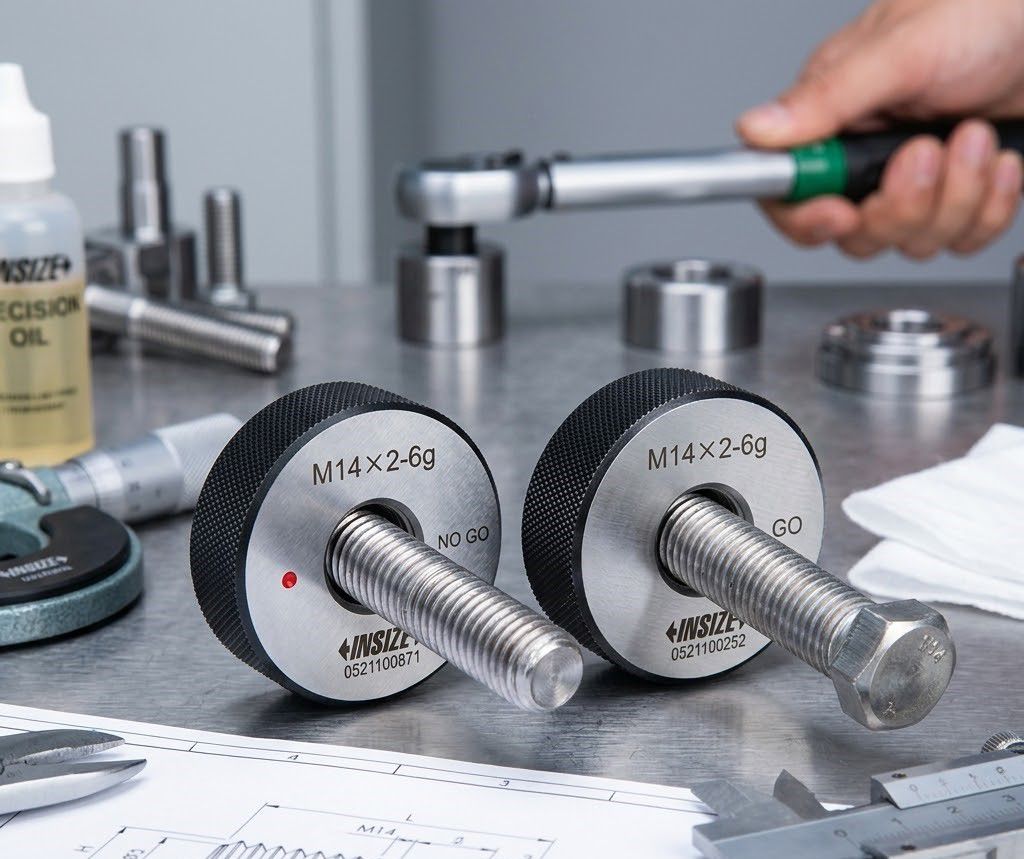
What does the number 6 in the symbols 6H and 6g mean?
The smaller the grade, the narrower the tolerance range, requiring more stringent machining. A larger grade allows for a wider tolerance range.
In the field of mechanical manufacturing, grade 6 is the most common because it creates a good balance between machinability and tightness of the joint. Most standard bolts, nuts, common machine parts, and mechanical components use this tolerance grade.
Therefore, encountering the symbols 6H or 6g on drawings is perfectly normal.
What is the difference between the letters H and g?
The uppercase letter H is used for internal threads, such as those on nuts or taps. The tolerance zone starts at the nominal size and extends inward towards the material.
Conversely, the lowercase letter g is used for external threads, such as on bolts or threaded shafts. The actual size of the external thread will be slightly smaller than the nominal size to create the necessary clearance during assembly.
Thanks to this very small clearance, the parts fit together smoothly without feeling stiff when tightened.
Why is the 6H/6g tolerance pair the most common in mechanical drawings?
Open a standard bolt catalog or view drawings of various machine parts; the 6H/6g designation appears very frequently. This is due to their standard clearance assembly characteristics.
The 6g external thread is machined slightly smaller than the nominal size, while the 6H internal thread maintains its corresponding tolerance range. These two parts form a stable assembly, minimizing thread jamming while maintaining the necessary robustness.
Therefore, the 6H/6g tolerance pair has almost become the default standard on most industrial machinery and mass-produced mechanical products.
How to read the M12×1.75-6g symbol on a drawing.
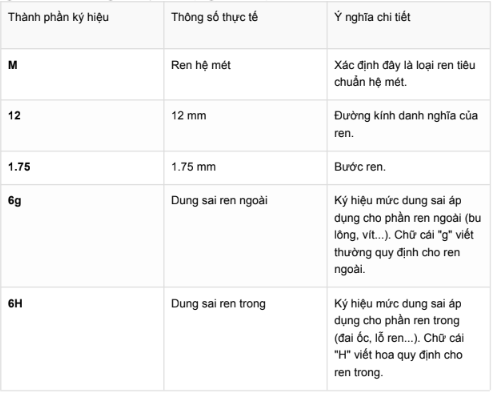
Even with the same M12 diameter, the thread pitch can still differ. M12×1.75 and M12×1.5 are not interchangeable. This is analyzed in more detail in the article How Do Coarse and Fine Threads Differently? Which Type Is Right for You?
How are 6H and 6g tolerances related to thread gauges?
After machining or tapping, operators rarely sit down to measure each thread parameter with calipers. A quicker and more common inspection method uses GO/NOGO thread gauges.
As long as the GO end passes the specified length and the NOGO end cannot fully penetrate the thread, the part meets the standard tolerance.
Can 6H and 6g tolerances be used interchangeably for inch threads?
Many people new to mechanics often think that as long as the diameter is the same, they can use the same gauges or tolerance standards.
In reality, metric and inch threads differ in thread pitch, notation, and inspection standards. A metric thread gauge cannot be used for an inch thread, and vice versa.
This article, Comparison of Metric and Inch Thread Gauges: How Do They Differently Work?, will help you better understand the differences between these two common thread systems.
Is a smaller tolerance always better?
At first glance, many people assume that grades 4 or 5 are better than grade 6. However, the narrower the tolerance range, the higher the machining cost and the more stringent the control requirements.
For most common mechanical parts, the 6H/6g tolerance provides a sufficiently stable and suitable fit for mass production. Smaller tolerance grades are usually found on specialized mechanical assemblies, measuring instruments, or components requiring very high tightness.
These few small characters after the thread size determine the compatibility of the entire system. Therefore, when reading mechanical drawings, the 6H or 6g tolerance should always be considered, just like the material or nominal size of the part. This is especially important when CNC machining, checking with thread gauges, or ordering components from multiple sources.