Why Measured Amplitude Can Be Lower Than the Real Value
When using an oscilloscope, it is common to notice that the measured amplitude is lower than the expected value. This does not always mean the signal is wrong. In many cases, the reason is the bandwidth of the oscilloscope.
For example, a 100 MHz oscilloscope used to measure a 100 MHz waveform may not show the true amplitude accurately. As signal frequency increases, the oscilloscope becomes less able to display the full signal level.
What Bandwidth Means
Bandwidth is an essential parameter for an oscilloscope. It refers to the analogue bandwidth of the oscilloscope’s analogue front end and directly affects signal measurement capability.
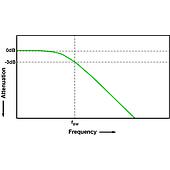
In practical terms, bandwidth is the highest frequency at which the measured sine wave amplitude is not lower than the -3 dB point, which is about 70.7% of the true signal amplitude. As frequency rises, accurate level display becomes more difficult.
In the source material, when the measured sine wave frequency is equal to the oscilloscope bandwidth and the amplifier response is Gaussian, the measurement error is about 30%. That is why a signal should usually be well below the bandwidth if high accuracy is needed.
The 5 Times Rule for Bandwidth Selection
To improve measurement accuracy, a common guideline is to choose an oscilloscope bandwidth that is at least five times the highest frequency of the measured signal.
This rule is especially useful because many real signals are more complex than a pure sine wave. They contain harmonic components that extend to higher frequencies. If the bandwidth is not high enough, those harmonics may be blocked or attenuated, which can cause amplitude distortion, edge loss, and missing detail.
Why complex waveforms are affected
Waveforms formed from multiple harmonic sine waves need enough bandwidth for the harmonics to pass through. If the scope cannot support those frequencies, the display may look incomplete or distorted. In such cases, signal characteristics such as bells and tones may lose reference value.
Bandwidth Limit Settings and Measurement Intent
Correct bandwidth selection depends on the signal being measured. For high-frequency signals, full bandwidth measurement should be used. The source example mentions measuring a 27 MHz crystal waveform: if a 20 MHz bandwidth limit is enabled, the waveform will be distorted and the measurement becomes of no value.
For low-frequency signals, bandwidth limit can be helpful because it filters high-frequency interference and makes the signal easier to see clearly. The key is to match the setting to the measurement purpose.
Bandwidth and Rise Time
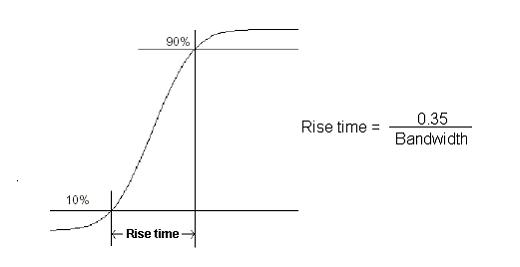
Rise time is another important factor related to bandwidth. It is usually defined as the time for a signal to rise from 10% to 90% of its maximum steady value.
The source material gives a simple formula for oscilloscopes below 1 GHz:
RT = 0.35 / BW
In this formula, RT is rise time and BW is bandwidth. The 0.35 factor is the scale relationship used in the first-order Gaussian model.
Using the example in the source, a 200 MHz oscilloscope has a minimum observable rise time of 1.75 ns. This means that even if a signal changes faster than that, the oscilloscope may not display the edge fully.
How to Read Lower-Amplitude Results Correctly
If the measured amplitude is lower than expected, the first step is to check whether the oscilloscope bandwidth is appropriate for the signal frequency. If the signal is close to the scope’s bandwidth, measurement error can be significant.
Also consider whether the waveform is simple or complex. A sine wave is already affected by bandwidth at high frequency, but complex waveforms may show even more pronounced distortion because they depend on harmonics.
In short, lower-than-expected amplitude may be a normal result of bandwidth limitations rather than a problem with the signal itself.
Key Takeaway
Measured amplitude can be lower than the real value when oscilloscope bandwidth is not sufficient for the signal being tested. Choosing the right bandwidth, understanding the 5 times rule, and considering rise time all help improve measurement accuracy.
For electronics manufacturing and testing applications, these basics are essential when selecting and using an oscilloscope.