An oscilloscope can report a lower amplitude than the actual value even when the displayed frequency appears correct. This behavior is often related to the instrument’s analog bandwidth rather than a change in the source signal. The closer the signal frequency is to the oscilloscope’s rated bandwidth, the more the front end attenuates the measured waveform.
Understanding this relationship is important when selecting an oscilloscope, configuring its bandwidth limit, or interpreting measurements from high-frequency and fast-edge signals.
Why does an oscilloscope measure a lower amplitude?
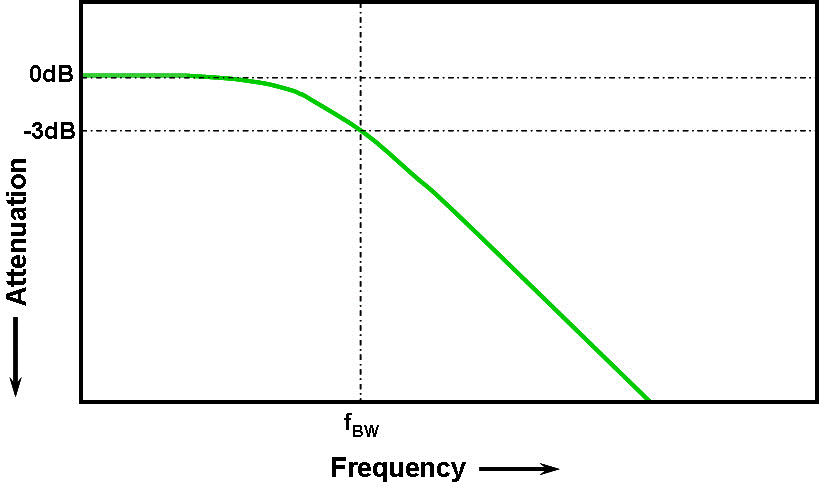
Oscilloscope bandwidth describes the analog bandwidth of the instrument’s analog front end. It directly affects the range of signals that the oscilloscope can measure without substantial amplitude attenuation.
The specified bandwidth is normally associated with the -3 dB cutoff point. At this frequency, the displayed amplitude of a sine wave is 70.7% of its actual amplitude. As signal frequency increases toward this point, the oscilloscope becomes less able to reproduce the signal level accurately.
For example, consider a 100 MHz oscilloscope measuring a 100 MHz sine wave with an actual amplitude of 1 Vpp. At the oscilloscope’s bandwidth limit, the displayed waveform may measure approximately 0.707 Vpp. The frequency can still appear as 100 MHz, but the amplitude is about 30% below the actual value.
This example explains why using a 100 MHz oscilloscope to examine a 100 MHz waveform does not provide an amplitude measurement with high accuracy. A bandwidth rating does not mean that every signal up to that frequency will be displayed at its full amplitude.
The -3 dB point is not a flat measurement boundary
It is easy to interpret the stated bandwidth as a sharp boundary between accurate and unavailable measurements. In practice, the response decreases as frequency rises. The -3 dB specification identifies the frequency at which sine-wave amplitude has already fallen to 70.7% of the true value.
For measurements requiring a much smaller error, the signal frequency should be well below the oscilloscope bandwidth. A commonly used guideline is:
Required oscilloscope bandwidth = highest measured signal frequency × 5
This five-times guideline is intended to improve measurement accuracy compared with operating directly at the bandwidth limit. It is particularly relevant when the waveform contains frequency components above its fundamental frequency.
Complex waveforms require attention to harmonics
The simple 0.707 amplitude example applies to a sine wave. Many practical electronic signals are more complex and contain multiple harmonic sine-wave components. These harmonics can extend across a much wider frequency range than the waveform’s fundamental frequency.
If the oscilloscope bandwidth is insufficient, higher-frequency components can be attenuated or blocked. The resulting display may show reduced amplitude, slower or missing edges, and loss of waveform detail. Consequently, selecting bandwidth only from the fundamental frequency may not be enough for a complex signal.
This distinction matters in electronics manufacturing and troubleshooting because the displayed shape depends on how effectively the measurement system passes the waveform’s frequency components. When those components are removed, the screen no longer represents all of the original signal information.
When to use full bandwidth
Full bandwidth should be used when the signal frequency or its important harmonic content exceeds the configured bandwidth limit. The source example describes measuring a 27 MHz crystal waveform. If a 20 MHz bandwidth limit is enabled, the limit is below the crystal frequency, so the waveform will be distorted and the measurement will not provide a useful representation of the signal.
For this type of high-frequency measurement, disabling the 20 MHz limit and using the oscilloscope’s full available bandwidth prevents that setting from intentionally filtering the signal.
When a bandwidth limit can help
A bandwidth limit is not always undesirable. When measuring lower-frequency signals, enabling the limit can filter high-frequency interference and make the waveform appear clearer. The correct choice therefore depends on the signal being examined.
- Use full bandwidth when high-frequency content is part of the signal and must be preserved.
- Enable the bandwidth limit when measuring lower-frequency behavior and when unwanted high-frequency interference is obscuring the display.
- Do not enable a limit below the frequency content needed for the measurement.
Before concluding that a circuit is producing insufficient amplitude, check whether the oscilloscope’s bandwidth limit is active and compare that setting with the signal frequency.
How bandwidth relates to rise time
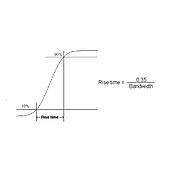
Bandwidth also influences the oscilloscope’s ability to display fast transitions. Rise time is generally defined as the time required for a signal to change from 10% to 90% of its maximum steady value.
For an oscilloscope below 1 GHz using a first-order Gaussian response model, the relationship can be estimated with the following formula:
RT = 0.35 / BW
In this equation, RT is rise time and BW is bandwidth. The value 0.35 is the scale factor for the 10% to 90% rise-time definition in the stated Gaussian model.
For example, a 200 MHz oscilloscope has a calculated minimum observable rise time of 1.75 ns under this relationship. Signals with very fast edges therefore require sufficient bandwidth if their transitions are to be represented meaningfully.
A practical bandwidth-checking process
When oscilloscope measured amplitude appears lower than expected, begin by identifying whether the waveform is a sine wave or a more complex signal. Next, compare its highest relevant frequency component with both the oscilloscope’s rated bandwidth and any enabled bandwidth limit.
If the signal is close to the rated bandwidth, amplitude attenuation is expected. If a low bandwidth limit is active, disable it when the filtered frequency content is important. For low-frequency measurements affected by high-frequency interference, enabling the limit may instead improve display clarity.
Finally, consider rise time as well as frequency. Adequate bandwidth is necessary not only for amplitude accuracy but also for preserving edges and waveform details. These checks help distinguish actual low signal amplitude from attenuation introduced by the measurement system.