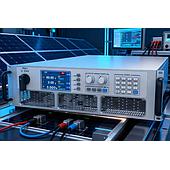
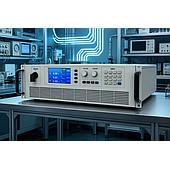
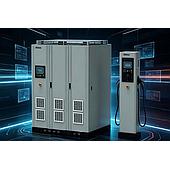
A programmable AC power supply selected only for an appliance’s steady-state nameplate current may be unable to support startup conditions. Motors, compressors, and switch-mode electronics can demand substantially higher current for a short time.
For home-appliance production-line testing, sizing the source at roughly 3x the appliance line’s steady-state current is a practical margin described for maintaining output voltage during transient demand. The appropriate choice still depends on the load type and the supply’s specified peak-current and protection behavior.
Summary: Startup inrush can exceed running current by several times. Nonlinear electronic loads can draw narrow current peaks. Compressor startup may require elevated current for longer than an instantaneous surge. Check crest factor, VA capability, and current-limit behavior alongside continuous current.
Why is nameplate current alone insufficient for appliance testing?
Nameplate current represents normal running demand, not necessarily the demand at turn-on. If a source reaches current limit during startup, its output voltage may sag, the appliance may fail to start, or the test result may reflect source limitation rather than appliance behavior.
For example, the provided sizing discussion describes a refrigerator compressor as having high current demand while the motor is initially stalled and has no back electromotive force. Other appliance loads mentioned include washing-machine motors, vacuum motors, microwave circuits, induction cooktops, and equipment containing switch-mode power supplies.
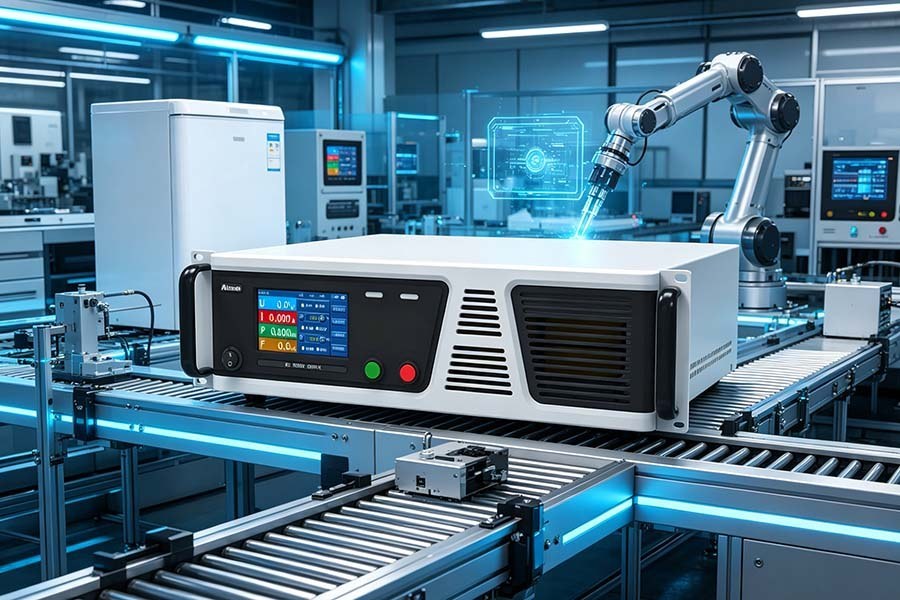
Why is a 3x current rating used as a practical sizing margin?
A 3x current rating is presented as a working margin because it addresses more than one type of startup demand: short motor inrush, capacitor charging in nonlinear loads, and compressor starting transients. It is not a substitute for checking the individual power supply’s specified overload and peak-current capability.
| Load condition | Behavior described | Why source headroom matters |
|---|---|---|
| Motor startup | Inrush can reach 5x to 8x running current for a short period. | The supply must tolerate the initial peak without excessive voltage sag or protection activation. |
| Switch-mode electronic load | Internal capacitors recharge near voltage peaks; crest factor can reach 3.5. | The source must deliver high, narrow current peaks while maintaining the waveform. |
| Compressor startup | A compressor may require about 3x running current for 500 milliseconds. | The elevated demand may last longer than an instantaneous inrush event. |
How do motor inrush and crest factor affect AC source selection?
Motor inrush is a high initial current caused by low effective impedance at startup. Although the highest peak may be brief, the source must have sufficient peak capability and control response to prevent output collapse during the first cycles.
Crest factor is the ratio of peak current to RMS current. The supplied guidance notes that switch-mode power supplies draw current in sharp pulses when their internal capacitors recharge, so continuous RMS current alone does not describe the complete demand placed on an AC source.
A stated example is a 15 A supply with a crest factor of 3.5, corresponding to 52.5 A peak capability. This example illustrates why both the continuous rating and the documented crest-factor specification should be reviewed.
What can happen when a programmable AC power supply is undersized?
An undersized source can enter foldback or shut down when load current exceeds its limit. In a constant-current response, it may reduce voltage instead of maintaining the commanded voltage, which can stall a motor and distort the test waveform.
These outcomes can interrupt automated power-on tests and make appliance performance difficult to assess. The key concern is that the test setup may be measuring the interaction between a constrained source and the appliance, rather than the appliance’s normal behavior under a stable AC supply.
Note: A voltage drop during startup is not, by itself, proof of an appliance fault. The AC source’s current limit, overload duration, and operating mode should be checked before interpreting the result.
When might a 3x current rating not be necessary?
Purely resistive loads may need less margin because their startup current is described as only about 10% to 15% above running current. Examples given include a toaster, space heater, and incandescent lamp; a 1.2x rating is described as potentially suitable for these cases.
This exception should not be extended automatically to appliance lines that include motors, compressors, microcontrollers, or switching power supplies. A mixed appliance test plan should be sized according to the load that creates the most demanding startup condition.
Which specifications should be checked besides continuous current?
Continuous current is only one selection criterion. The supplied guidance recommends reviewing crest factor, output VA relative to watts, and the behavior of the source when it reaches its limit.
- Crest factor: Indicates the source’s ability to supply short peak currents relative to RMS current.
- VA capacity: Matters for loads with poor power factor. A cited example states that a 500 W motor at 0.6 power factor requires about 833 VA.
- Protection behavior: Determine whether the source uses hard current foldback, shutdown, or another limiting approach during overload.
- Transient duration: Confirm how long the source can support elevated current, especially for compressor startup.
Why does a regulated bench source need more margin than a wall outlet?
A regulated programmable source actively controls its output voltage and waveform, whereas a utility-fed outlet is supported by a much larger distribution system. The source must therefore have enough internal energy storage, output-stage capacity, and control response to hold the programmed output during a demanding load transient.
For appliance testing, the practical goal is not simply to meet a steady-state current number. It is to select a programmable AC power source whose continuous, peak, VA, and protection characteristics can support the appliance’s actual startup behavior.