Compression strength reflects the ability of a carton box to withstand loads during stacking, storage, and transportation. A carton box compression tester is used to determine the maximum compression force, deformation, or load-holding capability of a carton under specified test conditions.
Test results depend not only on the carton material but also on moisture content, box dimensions and construction, specimen condition, and test conditions. These factors need to be controlled when evaluating or comparing the compression strength of packaging.
Factors Affecting Carton Box Compression Test Results
Moisture, Material, and Box Construction
Corrugated cardboard is sensitive to moisture. Different storage conditions can change the stiffness and compression strength of the specimen. When comparing different production batches, specimens should be conditioned and stabilized under equivalent environmental conditions.
In addition to the material itself, box dimensions, flute type, number of paper layers, and wall construction directly affect compression strength. Larger boxes or boxes with taller walls may become unstable under load more easily than smaller boxes made from the same material.
Specimen Condition and Positioning
Cartons that are dented, folded, or deformed before testing may produce lower results than intact specimens. Weak areas can also cause the load to be distributed unevenly when the compression plates are applied.
The carton should be positioned securely, centered, and properly aligned with the compression plates. A tilted or off-center specimen can create localized loading and affect the measured maximum compression force. When testing multiple specimens, the positioning method should remain consistent across all measurements.
Compression Speed and Test End Conditions
The movement speed of the compression plate affects how the carton deforms during testing. The test speed should therefore be set according to the applicable test method and maintained consistently between measurements.
The end condition of the test should also be clearly defined. The test may stop when the specimen reaches its maximum compression force, collapses, reaches a specified deformation level, or reaches a preset load. For stacking tests, a specified load may be maintained for a defined period to monitor carton deformation and load-holding performance.
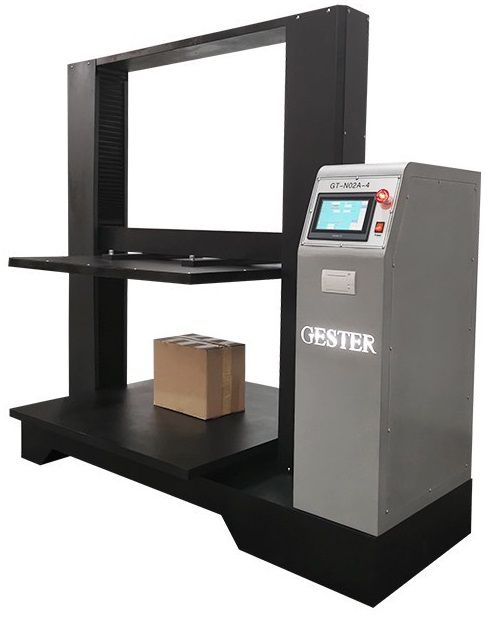
Applications of Carton Box Compression Testers
Carton box compression tester is primarily used to evaluate the load-bearing capacity and structural stability of cartons.
In manufacturing, test results can be used to verify carton quality, compare different materials or box constructions, and monitor variations between production batches. During packaging development, compression force data can also support the selection of a box structure suitable for the expected load.
For goods stored and transported in stacked configurations, compression testing can be used to evaluate stacking performance. Maintaining a specified load for a defined period allows users to monitor deformation and the ability of the carton to remain structurally stable.
How to Choose the Right Force Range for a Carton Box Compression Tester
Determine the Compression Force of the Specimen
The force range should be selected based on the actual compression force expected from the specimens being tested. Previous test data, technical specifications, or preliminary tests on representative specimens can be used when no existing data is available.
If the Carton box strength tester will be used for different types of cartons, determine the expected force range from the lowest-load specimen to the highest-load specimen before selecting the measurement range.
Choose a Force Range with Adequate Headroom
The maximum capacity of the tester should be higher than the expected maximum compression force to avoid operating the equipment continuously near its upper limit. The required margin should reflect specimen variation and the test requirements.
A tester with an unnecessarily large force range should not be selected based solely on its maximum load. When the actual test force falls within the lower part of the measurement range, the resolution and accuracy of the tester within the commonly used force range should also be considered.
Check Test Area and Operating Specifications
In addition to force capacity, the compression plates must be large enough to accommodate the largest specimen. The plate travel should also be sufficient for the carton height and expected deformation.
Compression speed, test modes, and data recording capabilities should match the testing procedure. For QC departments and laboratories, the ability to record compression force, deformation, and time-based data can make it easier to monitor results across different production batches.
Control Test Conditions
Proper control of specimen conditions and testing procedures helps maintain stable results that can be used for quality control, packaging design evaluation, and carton stacking performance assessment.
For results to be comparable, conditions should remain consistent from specimen preparation through the end of the test. Moisture content, specimen condition, carton positioning, compression speed, and test end criteria all need to be controlled.
The carton strength tester should also be inspected and calibrated periodically to ensure stable force measurement. When test conditions are kept consistent, differences between test results are more likely to reflect actual differences in specimen quality or box construction.
When selecting a carton deformation tester, first determine the actual compression force of the specimens, then choose a force range with sufficient headroom without being excessively large for the intended application. Compression plate dimensions, travel, test speed, and data recording capabilities should also be considered alongside the force capacity.