Memory depth determines how many data points an oscilloscope can store during a single acquisition. This parameter directly affects the actual sampling rate, observation time, and the ability to capture and analyze abnormal events.
Memory Depth refers to the number of data points that an oscilloscope can store during a single acquisition. It determines how long a signal can be recorded at a given sampling rate and also affects the actual sampling rate when the observation window is extended.
An oscilloscope with a very high maximum sampling rate does not necessarily maintain that rate under all measurement conditions. When a longer signal observation period is required, the available data points must be distributed over a longer time interval. If the acquisition memory is limited, the actual sampling rate may decrease to accommodate the longer acquisition time.
What Is the Memory Depth of an Oscilloscope ?
Memory depth is the number of sample points that an oscilloscope can store in its acquisition memory for a waveform record. This parameter is typically expressed in kpts, Mpts, or Gpts, representing thousands, millions, or billions of data points, respectively.
For example, an oscilloscope with a memory depth of 10 Mpts can store a waveform record containing up to 10 million sample points under the corresponding acquisition conditions. These points form the data used by the oscilloscope to display the waveform and perform measurements and analysis after acquisition.
Memory depth has a direct relationship with sampling rate and acquisition time:
Memory Depth = Sampling Rate × Acquisition Time
This can also be expressed as:
Sampling Rate = Memory Depth / Acquisition Time
For example, if an oscilloscope stores 10,000 points over a period of 10 µs, the corresponding sampling rate is 1 GSa/s. If the same 10,000 points are used but the acquisition time is extended to 1 second, the sampling rate drops to 10 kSa/s. This is also how Keysight explains the relationship between memory, acquisition time, and the actual sampling rate of an oscilloscope.
It should be noted that the formulas above describe the relationship when the number of stored points and acquisition time are defined for the same waveform record. The way memory is allocated and the specific sampling rate depend on the acquisition architecture of each oscilloscope model.
Nominal Sampling Rate vs. Actual Sampling Rate
The nominal sampling rate is the maximum sampling rate that the analog-to-digital converter (ADC) or acquisition system can achieve under the technical conditions specified by the manufacturer. This value is commonly used to describe the acquisition capability of an oscilloscope, but it does not mean that the instrument always operates at its maximum rate.
When the observation time is increased by increasing the time per division (Time/Div), the oscilloscope must record the signal over a longer period. If the memory depth does not increase accordingly, fewer sample points must be stored per unit of time. As a result, the actual sampling rate becomes lower than the nominal sampling rate.
For example, consider an oscilloscope with a maximum sampling rate of 1 GSa/s and a memory depth of 1 Mpoint. With an acquisition time of 1 ms, the memory can be filled at a sampling rate of 1 GSa/s. When the acquisition time is increased to 100 ms, the system only needs to retain approximately one sample for every 100 samples that would have been acquired initially, reducing the effective sampling rate to 10 MSa/s.
Therefore, when comparing two oscilloscopes with the same maximum sampling rate of 1 GSa/s, their acquisition capabilities cannot be assumed to be equivalent. An oscilloscope with deeper memory can maintain a high sampling rate over a longer period, depending on the acquisition architecture of each instrument. Keysight also describes deep memory as a factor that determines the maximum time over which a signal can be recorded at a high sampling rate.
What Benefits Does Deep Memory Provide When Measuring Signals ?
The most obvious benefit of deep memory is its ability to retain a large number of data points over a long acquisition period. This is useful when the signal under test contains short-duration events that do not occur continuously.
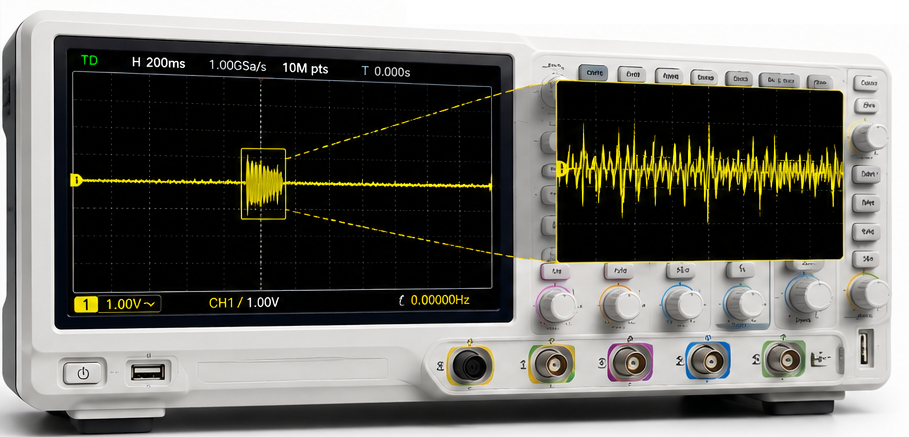
For example, a noise pulse may last only a few microseconds but appear tens or hundreds of milliseconds after monitoring begins. If the memory is too limited, the oscilloscope may have to reduce the sampling rate or record only a short section of the signal. As a result, the abnormal event may not be captured with enough detail for further analysis.
Deep memory is also useful when a small section of a long waveform record needs to be zoomed in for closer inspection. A large number of sample points preserves more information within the acquired waveform, making it easier to examine pulses, noise, rise time, fall time, or the timing relationship between different events. Keysight also identifies the combination of high sampling rate and deep memory as a key factor in capturing detailed waveforms that can be zoomed in and analyzed.
However, deep memory does not increase the oscilloscope's bandwidth or automatically improve measurement accuracy. Its primary function is to expand the amount of data that can be stored during acquisition. Measurement quality also depends on bandwidth, sampling rate, ADC resolution, probe characteristics, and the acquisition architecture.
The importance of memory depth also depends on the type of oscilloscope. Digital oscilloscope use digital acquisition and memory to store waveform data, making memory depth a key specification. PC-based oscilloscope similarly rely on digital acquisition and computer-based storage and analysis. Handheld oscilloscope may prioritize a balance between memory depth, portability, battery life, and field measurement requirements. By contrast, traditional analog oscilloscope do not use digital acquisition memory in the same way, so memory depth is not a directly comparable specification.
How Should Oscilloscope Memory Depth Be Evaluated ?
An oscilloscope should not be selected based solely on its maximum memory depth. This parameter needs to be considered together with bandwidth, sampling rate, and the required observation time.
If the application only involves measuring a stable periodic signal over a short period, moderate memory depth may be sufficient. In contrast, when monitoring circuit startup, checking long-duration communications, detecting intermittent noise pulses, or analyzing signals before and after a trigger event, deeper memory can provide a significant advantage.
Another important consideration is the actual sampling rate under the expected measurement conditions, rather than simply looking at the maximum specified value. Some oscilloscopes allow users to select or adjust the sampling rate and memory depth. In other operating modes, the time per division may determine how the system allocates these two parameters.
When comparing oscilloscopes, a simple question can serve as a useful starting point: How long does the signal need to be recorded while still retaining the required level of waveform detail? The answer helps determine the appropriate memory depth for the application.
Memory depth is not a parameter that should be considered separately from sampling rate and acquisition time. As the observation period increases, limited memory can cause the actual sampling rate to decrease. The deeper the memory, the more sample points the oscilloscope can retain in a long waveform record, depending on the instrument's acquisition architecture.
Therefore, when selecting an oscilloscope, it is important to consider memory depth, actual sampling rate, bandwidth, and acquisition time together.