Ecological monitoring often requires information across wide areas, repeated observations, and a consistent approach to data collection. A hyperspectral UAV nest system is designed to bring together unmanned aircraft operations, an automated hangar, and hyperspectral imaging for this type of inspection work. For organizations responsible for environmental quality control, the approach may help structure recurring monitoring tasks across farmland, forests, water bodies, and urban green spaces.
What Is a Hyperspectral UAV Nest System?
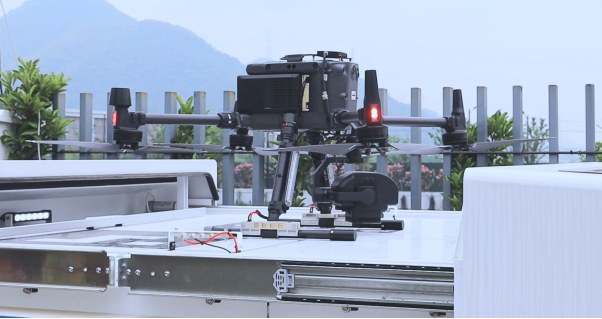
The CHN SPEC hyperspectral UAV nest system is presented as an integrated monitoring setup. Its main elements include an automatic UAV hangar, the CHNSpec FS60C hyperspectral camera, and a DJI M350 RTK drone. Rather than treating flight, imaging, and turnaround as separate activities, the system is intended to support an automated operating workflow.
Hyperspectral imaging gathers detailed spectral information from the observed scene. In ecological inspection, that information can be used to examine differences that may not be apparent in conventional imagery alone. The source material identifies potential uses involving changes in water conditions and variations in vegetation leaf condition.
Automated Operations for Repeatable Monitoring
The automatic hangar serves as the operating hub for the UAV. According to the available product information, it can identify and guide the returning drone for landing, then initiate automatic battery replacement. This workflow is intended to reduce the interruption between monitoring missions and keep the aircraft ready for subsequent assignments.
For inspection teams, repeatability is an important consideration. A planned flight route, a defined sensor payload, and an automated return process can provide a more organized basis for collecting observations over time. The DJI M350 RTK is described as carrying the hyperspectral camera to a target area along a preset route while supporting intelligent route planning and dynamic obstacle avoidance.
The Role of the CHNSpec FS60C Hyperspectral Camera
The CHNSpec FS60C is the imaging component named for this system. Its purpose is to capture spectral information for analysis of natural landscapes and environmental features. This enables monitoring programs to consider spectral characteristics alongside location and visual context.
Data collection is only one part of an inspection workflow. The value of spectral data depends on how the monitoring objective is defined, how flights are planned, and how results are interpreted. A clear process can help teams compare data collected at different times and focus field investigations on areas that require closer review.
Potential Applications in Environmental Inspection
Agriculture and Crop Observation
In agricultural settings, hyperspectral monitoring can be used to observe crop growth status across farmland. The source material notes that vegetation indices may be considered when assessing whether crops show signs associated with nutrient shortages, pests, or disease. Such observations can help guide further agronomic review related to fertilization, irrigation, or pest management decisions.
Forestry Monitoring
Forests cover large and sometimes difficult-to-access areas, making aerial inspection useful for broad surveys. By reviewing the spectral characteristics of trees, monitoring teams may identify areas that warrant attention for potential pest and disease issues or fire-related hazards. This makes the system relevant to programs that need repeatable coverage of extensive forest areas.
Water Bodies and Urban Green Spaces
Urban environmental management can involve river monitoring, green-space assessment, and wider ecological planning. The hyperspectral UAV nest system is described as supporting observation of city water bodies and green areas. Results may provide an additional information layer for inspection, planning, and management activities when used with appropriate local assessment methods.
Data Analysis and System Adaptability
The system is described as incorporating multiple deep learning algorithms and allowing users to import algorithm models for specific application scenarios. This flexibility may be relevant when monitoring requirements differ between crop fields, forest stands, or urban sites. The available information also states that third-party data can be connected for calibration.
Organizations should define their monitoring goals before selecting algorithms or interpreting outputs. Important questions include the area to be covered, the observation frequency, the target conditions, and the process for reviewing results. A structured approach helps ensure that collected spectral data supports the intended quality control and inspection process.
Considerations for Ecological Monitoring Programs
A hyperspectral UAV nest system can support a more automated approach to environmental observation, but it should be treated as part of a broader monitoring program. Flight planning, local operating requirements, data calibration, analysis procedures, and follow-up verification all remain important. The combination of an automated hangar, DJI M350 RTK platform, and CHNSpec FS60C camera provides a defined equipment configuration for teams evaluating hyperspectral monitoring workflows.
For ecological quality control and inspection, the key benefit is the ability to organize repeated aerial data collection around a specified monitoring objective. Whether the focus is agricultural land, forest health, water bodies, or urban green spaces, the system offers a way to combine automated UAV operations with detailed spectral observation.