The number of operating years alone cannot determine how much of the system's original capacity remains. It is necessary to distinguish between solar panel degradation and losses occurring throughout the entire system.
How Much Do Solar Panels Degrade After 5 Years ?
Field studies monitoring solar power systems have shown that degradation rates vary between different types of solar panels. Data from the U.S. National Renewable Energy Laboratory indicates that many panel models have a median degradation rate of around 0.25–0.55% per year. Some technologies have higher degradation rates.
If a solar panel is assumed to degrade at a constant rate of 0.5% per year, its theoretical power output would decrease by approximately 2.5% after five years. A 550 W solar panel would then have an equivalent output of around 536 W.
This is only a calculation based on an assumed degradation rate. Actual power does not necessarily decline at the same rate every year, and degradation can vary between individual panels within the same system.
During operation, additional losses can also result from light and temperature conditions, solar irradiance, shading, cables, connectors, or the inverter.
For an accurate assessment, measured power should be evaluated under the same irradiance and temperature conditions. The performance of different panel strings should also be compared.
A Reduction in Panel Power Does Not Necessarily Mean the Same Reduction in Energy Output
A 550 W solar panel can only deliver its rated power under standard test conditions. When installed on a factory rooftop, the photovoltaic cell temperature, solar irradiance, and angle of sunlight continuously change.
High temperatures reduce the panel's voltage. Cables and connectors introduce additional electrical losses. The inverter also consumes part of the energy while converting direct current into alternating current.
As a result, the system's energy output may decrease even when the degradation level of the solar panels remains within the normal range.
Energy production also depends on weather conditions from year to year. A year with lower solar irradiance will produce less electricity even if the panels have not experienced significant degradation.
Comparing Panel Strings to Identify Areas of Degradation
For systems with multiple panel strings, comparing data from strings operating under similar conditions is an effective way to detect abnormalities.
Strings with the same number of panels, the same installation orientation, and similar shading conditions can be compared. If one string consistently shows lower current or power output than the others, that area should be inspected separately.
Open-circuit voltage and short-circuit current can be used for an initial check. For a more detailed assessment, measuring the current-voltage curve makes it possible to examine the overall electrical characteristics of the panel string.
This measurement provides parameters such as maximum power, voltage at maximum power, and current at maximum power. Abnormal changes in the curve may be associated with differences between panels, shading, power degradation, or electrical faults within the circuit.
=> Analyzing I-V Curve Deviations in Solar Power Systems
Temperature and Other System Components Also Affect Energy Output
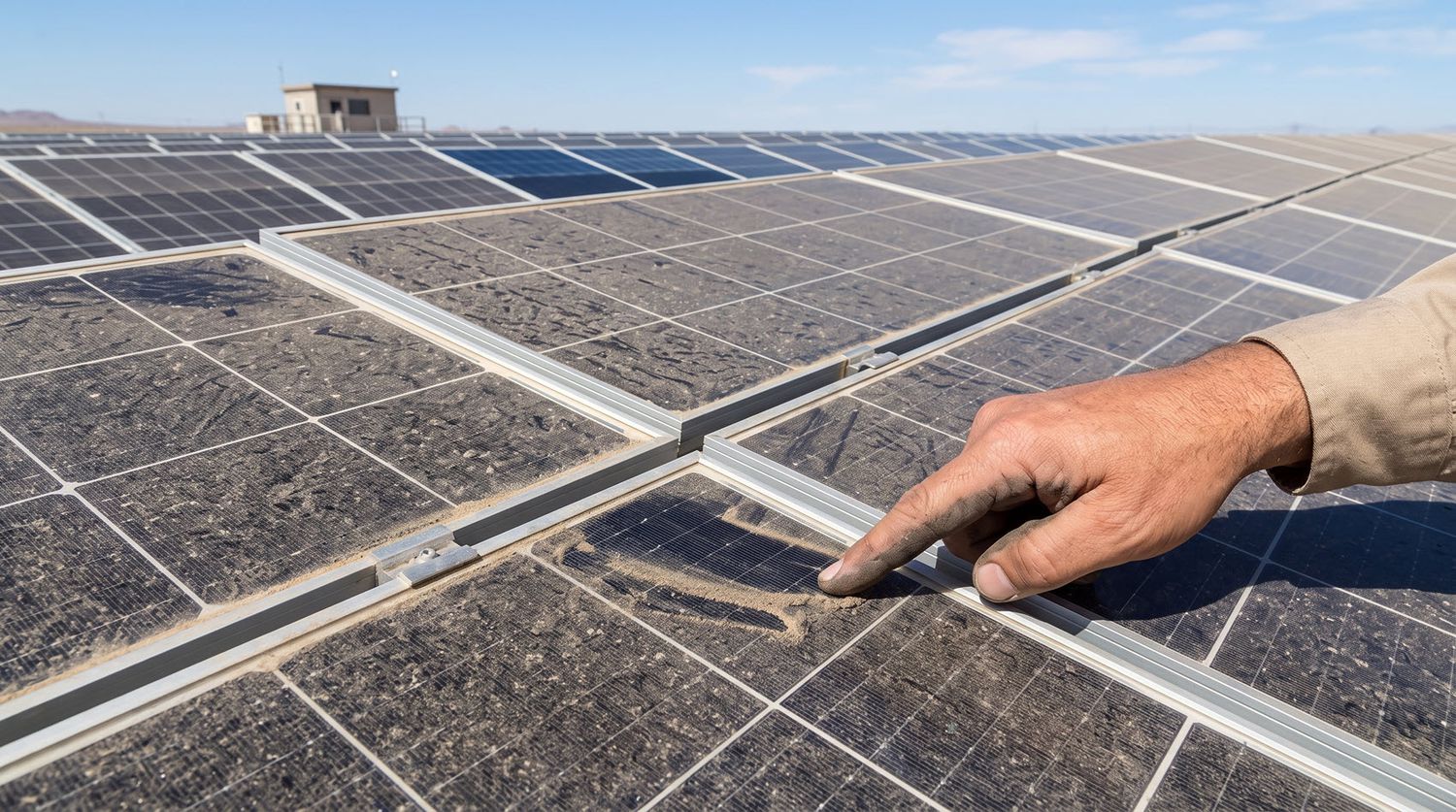
A hot, sunny day does not necessarily provide optimal conditions for a solar panel to achieve high power output. As the photovoltaic cell temperature rises, voltage decreases, which can reduce power output.
For this reason, both solar irradiance and temperature should be recorded during each measurement. Ignoring these two parameters can make comparisons between different measurement periods inaccurate and may not reflect the actual level of degradation.
A thermal imaging camera can help identify abnormally hot areas on solar panels, connectors, and junction boxes. Localized hotspots should be inspected separately because they may be associated with connection faults or abnormalities in photovoltaic cells.
After several years of operation, outdoor cables are also exposed to ultraviolet radiation, temperature changes, and humidity. Connectors undergo continuous heating and cooling cycles. Areas where cables come into contact with the roof or are bent excessively may develop damage over time.
The inverter is also exposed to thermal and electrical loads over long periods. When energy output shows a downward trend, inspection should not be limited to the solar panels. These components should also be evaluated.
Storage data for the Solar Power System
For a factory rooftop solar power system, inspection data should be recorded throughout each stage of operation.
Energy output, solar irradiance, temperature, string voltage, string current, and current-voltage curve measurements can provide reference data for future inspections.
When a panel string begins to show a decline in power output, technicians can compare its current performance with data recorded for the same string in previous years. This approach helps distinguish gradual age-related degradation from newly occurring faults.
After five years, the accumulated operating data is long enough to identify performance trends. This is an appropriate time to move beyond simply monitoring energy production and begin assessing the condition of individual system components.
=> Rooftop Solar PV System Maintenance Procedures
For a factory rooftop solar power system, periodic inspection data and long-term data records can serve as a health record for the entire system. This provides a basis for detecting early degradation, identifying equipment that requires inspection, and planning appropriate maintenance. Combining energy output monitoring with solar irradiance and temperature data, individual string inspections, and current-voltage curve measurements allows the level of degradation to be assessed more accurately.
=> Register Now: [EMIN x Fluke] Workshop Series on MEP Systems Maintenance and Rooftop Solar Infrastructure
The Workshop organized by EMIN and Fluke, will take place in Da Nang on October 27, 2026, and Southern Vietnam on October 30, 2026.
Register early to reserve your spot and receive the complete set of internationally recognized technical materials!