Hyperspectral Camera for Smarter Wheat Pest Monitoring
Fast, reliable pest identification is an important part of crop monitoring. Conventional inspection often depends on visual observation and morphological identification, which can be labor-intensive and difficult to scale across large areas. Hyperspectral pest identification offers a different approach: it records detailed spectral information alongside the spatial appearance of an insect.
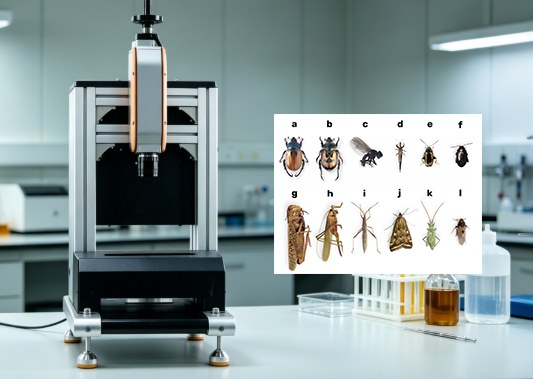
A reported study involving wheat-field pests explored this approach with the FigSpec FS-13 hyperspectral camera and machine-learning classification. The work focused on spectral feature analysis for 12 major pest types in cereal crops. Its findings illustrate how hyperspectral data may support research workflows for agricultural pest monitoring and precision plant protection.
Why Insects Can Be Distinguished by Spectral Data
Unlike an RGB camera, which records broad red, green, and blue channels, a hyperspectral camera can collect many continuous narrow spectral bands. In the reported application, the relevant visible-to-near-infrared range was 400–1000 nm. Each image pixel can therefore contribute a spectral curve as well as positional information.
For insect samples, spectral responses can vary with physical characteristics. Surface pigments, body coloration, chitin structure, wing transparency, and surface texture may all affect reflectance. These differences can create measurable patterns that are not always apparent through visual inspection alone.
The study described clear reflectance differences among insect species. Light-colored or bright insects were associated with higher reflectance than darker insects, while transparent or semi-transparent wings could show strong near-infrared reflection features. Smooth body surfaces and different chitin structures were also identified as factors that may influence spectral behavior.
Using Data Analysis to Separate Pest Types
Principal component analysis
Multispectral camera contain a large number of wavelength variables, so data reduction can be useful before classification. The study applied principal component analysis (PCA) to examine the main sources of spectral variation. According to the reported results, the first two principal components explained more than 80% of the observed variance.
The first component was primarily associated with overall brightness differences, while the second reflected more subtle differences related to pigment and body-surface characteristics. Pest types showed varying degrees of separation in the PCA score plot. This provides a practical basis for assessing whether spectral signatures contain useful discriminatory information before building a classification model.
PLS-DA classification
The research team also used partial least squares discriminant analysis (PLS-DA) to classify the 12 pest types from data acquired with FigSpec FS-13. Model assessment included the coefficient of determination (R²), predictive ability (Q²), and root mean square error of calibration (RMSEC).
Reported performance differed among insects. Larger species with vivid body colors, including scarab beetles and green bush crickets, reached identification accuracy of about 90% in the study. Smaller or dark-bodied species, such as flea beetles and thrips, were more challenging to classify. Even so, the overall results indicated that the model could distinguish the 12 evaluated pest types.
What This Means for Agricultural Inspection
This research case shows the potential role of hyperspectral camera in pest-monitoring studies. A system such as FigSpec FS-13 can provide data for comparing spectral features and developing classification workflows. Rather than relying on a single visible image, researchers can evaluate wavelength-dependent reflectance patterns that relate to insect characteristics.
For agricultural teams, the value of this approach is in its potential to support more consistent data collection and automated analysis. However, classification performance should be evaluated for the target crop, pest species, sample conditions, and modeling method. Differences in insect size, coloration, and morphology can affect how readily classes are separated.
Hyperspectral camera identification combines detailed spectral imaging with analytical models to investigate differences between insect types. In the reported wheat-field research, FigSpec FS-13 data supported PCA exploration and PLS-DA classification of 12 pests. The case provides a useful example of how hyperspectral workflows can contribute to agricultural research and future precision crop-monitoring applications.