In factories, production areas or construction sites with electrical equipment, this system is no longer too strange. For those who want to learn about mobile grounding systems and notes when using it, this article is for you.
Let's find out what the grounding system is?
In workplaces involving electricity—especially in production areas—safety must always be the top priority. Many people mistakenly believe that simply switching off the power is enough to stay safe. In reality, electric leakage, current escaping through equipment casings, or residual voltage can still pose serious risks if not properly handled. This is where a portable grounding system becomes essential.
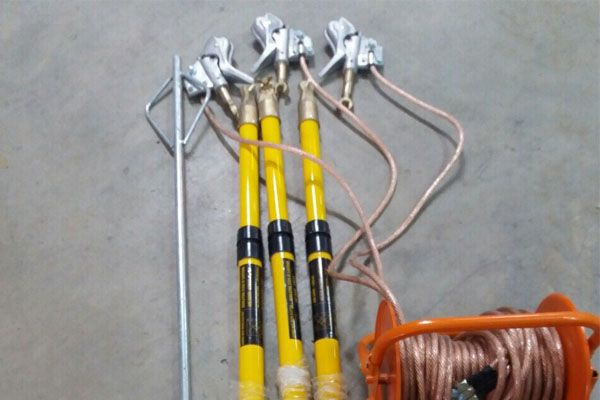
In principle, a portable grounding system functions the same as a fixed grounding system: it redirects leakage current safely into the ground to prevent harm to humans. Its key advantage lies in mobility and flexibility across various scenarios—from temporary construction sites and outdoor projects to urgent inspections or maintenance tasks. Lightweight and easy to operate, it requires minimal setup time while still delivering effective protection.
In developed countries like those in Europe and North America, grounding has long been a mandatory part of every electrical system. Power plugs, for example, are designed with three prongs—one of which is the grounding pin (“E”), playing a crucial role in user safety. In Vietnam, grounding methods tend to be more manual, such as burying a steel rod into the ground and connecting it to the equipment casing with a wire. It may sound simple, but this remains one of the most practical ways to minimize the risk of electric shock during machine operation.
Above all, never underestimate the importance of what might seem like a small detail—because in electrical safety, those small details can save lives.
Uses of mobile power supply system
Working with electricity always carries significant risks—sometimes, even a minor mistake can lead to severe consequences, potentially endangering lives. That’s why, in industries that involve direct contact with high voltage, implementing a grounding system—especially a portable one—is not just an option, but a mandatory part of safe operating procedures.
Grounding is not merely about connecting equipment to the earth; it’s a safeguard against dangerous scenarios. For instance, if there’s an error during power disconnection, the grounding system allows the technician to detect it immediately when performing a voltage check. Or in the event of power being mistakenly switched back on, the system will respond by creating a short circuit, triggering protective devices like circuit breakers or automatic switches to cut off the current—minimizing risk for the operator.
Main structure of mobile grounding system
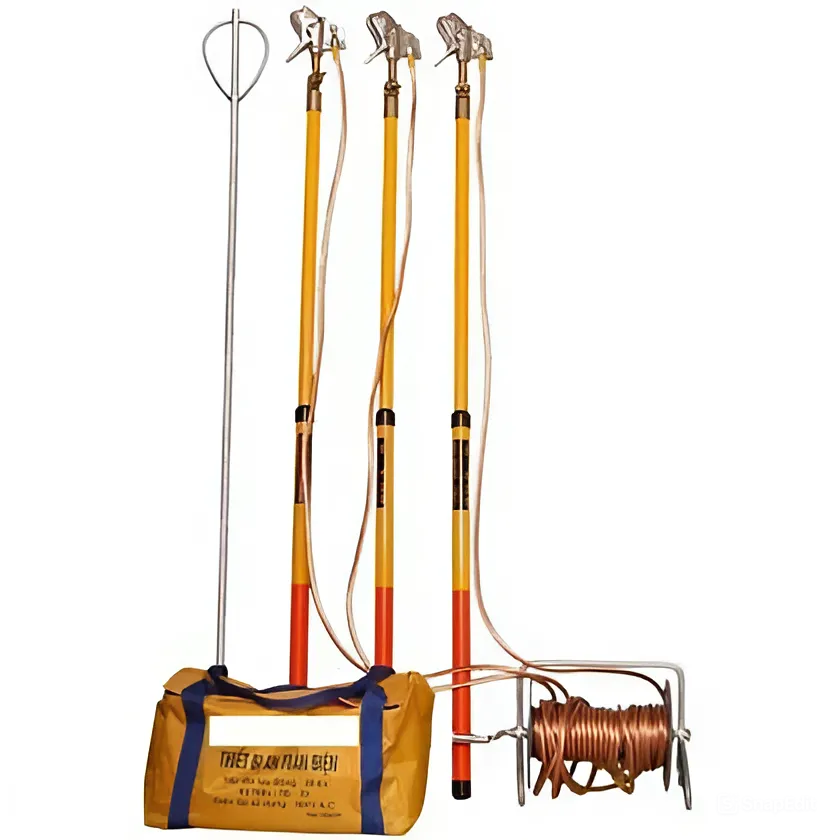
Currently, grounding systems are designed in a variety of configurations to meet the specific requirements of different work environments. Despite the diversity in types and models, most grounding sets follow a standard technical structure to ensure effective and safe dissipation of electrical current into the ground.
A typical grounding set generally includes: grounding electrodes, grounding cables, insulating rods, insulating stakes, and duckbill clamps.
Grounding electrodes are commonly made of galvanized steel rods or round galvanized steel. Depending on construction needs, either vertical or horizontal electrodes may be used. They usually range in length from 2 to 3 meters and are driven into the ground vertically at a depth of approximately 0.5 to 0.8 meters. These electrodes are interconnected underground using flat steel bars to create a stable current path.
The grounding cable serves as the conduit for leakage current, carrying it from the equipment to the electrodes. These cables are typically made of copper-clad steel with a minimum cross-sectional area of 25 mm² to ensure adequate load capacity. In many cases, the cable size is selected so that it does not exceed one-third the cross-sectional area of the main phase conductor. Grounding cables are placed on the ground surface, with one end connected to the equipment being protected and the other end connected to the buried electrodes.
Insulating rods and stakes are tools used during grounding operations. They are primarily made of fiberglass or high-performance composite materials, offering strong insulation properties in high-voltage environments.
Duckbill clamps are used to securely fasten grounding cables to the required connection points. These clamps are typically manufactured from aluminum alloy or coated with conductive materials such as copper or gold, depending on the required standards. They are designed to provide firm clamping using bolts and screws, ensuring a stable and reliable connection between the grounding cable and the equipment.
When working with portable grounding systems, there are several precautions that operators must observe. Before performing any task, workers should be properly equipped with personal protective equipment (PPE) suited for high-voltage environments. Basic PPE includes protective clothing, safety helmets, insulated gloves, anti-slip boots, safety harnesses, and voltage testers.
Some notes when using mobile grounding system
Before installing or removing the ground, make sure the system is completely de-energized. When checking and working on the conductor, always use standard insulating gloves and a suitable insulating pole. The electrical test equipment must correspond to or be higher than the nominal voltage of the operating system to avoid risks from voltage differences.
During the operation, the ground wire must never be placed near the operator, and must not be in direct contact. The position of the handle on the pole must comply with the design safety distance, not exceeding the allowable isolation zone.