
Paint thickness gauge for ADAS bumpers is an important part of a controlled automotive refinishing process. Many current vehicles incorporate Advanced Driver Assistance Systems (ADAS), and sensors may be integrated behind or within plastic bumpers and fascias. When these parts are refinished, the coating system needs to remain within the vehicle manufacturer’s applicable requirements.
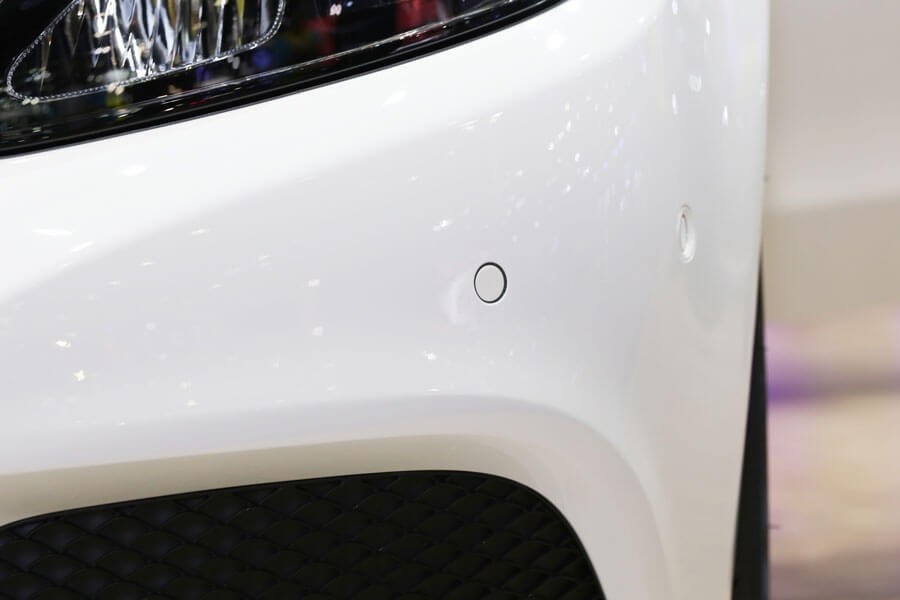
Coating thickness is not only a cosmetic consideration. Excessively applied paint may impede sensor signals and affect how an ADAS function performs. For collision repair facilities and vehicle manufacturers, checking the finished coating thickness provides documented information for evaluating whether a paint system is within the specified range.
Why paint thickness matters on ADAS-equipped bumpers
ADAS technologies can include blind spot detection, lane departure warning, pedestrian detection, integrated brake assist, adaptive cruise control, and collision-avoidance braking systems. These systems can use sensors to detect movement and proximity to objects. On vehicles where sensors are associated with bumpers or fascias, repair work and coating build-up require particular attention.
The acceptable coating thickness is determined by the applicable OEM guidance. For example, the source material notes that General Motors specifies a maximum paint thickness of 13 mils (330 microns) on ADAS-equipped bumpers and fascias. This value should not be treated as a universal limit: technicians should always use the requirements that apply to the specific vehicle and repair procedure.
Measuring during or after refinishing helps teams manage total paint build-up rather than relying on visual assessment alone. It also supports a more consistent process across plastic exterior parts, including bumpers and fascias.
Using ultrasonic measurement on plastic substrates
Traditional magnetic coating thickness methods are intended for metallic substrates, whereas automotive bumpers are commonly plastic. The DeFelsko PosiTector 200 B is an ultrasonic coating thickness gage intended for non-destructive measurement of paint on plastic automotive bumpers, fascias, and other interior or exterior plastic parts.
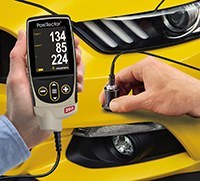
The probe sends a high-frequency sound pulse through a coupling gel into the coating. The pulse reflects at material interfaces with different densities. The instrument determines thickness from the signal travel time between the probe and a coating interface. In its normal interpretation, the PosiTector 200 identifies the largest echo within the selected range as a coating-to-coating or coating-to-substrate echo.
Automotive paint systems may include an adhesion promoter, primer, basecoat, and clear coat. Depending on the measurement objective, a repair team may need the total combined thickness of the full system or thickness information for individual layers.
PosiTector 200 B model options
Two PosiTector 200 B versions are identified for this application:
- PosiTector 200 B1 is the standard model for measuring total coating thickness.
- PosiTector 200 B3 is the advanced model, capable of measuring total thickness and up to three individual layer thicknesses in a multilayer system.
Selecting the appropriate model depends on whether the inspection task requires only the overall paint-system thickness or additional layer-level information. The total thickness result is especially relevant when following a vehicle manufacturer’s refinishing limit for an ADAS-related component.
Basic measurement process
The PosiTector 200 B is described as ready to measure out of the box for most applications, without calibration adjustment. For checking total paint thickness on bumpers and fascias, the source procedure recommends enabling Max Thick Mode in the setup menu.
- Apply a small droplet of ultrasonic coupling gel to the coated bumper or fascia.
- Place the probe on the gel and press it down to begin the measurement.
- Lift the probe when the double beep is heard and the result appears. Holding the probe in place can provide another reading at the same location.
The displayed value represents the total thickness of the paint system when using this approach. Results may be displayed in mils or microns. After measurement, wipe the probe and the tested surface with a tissue or soft cloth to remove coupling gel.
Practical refinishing control
A coating thickness gauge should be used as part of the quality control process, particularly when working with plastic bumpers or grilles equipped with integrated sensors. Measurement results do not replace technical requirements, repair procedures, or calibration instructions provided by the vehicle manufacturer.
For vehicles equipped with ADAS, it is important to correctly identify areas containing sensors, control the paint thickness according to the specifications applicable to the specific vehicle, and follow the relevant technical procedures recommended by the vehicle manufacturer. With its ability to non-destructively measure paint coatings on plastic substrates, the PosiTector 200 B provides a practical solution for checking coating thickness during automotive plastic bumper finishing and repair.




