The MIT Folding Endurance Tester GT-N16 is a quality-control instrument for assessing how paper and cardboard withstand repeated folding under controlled tension. Folding endurance matters whenever a sheet material will be bent repeatedly during use or processing, such as when pages are turned, cartons are folded, or printed materials are converted. By applying a repeated folding action until a specimen fails or a preset endpoint is reached, the test provides a structured basis for comparing material behavior.
For laboratories and production teams, a folding endurance test can support incoming-material checks, formulation comparisons, process evaluation, and routine quality inspection. Results should be considered alongside the sample condition, specimen preparation, tension selection, and the applicable test method. Consistent setup is essential when results are compared across samples.
What is the MIT Folding Endurance Tester GT-N16?
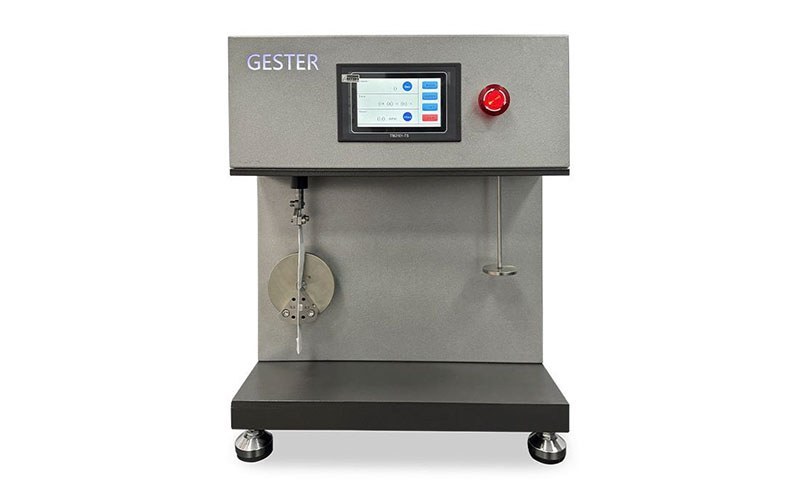
The MIT Folding Endurance Tester GT-N16 is intended for folding-resistance testing of paper and cardboard. Its horizontal configuration uses a clamping and folding arrangement to repeatedly flex a mounted specimen. A spring system applies tension while the folding mechanism creates reciprocal folds.
During the test, the specimen is exposed to repeated stress at the same folding location. As fatigue develops, the material may eventually break. The instrument records the number of folds endured, giving users a measurable indication of resistance to repeated bending under the selected conditions.
The GT-N16 includes functions for parameter testing, adjustment, display, conversion, and memory according to the supplied product information. These functions can help operators prepare and run repeatable test sequences when the same procedure is maintained.
How a paper folding endurance test works
A typical test begins with a paper or board specimen secured in the tester’s clamping device. The operator selects a suitable fixture based on specimen thickness and installs the specimen securely. Weights are then fitted as required for the selected tension arrangement.
Once the setup is complete, the spring system provides controlled tension and the folding head moves back and forth. This reciprocal action repeatedly bends the specimen, simulating the localized folding stress that can occur in practical handling and converting operations.
The test may end when the specimen breaks or when the configured count is completed. The source information describes two ways to express the data:
- Number of folds: the direct count of folding cycles endured by the specimen.
- Base-10 logarithmic value of double folds: a mathematical expression that can be useful for laboratory analysis and comparison.
Within comparable test conditions, a higher measured folding-resistance value indicates that the material endured more repeated folding before failure. It does not, by itself, describe every aspect of paper or board performance.
Key specifications of GT-N16
The following specifications are provided for the MIT Folding Endurance Tester GT-N16:
- Measuring range: 0 to 99,999 times
- Folding angle: 135 ±2
- Folding frequency: 175 ±10 times per minute
- Folding head width: 19 ±1 mm
- Folding radius: 0.38 ±0.02 mm
- Spring tension: 4.91 N to 14.72 N
- Folding-mouth gap options: 0.25, 0.50, 0.75, and 1.00 mm
- Tension-force change caused by eccentric rotation of the clamping folding head: ≤0.343 N
The supplied information also notes that for each 9.81 N increase in tension, spring compression is reduced by at least 17 mm. Operators should select and document the conditions used for each test so that results remain meaningful for internal comparison.
Standards referenced for the test
The product information references ISO 5626, GB/T 2679.5, QB/T 1049, and ASTM D2176 in connection with folding-resistance testing. Before using any standard for a specific quality program, laboratory, or customer requirement, confirm the current applicable edition and verify that the test configuration, specimen preparation, and reporting method match that requirement.
Basic operating workflow
Prepare the instrument
Before using Paper Folding Endurance Tester, check the listed accessories: one wrench set, four clamp sets, and three weights. Confirm the power connection, switch on the instrument, and level the machine using its level meter.
Mount the specimen
Select the appropriate fixture according to specimen thickness and install it. Reset the fixture, place the specimen in position, secure the specimen, and install the required weights. Careful mounting helps prevent unintended slippage or inconsistent stress during the folding sequence.
Set and run the test
The supplied operating information identifies Counter and Timer modes under the SETTING function. In Counter mode, set the desired count, then set the speed. Return to the test interface, use Zero to clear the count, and select TEST to begin. The test stops automatically when the configured test is complete; it also stops if the specimen breaks during testing.
Using results in quality control
Cardboard bending tester is most useful when it is part of a defined inspection routine. Keep specimen dimensions, material direction, tension, gap selection, and test settings consistent for a given comparison. Record whether the test stopped because of specimen breakage or because a preset count was reached.
For paper mills, converters, print processors, packaging teams, and material laboratories, the MIT Folding Endurance Tester GT-N16 offers a focused way to observe folding fatigue. Used with a documented procedure, it can help teams compare batches and investigate changes in paper or cardboard folding behavior.