Some models look great on the runway, but after a few months of working near oil slicks or metal dust, they start to malfunction, the screen becomes slow, or the response is slower than before.
Therefore, when choosing a device, prioritizing water resistance or resolution is very much related to the daily usage environment.
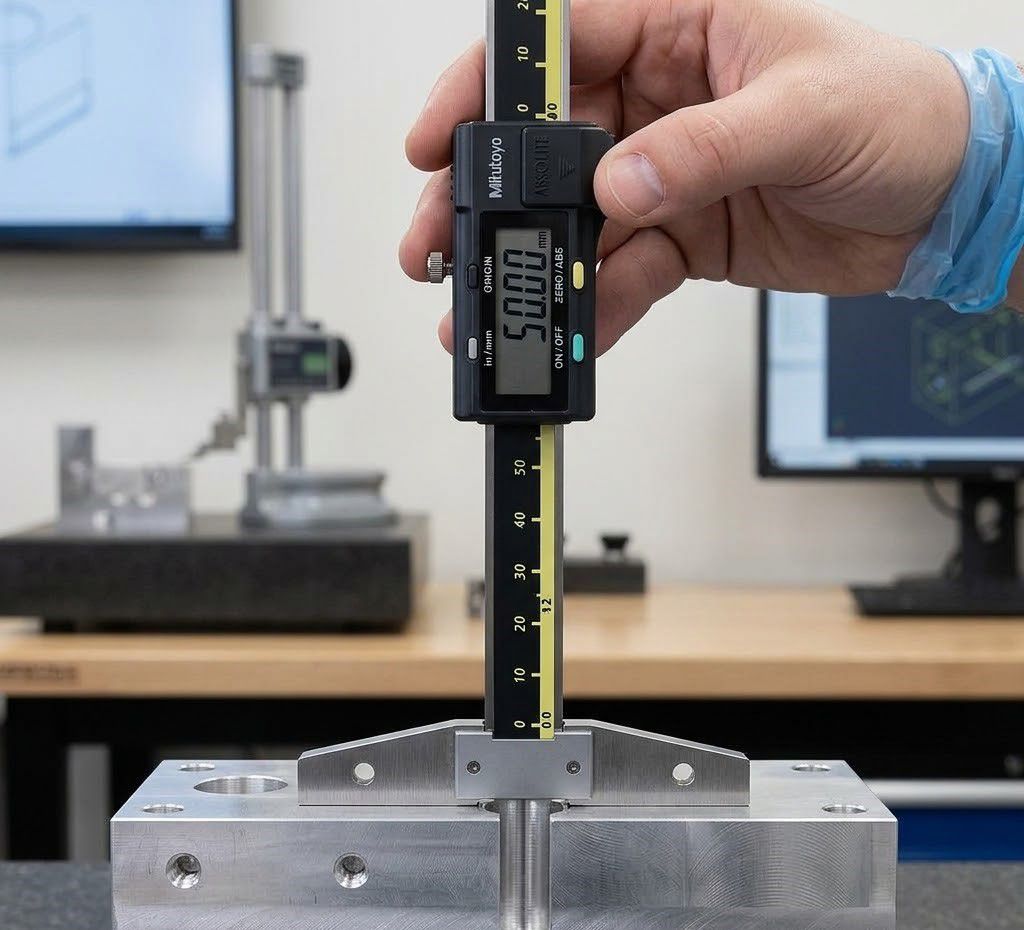
High resolution doesn't necessarily mean it can be fully exploited in the mechanism
With electronic depth gauges, common resolutions are typically 0.01 mm or 0.001 mm.
While this might seem like a significant difference, many common machining tasks don't require such a small resolution. Positions like measuring mechanical grooves, inspecting drill holes, aligning parts, or measuring mold depths work perfectly well with 0.01 mm.
Meanwhile, tasks involving high-precision molds, electronic components, or ultra-fine parts truly exploit the advantages of extremely low graduations.
A common problem in a machine shop is that the display shows great detail, but slight table vibrations, burrs on the part, or uneven hand pressure can cause significant variations in the results. In this case, the impressive resolution doesn't make as much of a difference as people might initially think when learning about the product.
An oily and dusty environment affects the measurement results faster than expected
In CNC or metalworking environments, coolant and fine dust are present almost constantly throughout the day. Over time, moisture and metal dust can seep into the button assembly or the internal electronics of the device.
Initially, the gauge works normally. Then the screen starts responding more slowly, the buttons lose sensitivity, or the measurements become erratic.
This is also why many workshops are now paying close attention to water resistance rather than just resolution.
The difference lies in the long-term user experience
Some new measuring instruments feel very modern in the hand, with beautiful screens and extremely smooth displays. However, after a few months of continuous use, their stability starts to change quite noticeably.
Meanwhile, some models that don't look particularly impressive in terms of specifications maintain stable operation over a long period, even when frequently exposed to oil or moisture.
This significantly impacts daily work speed. A measuring device with fast response, stable buttons, and an easy-to-read screen will be much more comfortable when continuously measuring hundreds of details.
Not all waterproof rulers are the same
Some models offer basic moisture resistance to limit light moisture. Others are designed for industrial environments with significantly better oil and dust resistance.
Models like the MITUTOYO 571-212-30 Digital Depth Gauge are quite common in QC rooms and precision machining workshops due to their high build quality and stable performance after prolonged use.
Besides water resistance, many people are now also interested in:
+ body rigidity
+ sliding feel
+ button sensitivity
+ screen brightness
+ battery life
+ oil and dust resistance
These factors directly impact daily user experience more than most advertised specifications.
Which factor should be prioritized first?
For cleanroom applications with minimal dust and requiring extremely small reading errors, high-resolution depth gauges are more suitable.
Conversely, in environments with continuous operation for many hours each day, water and oil resistance become significantly more important.
Ultimately, the effectiveness of a depth gauge often depends on its ability to withstand the specific working environment, not solely on the specifications displayed on the product.