OWON introduces the TAO3000 series oscilloscope as a tool for automotive signal measurement, specifically targeting sensors that directly control the engine and transmission. This article focuses on the application of measuring the air control valve sensor and highlights several technical benefits outlined in the source material.
OWON Oscilloscope in Automotive Sensor Testing
As automobiles become more advanced, vehicle maintenance also becomes more demanding. High-tech components are now common in modern cars, which means technicians need suitable test equipment to inspect signals and confirm whether sensors are working properly. In this context, a digital storage oscilloscope (DSO) is presented as a priority tool for automotive sensor measurement.
This article focuses on the application of the OWON TAO3000 series tablet oscilloscope in automotive sensors, with a specific look at the air damper sensor. The examples in the source material show how waveform observation can help check sensor behavior and support a general judgment about motor status.
The air damper sensor is also referred to as the throttle opening sensor. Its role is to control the fuel injection level by sending the opening position and level of the air damper to the ECU. Based on this signal, the ECU can decide how to allocate fuel injection.
In automatic gearboxes with electronic control, the air damper sensor also sends a signal used to adjust gear position. Because of its importance, most vehicles use dual-signal sensors for this application.
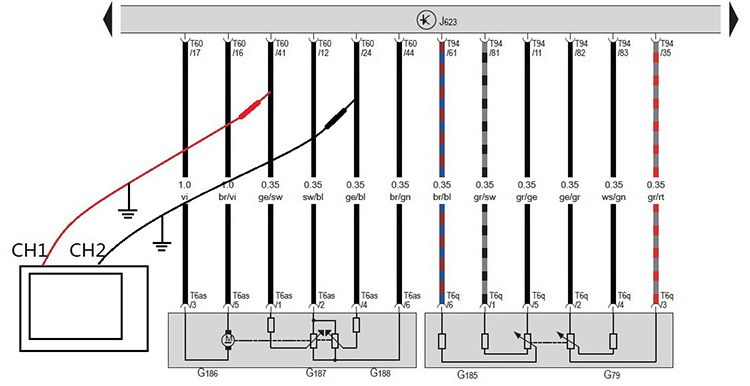
The goal of air damper sensor measurement is to check the motor status. By observing the signal waveform, technicians can compare the behavior of two sensor channels and look for changes that may indicate a fault.
The source example describes a measurement setup for the Maiten B7, using the OWON TAO series DSO and taking the TAO3104A as the example model. The captured signal is used to observe how the sensor responds during braking and other operating conditions.
Signal Behavior Observed on the TAO3104A
When braking heavily, the voltage of air damper position 1 reflected on CH1 decreases and the waveform becomes concave. At the same time, the voltage of air damper position 2 reflected on CH2 increases and the waveform becomes convex. The sum of CH1 and CH2 is read as 5V.
This combined check is used to co-verify the two sensors in the air damper system. If the total is larger or smaller than 5V, the general judgment is that something may be wrong with the sensor.
The source also mentions captured waveforms from measurements of the Maiten magneto-electric crankshaft sensor and Hall Rifle camshaft sensor on the OWON TAO3104A, showing that the instrument can be used in broader automotive waveform inspection tasks.
TAO3000 Series Tablet Oscilloscope Features
The TAO3000 series is described as offering a range of features designed to provide more detailed signal observation. The series offers bandwidth of up to 120 MHz, a maximum real-time sampling rate of 1 GSa/s, 14-bit vertical resolution, a 40 Mpoint record length, and a waveform refresh rate of up to 75,000 wfms/s.
The 14-bit ADC hardware resolution improves measurement accuracy compared with many other oscilloscopes on the market, allowing waveforms to be observed in greater detail and small changes in voltage signals to be measured more accurately. Low noise also supports the measurement of weak signals, while the large record memory enables longer signal acquisition. The high waveform refresh rate helps capture waveform details and abnormal events more effectively.
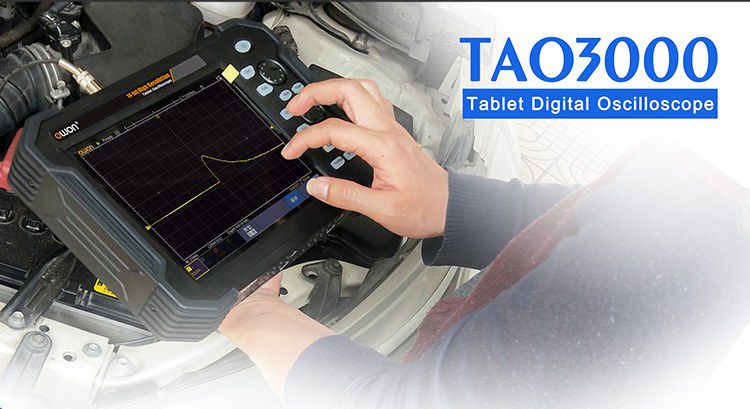
The 4-channel TAO3000 series tablet oscilloscope includes several capabilities highlighted in the source material:
- Bandwidth up to 120MHz
- Maximum real-time sampling rate of 1GSa/s
- 14-bit vertical resolution
- Record length of 40M
- Waveform refreshing rate of 75,000 wfms/s
- Low base noise for small-signal capturing
- Triggering and decoding functions
- SCPI and LabVIEW support
- 8-inch 800 x 600 multi-point touch screen
- USB host, USB device, LAN, and optional Wi-Fi
The 14-bit high-resolution hardware ADC is described as providing higher precision, helping users observe waveform details more clearly and measure small voltage changes more accurately. Low background noise improves small-signal measurement, while high storage and a high refresh rate help the oscilloscope capture longer signals, waveform details, and exceptional events.
Triggering, Decoding, and Analysis Tools
The TAO3000 series handheld oscilloscopes support multiple trigger modes, including Edge, Video, Pulse, Slope, Runt, Windows, Timeout, I2C, SPI, RS232/UART, CAN, and Nth Edge. Serial bus coding is also available for I2C, SPI, RS232/UART, and CAN.
For signal processing, the series supports arithmetic functions such as +, -, *, and /, along with FFT, FFTrms, Intg, Diff, Sqrt, User Defined Function, and digital filters such as low pass, high pass, bandpass, and band reject.
Wireless Operation and Remote Viewing
The built-in Wi-Fi module allows users to connect to the TAO3000 through a mobile device. The source states that users can view and control the same screen, store and view waveform data through an app, share data with others, and support collaborative analysis. These functions make the workflow more flexible during automotive maintenance tasks.
2-Channel TAO3000 Tablet Oscilloscope
The 2-channel TAO3000 series version is presented as a 2-in-1 device that combines a DSO with a Dektop multimeter. It includes a built-in 4½-digit multimeter, and the multimeter interface appears on the same screen as the oscilloscope.
Its data logging function can record data over a long period and export it to a CSV file. According to the source, the available operation methods make car maintenance testing more convenient.
The OWON TAO3000 series tablet oscilloscope is positioned as a practical tool for automotive sensor testing, especially when checking air damper sensor signals and comparing dual-channel waveform behavior. With features such as 14-bit resolution, high sampling rate, multiple trigger modes, waveform decoding, and wireless connectivity, it supports signal observation and measurement tasks in vehicle maintenance workflows.