If RCCB is specialized in detecting and disconnecting when there is a leakage current, RCBO integrates overcurrent and short circuit protection, providing more comprehensive protection. The following article from EMIN will help you better understand the difference between RCBO and RCCB in a specific and easy-to-understand way.
Explore the operating structure and specifications of RCCB
RCCB (Residual Current Circuit Breaker) is a circuit breaker specifically used to protect against leakage current, often installed in civil electrical systems to increase safety. The operating mechanism of this device is based on the ability to detect leakage current through a component called RCD - a residual current sensor in the shape of a toroidal coil, surrounding the phase wire and neutral wire. When leakage current appears, the current difference between phase and neutral will cause the coil to heat up, activate the thermal relay and command the circuit to be cut off. RCCB is currently commonly produced in two versions: 2-pole type for 1-phase electricity and 4-pole type for 3-phase electricity. In terms of appearance, the device is in the form of a miniature circuit breaker with a control lever and a leakage current test button integrated right on the body.
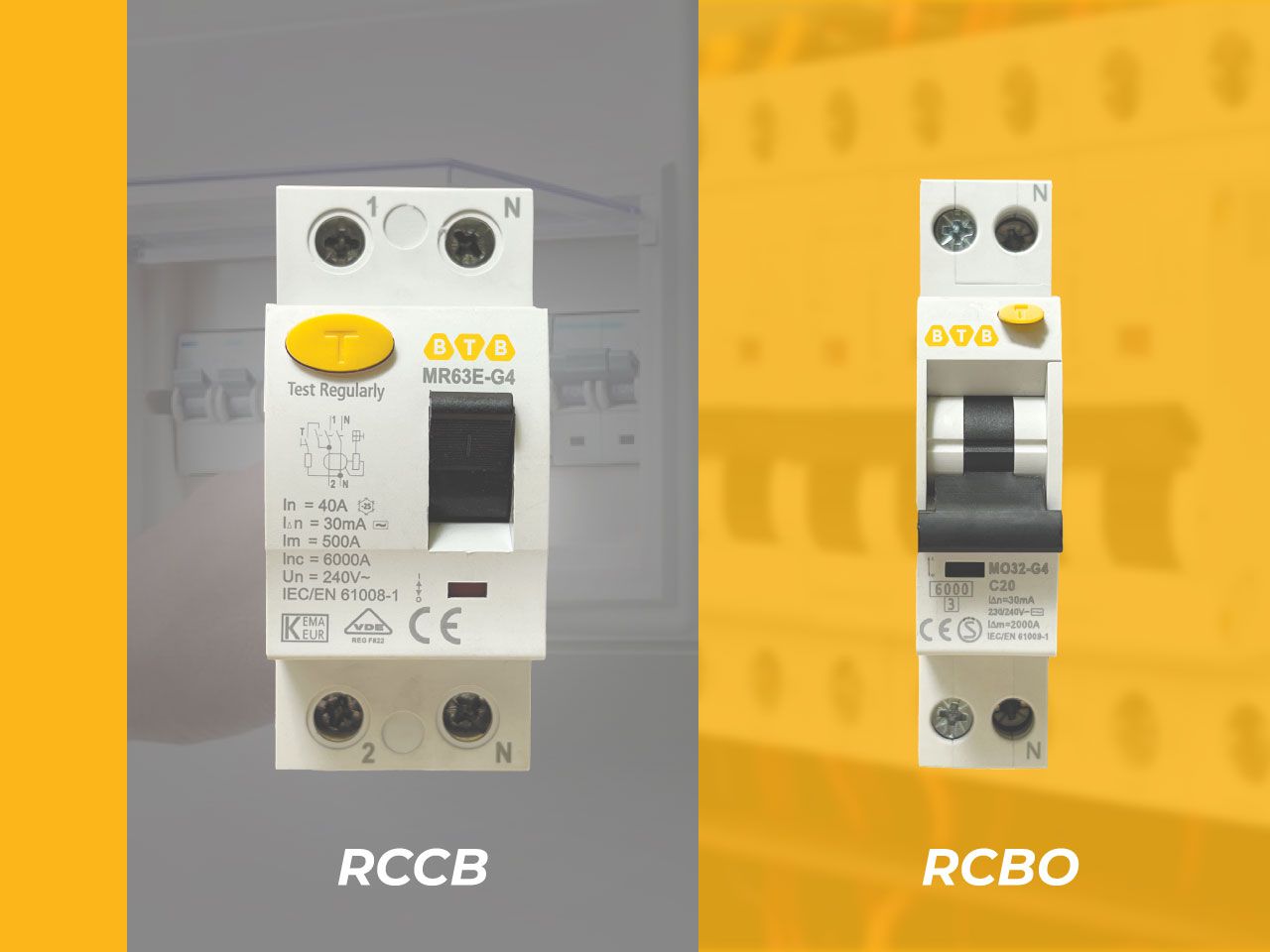
Some typical specifications of RCCB include:
Leakage detection threshold: 10mA, 30mA, 100mA and 300mA
Short circuit breaking capacity: 6kA and 10kA
Rated current: 16A, 20A, 25A, 32A, 40A, 50A, 63A, 80A, 100A
Structure and specifications of RCBO - Multi-function integrated protection device
RCBO (Residual Current Circuit Breaker with Overcurrent protection) is a new generation of anti-shock device, integrating three functions at the same time: leakage current, overload and short circuit protection. In essence, RCBO is a combination of RCCB and MCB in the same device, helping to optimize space and simplify the electrical system. The external appearance of RCBO is often similar to a shrimp circuit breaker, equipped with a lever according to the number of poles, along with a leakage current test button like on RCCB.
Inside the RCBO, two key components, the RCD circuit (residual current detection) and the ARC divider (overcurrent and short circuit protection), play a role in detecting faults. As long as one of these two mechanisms is activated, the RCBO will immediately cut off the circuit to protect equipment and people. Unlike RCCB, RCBO has an additional ARC divider to take on the function of cutting off when there is a fault in the current.
Typical specifications of RCBO include:
Leakage current detection threshold: 10mA, 30mA, 100mA, 300mA
Short circuit current capacity: 6kA
Rated current: 6A, 10A, 16A, 20A, 25A, 32A, 40A, 63A
Functional comparison between RCCB and RCBO
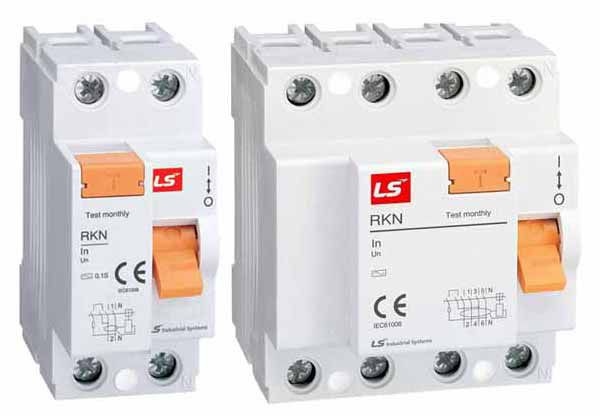
The core difference between RCCB and RCBO lies in the scope of protection. While RCCB is only specialized in detecting and cutting off current when an electric leakage occurs, RCBO is a multi-purpose device that combines both anti-shock and overload and short circuit protection functions. As a result, RCBO provides more comprehensive protection for the electrical system.
Both devices are based on the principle of comparing the incoming and outgoing currents to detect leakage current. The internal RCD circuit will detect the current imbalance in the circuit. When the residual current exceeds the safety threshold, the circuit will automatically be cut off to prevent electrical risks.
For RCBO, overload and short circuit protection features are integrated similar to MCB, through thermal and magnetic sensor mechanisms. Thanks to that, RCBO not only prevents electric shock but also disconnects the circuit when there is a problem with the current.
See more devices at: EMIN electrical circuit breaker
Difference in application of RCCB and RCBO
In terms of application, both RCCB and RCBO play a role in protecting the safety of electrical systems, especially in areas with potential risks of electrical leakage such as toilets, kitchens, factories, or places with high humidity. However, each type is suitable for specific usage situations:
Leakage current 10mA, 30mA: Usually used for civil and commercial works to ensure personal safety.
Leakage current 100mA: Applied for fire prevention and electrical short circuit prevention purposes in larger areas.
300mA leakage current: Installed in industrial electrical cabinets where the entire system is required to be protected.
RCBO with its diverse protection capabilities and wider rated current is gradually becoming the optimal choice for both the main electrical system and each individual branch. Unlike RCCB, RCBO can operate independently, without the need for an additional MCB in front.
In addition, RCBO is especially suitable for separate protection of large-capacity equipment such as air conditioners, welding machines, solar power systems, inverters, escalators or elevators. Meanwhile, RCCB is mainly arranged in the main electrical circuit or fixed areas requiring basic anti-shock.